How Much is Enough?
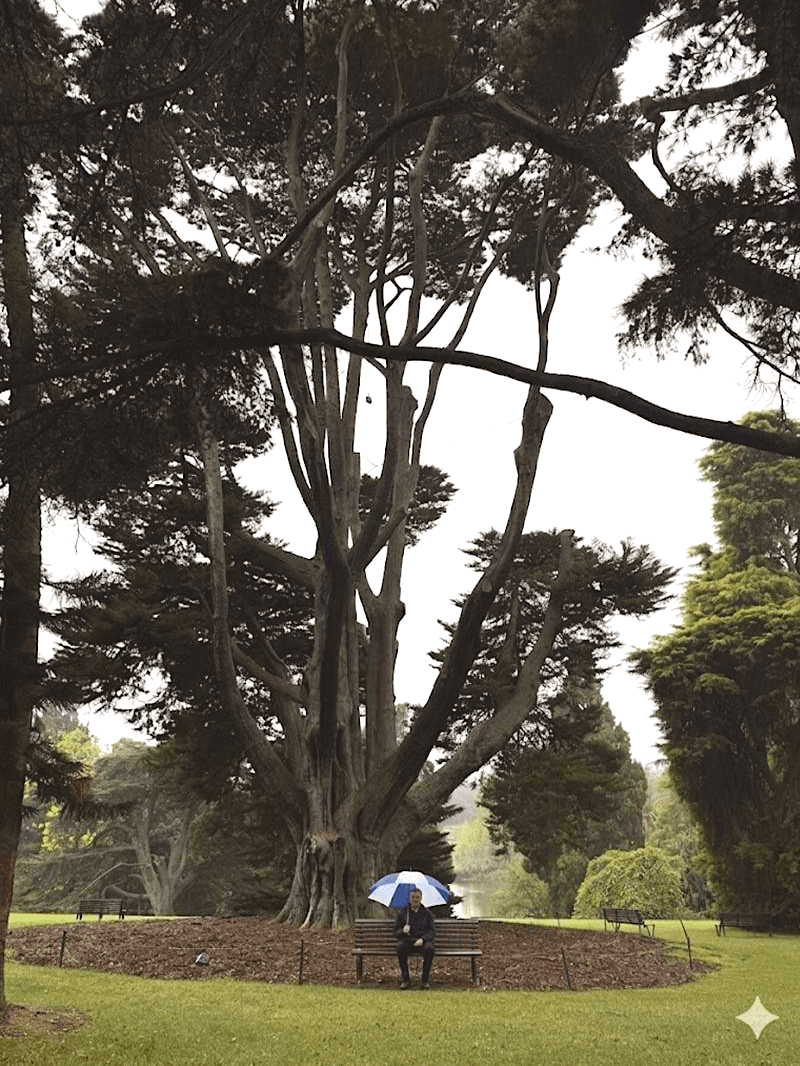
Photo taken at the Royal Botanic Gardens, Melbourne
I was that person.
Every bonus season, I felt it too: the quiet calculation, the comparison, and the sense that the number, whatever it was, fell slightly short of what felt right. I had a lifestyle to maintain and children to educate overseas. Expectations—my own and my family's—had quietly accumulated into a kind of permanent pressure. I was earning generously well, yet the question remained. Is this enough?
I don't say this with shame. It is the inevitable outcome of the machinery that shaped my generation.
I spent thirteen years at IJM and another eighteen at Gamuda. For over a quarter of a century, my life was defined by the relentless, entrepreneurial corporate culture that characterises the Chinese business community in Malaysia. It is a world where performance is a religion, execution is everything, and the metrics of success are uncompromisingly material.
In that environment, your value is constantly weighed. In Malaysia, the systemic reality of national policies means that as a minority, you do not have the luxury of coasting. You learn quickly that the playing field is not level. To protect your family, you strive twice as hard and build your own fortresses of financial security. Striving becomes a defensive mechanism—a rational response to a system that demands constant accumulation as a form of self-defense.
I carried that defensive orientation until a headhunter called.
The Pivot: India
I accepted a CEO role in Bangalore with the GMR Group—a direction I had never planned for myself.
For seven years, the gap between my world and the world around me wasn't abstract. It had faces, names, and daily texture. I moved through stark differentials, earning a salary that bore no resemblance to what my driver, my site workers, or the families in the communities we worked alongside earned. That awareness quietly rearranged what more meant.
During my time there, the GMR Foundation ran a community programme involving teaching at a slum school. Both my children went to teach there.
Every evening, I would see my daughter at the dining table preparing for the next day — simple drawings on paper, nothing elaborate. She served the children dhal and rice at lunchtime. She played kavadi with them in the field at break. She managed a single room of children aged six to fourteen, none of them quite knowing what formal education was, all of them grateful for whatever she brought.
She would tell me things at the end of each day.
"Papa, they don't have much. But they are so grateful just to be in class."
And then, quietly, almost to herself, "Maybe they just don't know any better."
That last line stayed with me. I have turned it over many times since. Were these children carefree because they were innocent of what they lacked? Or were they showing us something we had forgotten—that joy does not require the conditions we have decided it requires?
I listened to her each evening. But I don't think I truly heard her. My mind was still occupied by the corporate machinery and the old habits of calculation.
The rebuilding of my lens had to happen first.
This Isn't Just Another Day of Your Life →
Cleaning the Lens
It started in pieces. A door opened through meditation, and then, while traveling to a site visit, I listened to hours of The Audacity of Hope. Something clicked on that drive. I realised that every journey—every morning walk, every long commute—could become a classroom. That learning required only attention and willingness.
I started searching. And what I found—the Vedanta Society podcast by Swami Tyagananda—became my most important teacher. Several things landed in me and have never left.
The first was a shift in prayer. I had believed in God my whole life but rarely prayed. I believed we shape our own destiny—that asking God for things was somehow a weakness. India changed that. It turned prayer not into petition but into gratitude. Now I begin each day thanking God for what my parents gave me. For a wonderful family. For the health of my brothers and my friends—some of whom are going through very difficult times. I pray for the wisdom to help them. For my intellect to be of use.
The second was the realisation that contentment is an inside job. Swami said something I have never forgotten: we do not see the world as it is; we seeit through the filters of our past.
He illustrated this with a simple image. A man walks into a dark room. On the floor he sees a coiled snake. He freezes in terror. Someone brings a light. It is just a rope. The snake was never there—but the fear was completely real. It was created entirely by a mind projecting its fears onto what it could not yet see clearly.
That is the scarcity mindset in one image. The not-enough was never really in the number. It was in the mind doing the looking—conditioned over decades to see threat and insufficiency everywhere. You cannot fix that with a bigger bonus. The room doesn't need more furniture. It needs more light.
Contentment begins the moment you stop mistaking the rope for a snake.
The third was the movement from doing to being. For over a quarter of a century, my mind operated as a project manager of the future, always three steps ahead of my feet. Today I no longer wake up into a race. I arrive in my own morning. I have traded the frantic rush for a disciplined quiet hour—walking, working out, greeting the day before it begins in earnest.
Photography has become my classroom for this new way of being. To capture a meaningful image, you must move from doing to observing. You cannot force the moment. You must wait for it with a still mind. When you stop trying to fix the frame and simply witness it, you move from living in your head to finally inhabiting your own body. Being is the realisation that this moment does not need to be managed. It only needs to be witnessed.
The Ancient Witness
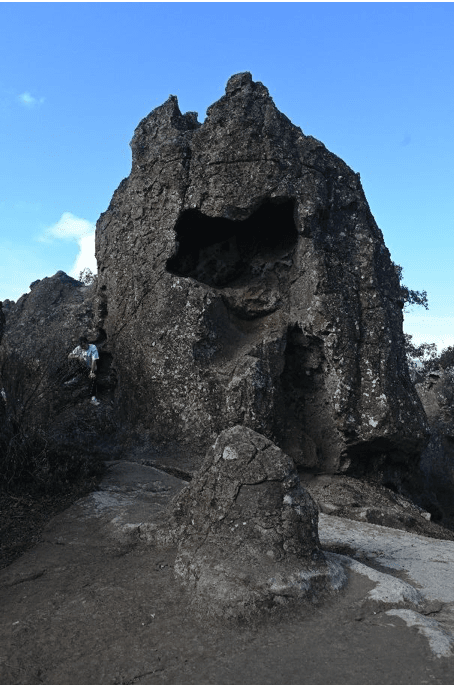
Mount Macedon, Victoria. I forgot to read the information tablet telling me how high it was and who first climbed it. I was too busy looking at the rock.
I am writing this on holiday in Australia. Earlier this week I stood before an ancient rock formation at Mount Macedon and forgot to read the tablet with its measurements and records. I was too absorbed in the presence of something that had been standing there for millions of years, indifferent to every metric ever applied to it.
On a cold Melbourne morning, I spotted four immigrant boys heading to school. Different backgrounds, same uniform, same opportunity.
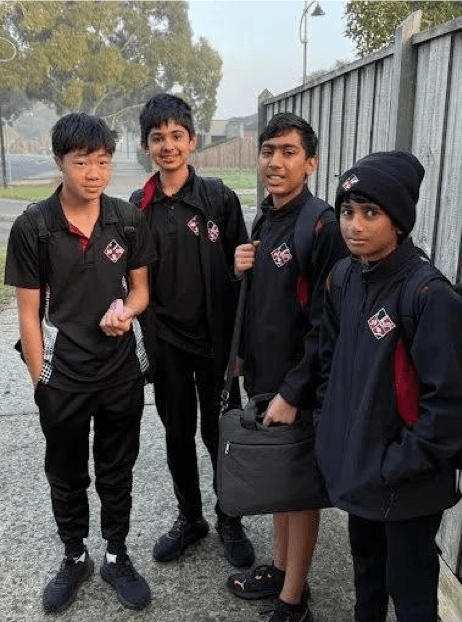
I stopped and asked if I could take their photo. They simply smiled and nodded—the same uncomplicated openness I saw in the children of Bangalore all those years ago.
It was only after these realisations had settled into my daily walks that the final piece of the puzzle fell into place. At the end of my daughter's teaching stint, the school held a small gathering. The children came with flowers. Someone took a photograph.
I still remember lookingat that photo. This time, I actually saw it. Because by then, I had the eyes to see. The smiles on those children's faces were not polite smiles. They were the smiles of people who were completely full—full of something that had nothing to do with what they owned or earned or were promised next bonus season.
I looked at that photo for a long time.
A Final Note
How much is enough?
I no longer think it is a number.
I think it is a moment of recognition—when you stop measuring your life against someone else's and start actually inhabiting your own. When your morning prayer is full of thanks and has no demands. When you can look at a photograph of children holding flowers and feel, in your chest, exactly what they are feeling.
Those children already knew the answer.
It took me seven years of living among them—and many early morning walks—to begin to understand the question.
And I am still walking.



Personal
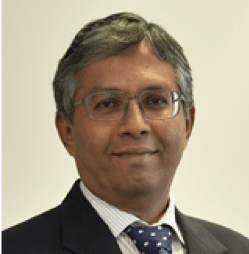
Param Sivalingam is a 45-year veteran of the construction industry, renowned for leading multicultural and multi-disciplined teams across Malaysia, Singapore, Qatar, and India. Throughout a career defined by iconic mega-projects, Param has mastered the delicate balance between the "hard" technical demands of civil and systems integration and the "soft" side of human leadership.
His leadership philosophy was profoundly refined during his tenure in India, where his spiritual growth enmeshed with his disciplined professional rigor. This unique fusion allowed him to mould high-performing teams that delivered complex projects under strict budget and timeline constraints. A firm believer in resilience and personal discipline, Param currently lends his extensive expertise to the East Coast Rail Link (ECRL) project. He is dedicated to the idea that professional excellence and personal strength are the foundations for supporting and lifting others.