What Manchester United Teaches Us About Identity, Coherence and Transformation
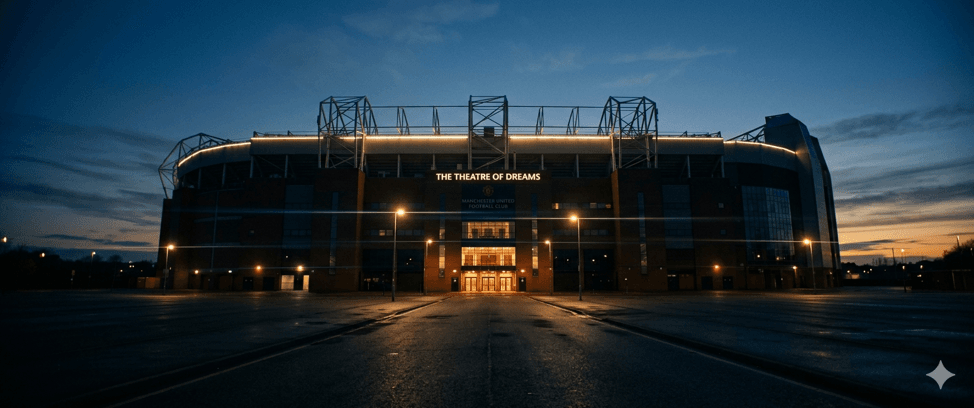
The first article in this series asked why talented people stop performing. The second asked why intelligent leaders fail despite experience and authority. Both questions pointed toward conditions: the climate a leader creates, the inner state from which they operate. But there is a prior question, deeper than both, that organisations in prolonged difficulty must eventually face.
What happens when the system itself no longer knows who it is?
This is not a question about tactics or leadership appointments, though it touches both. It is a question about identity, about the coherence that allows an organisation to function as a whole rather than as a collection of competing intentions. When that coherence is lost, no amount of managerial change fully restores performance. The interventions sit on the surface of a problem that runs deeper than any individual appointment can reach.
Manchester United’s post-Ferguson journey is, among other things, a study in what happens when a system loses the thread of its own identity, and what it may mean to find it again.
The Identity That Was
Before examining what was lost, it is worth naming what existed. Ferguson’s Manchester United was not simply a successful football club. It was an organisation with a coherent identity expressed consistently across every level of its operation: a style of play that valued attacking expression and forward momentum; a development culture that trusted and promoted young players before they were ready by conventional measures; a psychological disposition toward the late comeback, the refusal to accept defeat as settled, that became known beyond football as “Ferguson time.”
These were not marketing slogans. They were the lived culture of the organisation, the shared understanding of what it meant to be part of Manchester United, enacted daily on training grounds, in team selections, in the manager’s public presence and private communications. Karl Weick, in his work on sensemaking in organisations, argues that identity is not a fixed possession but a continuous construction, an ongoing process of answering the question: who are we in relation to what is happening around us? At Old Trafford under Ferguson, that question had a stable, credible answer. The organisation knew what it was.
Ferguson himself described it with characteristic directness. Winning championships, he said, was Manchester United’s trade. Not an aspiration. Not a strategy. A trade: something built into the organisation at the level of craft, repeated and refined across decades until it became the natural expression of how the system operated.
The Fragmentation That Followed
What the post-2013 period produced was not simply a run of poor results. It produced something more structurally damaging: a condition in which the organisation could no longer give a stable, coherent answer to the question of its own identity.
Each incoming manager arrived with a different answer. Moyes: caution and consolidation. Van Gaal: positional control and systematic possession. Mourinho: defensive pragmatism and siege mentality. Solskjaer: a return to attacking directness and the club’s emotional heritage. Ten Hag: high-intensity pressing and positional fluidity in the Dutch tradition. Amorim: a 3-4-3 system designed around specific physical profiles the squad did not possess. Each identity was genuine in its own terms. None was the club’s identity. None had time or conditions to become so.
The result, which Weick would recognise immediately, was a collapse of collective sensemaking. When an organisation cannot construct a coherent account of who it is, the people within it begin to construct individual accounts. Different players understood their roles differently. Different staff operated from different assumptions about what the club was trying to become. The organisation became, in the precise language of systems theory, reactive rather than coherent, responding to immediate pressures rather than acting from a settled sense of direction.
Marcus Rashford, a product of the club’s own academy and one of its most significant players across that period, described the experience of those years with unusual candour: the club was stuck in no man’s land, trapped between eras with no clear direction. That is not the observation of a discontented footballer. It is an organisational diagnosis. The system had lost the capacity to make sense of itself.
Remembrance Versus Reinvention
Robert Kegan’s work on adult development offers a useful distinction here. Kegan argues that transformation is not the same as learning new information. Learning adds to what a person knows. Transformation changes the very form through which they know. It is a shift in the structure of meaning-making, not simply an update of its content.
The temptation in organisational crisis is to reach for reinvention: a new identity, a new philosophy, a clean break from what preceded it. This is the instinct that produced each successive managerial appointment at Old Trafford. Each one was, in some sense, an attempt to become something new. The assumption was that the old identity had failed, that what was needed was a replacement rather than a recovery.
But Kegan’s framework suggests something more nuanced. The most durable transformations are not those that discard the old self but those that develop the capacity to hold it differently, to move what was previously subject, invisible and unquestioned, into the position of object, something that can be seen, reflected upon, and consciously chosen. An organisation that has genuinely transformed does not abandon its history. It develops a new relationship with it.
Transformation occurs not when we add new knowledge but when we change the very form through which we know. The organisation that remembers itself is not returning to the past. It is recovering the capacity to act from a coherent inner source. — After Robert Kegan
What Manchester United needed, across those years, was not a new identity but a recovered relationship with the identity that already existed. The club’s foundational character, attacking expression, developmental trust, psychological resilience, relentless forward movement, had not disappeared. It had been buried under successive layers of systems imposed from outside, each one requiring the organisation to become something other than what it was.
The distinction Kegan draws between remembrance and nostalgia is critical here. Nostalgia looks backward and wishes. Remembrance looks backward to recover something that remains genuinely alive, and brings it forward into present conditions. An organisation that remembers itself is not regressing. It is reconnecting with the source from which coherent action becomes possible.

The Conditions for Coherence
Edgar Schein’s work on organisational culture identifies three levels at which culture operates: the visible artefacts and behaviours, the espoused values and stated beliefs, and the underlying assumptions that are held so deeply they are rarely examined at all. Sustained organisational dysfunction, in Schein’s framework, almost always involves a fracture between these levels: what the organisation says it values diverges from what its underlying assumptions actually produce.
At Manchester United, the underlying assumption for much of the post-Ferguson period appeared to be that success was a product of the right individual appointment, the right transfer, the right system. This is a technical assumption: that the problem has a technical solution. It produced, predictably, a cycle of technical interventions, each generating temporary improvement before the underlying incoherence reasserted itself.
The Emergence Mirror Framework, developed through sustained research into the relationship between human development and AI governance, proposes a different account of what produces lasting performance. At its centre is the recognition that sustainable organisational function requires alignment across four dimensions: the psychological safety that allows people to take genuine risk, the agency that allows them to act from their own judgement rather than from defensive compliance, the discernment that enables appropriate response to complex situations, and the developmental maturity to hold all of this in coherent relationship.
What this framework makes visible, in the Manchester United case, is that the club’s problems were never primarily tactical. They were developmental. The organisation lacked the conditions under which its people could operate at the level their talent required. Psychological safety was absent, replaced by fear of managerial volatility. Agency was suppressed, replaced by the requirement to conform to systems designed without reference to individual strengths. Discernment was overwhelmed by the pace of change: no sooner had players begun to understand one system than another replaced it.
Margaret Wheatley, writing on organisations as living systems, observes that healthy systems maintain coherence not through control but through the clarity of their identity. When every part of the system knows clearly what the organisation is for and who it is, coordination emerges without requiring enforcement. The system regulates itself. When that clarity is absent, no amount of external control can substitute for it, because control can compel compliance but cannot generate the discretionary intelligence that genuine performance requires.
The Structural Shift
The changes that accompanied INEOS’s ownership restructuring at Manchester United were, in isolation, unremarkable. A professionalised football hierarchy. Data-informed recruitment. A clear division between executive functions and coaching responsibilities. A long-term investment in infrastructure. These are the standard components of a modern football operation.
What made them significant was not their novelty but their coherence. For the first time since Ferguson’s departure, the organisation appeared to be operating from a single, consistent account of what it was trying to become. Not a new identity imposed from outside, but a recovered and articulated version of something already present: an emphasis on developing young players, on attacking expression, on cultural clarity within the dressing room, on a style of play that the club could own across time rather than across a single managerial tenure.
Jason Wilcox, appointed Technical Director under the new structure, spoke of a club-wide blueprint focused on long-term style of play rather than single-manager demands. That phrase is, in organisational terms, a declaration of identity. The club was attempting to name what it was, and to ensure that the name survived any individual appointment.
Peter Senge’s concept of the learning organisation is relevant here. Senge argues that the deepest learning in an organisation occurs not when individuals acquire new skills but when the system as a whole develops the capacity to see itself clearly, to understand its own patterns, and to act from shared vision rather than from fragmented individual agendas. The precondition for that learning is coherence: a sufficiently stable and widely held account of the organisation’s identity and purpose.
What INEOS began building, and what Carrick’s arrival in January 2026 appeared to crystallise at the level of daily practice, was the infrastructure of that coherence. Not performance targets. Not tactical blueprints. The conditions under which the system could begin to remember what it was.
A Roman Holiday: The Hostage You Don't See Coming →
When the System Moved
The observable shift in Manchester United’s performance under Carrick was rapid enough to be striking. Eleven wins from sixteen league games. A third-place finish. The Champions League returned. But the speed of that recovery is itself instructive. Systems do not transform that quickly from a standing start. What the Carrick period suggests is that the transformation had been building beneath the surface of visible results, that the structural and cultural work of the preceding months had prepared the ground for something that looked sudden but was not.
Weick argues that sensemaking is retrospective: we understand what was happening only after it has happened, by looking back at actions already taken and constructing a coherent account of them. The players who flourished under Carrick had not changed. They were the same individuals who had struggled through the preceding seasons. What changed was the context within which their actions could be understood, including by themselves. Roles became clear. Expectations became consistent. The question “who are we” began, in the daily practice of training and competition, to acquire a stable answer.
Bruno Fernandes, asked to describe what had changed, spoke not of tactics but of clarity: of knowing where the spaces would be, of understanding the non-negotiable rules of the structure, of being trusted to make decisions within them. That description is an account of an organisation beginning to cohere. The sensemaking had resumed. The system was beginning to remember itself.
What Lasting Recovery Requires
It would be premature to describe Manchester United’s recovery as complete. One season of results, however impressive, does not constitute the restoration of a culture. Culture is built slowly, through the accumulation of consistent experience across time. What the 2025-26 season provided was evidence that the conditions for that accumulation were present: psychological safety sufficient for players to take genuine risk, agency sufficient for them to act from their own judgement, a structural clarity that could survive the departure of any individual.
The lesson for leaders and organisations extends well beyond football. Sustainable transformation is not achieved primarily through strategy, structure, or individual leadership, though all three matter. It is achieved when the system recovers the capacity to know itself, to construct a coherent account of its identity that its people can inhabit and act from, that survives the inevitable turbulence of changing circumstances.
This recovery cannot be forced. It can only be created. The conditions it requires are precisely those that the first two articles in this series have described from different angles: the psychological freedom that a secure base provides, the quality of attention that a leader brings before they impose anything, and now, at the organisational level, the coherence that allows the whole system to function as more than the sum of its parts.
Kegan’s subject-to-object shift applies to organisations as it does to individuals. The patterns that were previously invisible, the unexamined assumptions about what football at Old Trafford meant, what it felt like, what it required, are now at least partially visible. An organisation that can see its own patterns can begin to choose them consciously rather than repeat them automatically. That capacity, however tentative in its early expression, is the beginning of genuine transformation.
Winning was the outcome. Remembrance was the transformation. The club was not becoming something new. It was recovering the capacity to be, at last, what it had always been.
A Final Reflection on the Trilogy
Across these three articles, Manchester United has served as a publicly observable case study for something that happens in every organisation facing sustained difficulty: the convergence of fear, ego, and identity loss into a condition that no single intervention can resolve.
Kohlrieser showed us what fear does to talented people. Scharmer showed us what certainty does to capable leaders. Kegan, Weick, and the Emergence Mirror Framework together show us what identity drift does to a system: it fragments the collective sensemaking that allows coherent action, and replaces it with the exhausting effort of constant adaptation to competing visions of what the organisation is supposed to be.
The recovery, when it comes, is rarely dramatic. It does not announce itself. It appears, quietly, in the willingness of a player to attempt something ambitious in the knowledge that the attempt will be honoured regardless of outcome. In the question a leader asks before installing anything. In the structural decision to name what the organisation is and hold that name consistently across time.
Football provides the observable field. Leadership remains the true subject. And the subject, in the end, is this: sustainable performance requires that the people within a system feel free, that the leaders within a system can see, and that the system itself knows who it is.
When all three conditions are present simultaneously, what follows is not merely results. What follows is coherence. And coherence, quietly and without announcement, is where excellence lives.


Leadership

Arul Aruleswaran is a transformation architect, researcher, and author whose work explores leadership, human development, organisational transformation, and emerging technologies. Drawing on more than two decades of experience across supply chains, government services, and business transformation, he combines practitioner insight with interdisciplinary research to examine how individuals and organisations navigate complexity, uncertainty, and change. His current work focuses on discernment, stewardship, and Human-AI interaction through Emergence Mirror Labs (EML), where he is developing frameworks for leadership, organisational development, and responsible AI. Arul writes regularly on leadership, transformation, decision-making, and the human dimensions of technological change.