A Roman Holiday: The Hostage You Don't See Coming
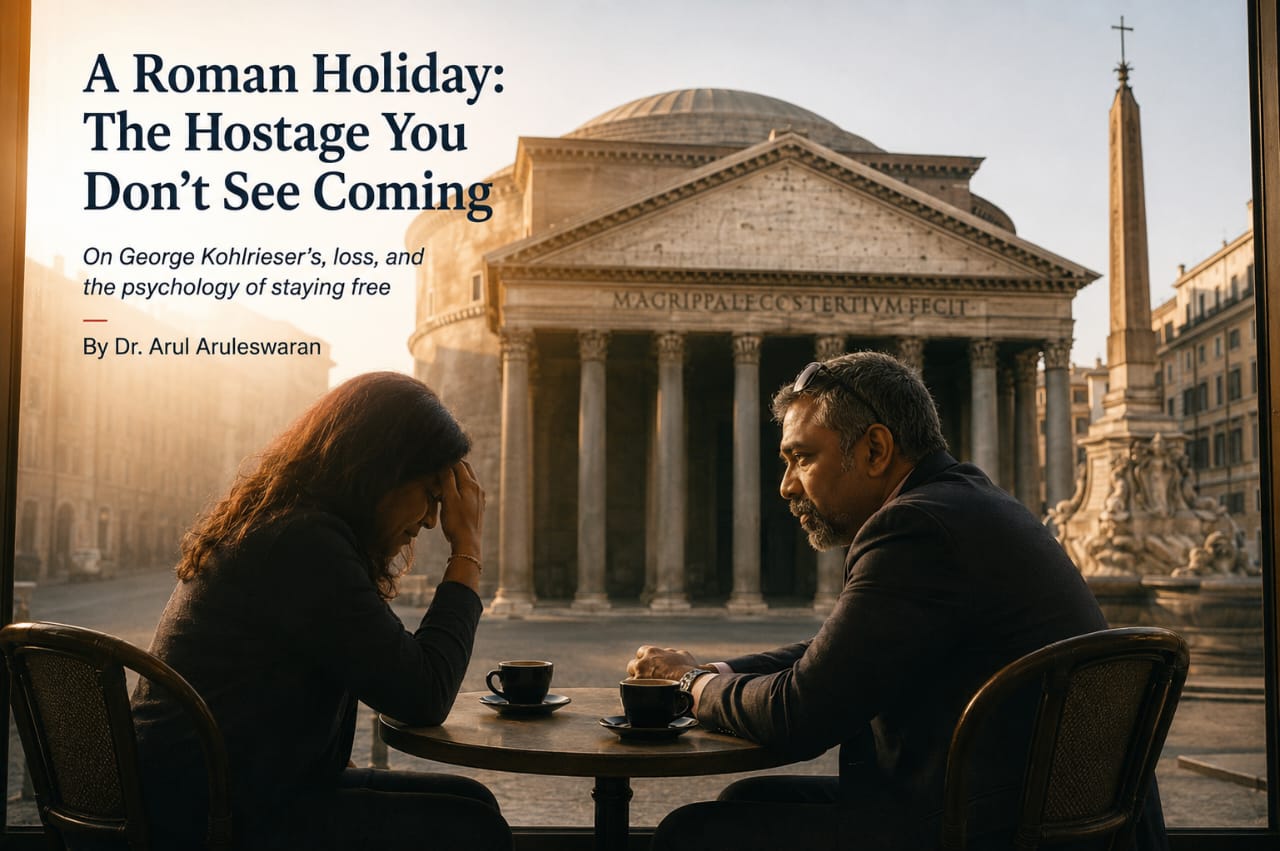
When most people hear the word hostage, they picture a crisis: armed standoff, negotiators, lives hanging in the balance. George Kohlrieser, clinical psychologist and one of the world's most experienced hostage negotiators, has spent decades arguing that the most common hostage situation looks nothing like that. No weapons or demands. Just an ordinary person, in an ordinary moment, quietly taken captive by their own mind.
His book Hostage at the Table remains one of the most precise accounts of how this happens and, more importantly, how to prevent it. Kohlrieser draws directly from his experience resolving over 300 hostage situations to illuminate something most leaders never expect to face: the moment they become their own captor. Subtle as these mechanisms may be, they can significantly affect performance, relationships, and decision-making.
Understanding how self-hostage forms is the first step toward ensuring it does not.
How We Take Ourselves Hostage
Kohlrieser identifies four mechanisms through which capable, intelligent people become prisoners of their own psychology.
The first is victimhood. Not the experience of being wronged, which is real and sometimes unavoidable, but the decision, almost always unconscious, to make that experience permanent. A difficult event becomes a defining narrative. The temporary becomes the total. Victimhood becomes a hostage state, Kohlrieser argues, when a person begins to believe their situation is fixed, global, and inescapable. It closes the mind to options that remain genuinely available. It is, as he puts it bluntly, "a lousy place to build a home." Many people visit, the danger is in staying.
The second mechanism is learned helplessness. Drawing on Martin Seligman's foundational research, Kohlrieser describes the trap of a person who stops seeking solutions because they have concluded, wrongly, that they have no control. The exit is visible. They cannot see it. This is not weakness of character. It is a psychological response to repeated experiences of powerlessness, and it can occur in highly competent people when the conditions are sufficiently disorienting. The person remains bound not by circumstance but by their own prior conclusion about circumstance.
The third is being hostage to the past. Current pain, Kohlrieser observes, is almost always amplified by unhealed older pain. The wound from today reopens a wound from years ago, and suddenly we are not responding to what is in front of us. We are responding to everything that came before it. A difficult conversation triggers an old shame. A loss reopens a grief that was never fully processed. Leaders who carry unresolved emotional weight from the past find themselves making present decisions from that older, unfinished place.
The fourth is emotional hostage-taking, where another person's distress, anger, or grief pulls us so completely off-centre that we lose our own capacity to think and act. We become, in Komhlrieser's framing, a hostage to their emotional state rather than a steady presence within it. The capacity to remain anchored while someone close to us is destabilised is one of the most demanding requirements of genuine leadership, and one of the least discussed.
The common thread across all four mechanisms is loss. Kohlrieser is emphatic on this point. Every hostage situation, literal or figurative, starts with someone experiencing a profound sense of loss and finding no constructive path through it. Loss of control, loss of expectation, loss of a person, loss of a plan. The hostage state is what forms when loss meets a closed system. Loss is the entry point from which these mechanisms take hold. What follows determines whether captivity forms.
The Story You Tell Yourself About Getting Old Is The Thing That's Actually Ageing You →
A Fortnight in Italy
Consider a scenario that illustrates how completely these conditions can converge on an ordinary person.
A couple arrives in a European city to begin a long-planned holiday. Within days, their travel documents are stolen. The planned itinerary, a Mediterranean cruise, concerts, family visits across three countries, collapses entirely. They are confined to a single country by bureaucratic necessity, dependent on an embassy process that moves slowly and requires repeatedly reliving the precise details of what was lost. One partner is in shock, grieving, blaming herself for what happened. The other must hold the situation together while carrying his own disappointment quietly.
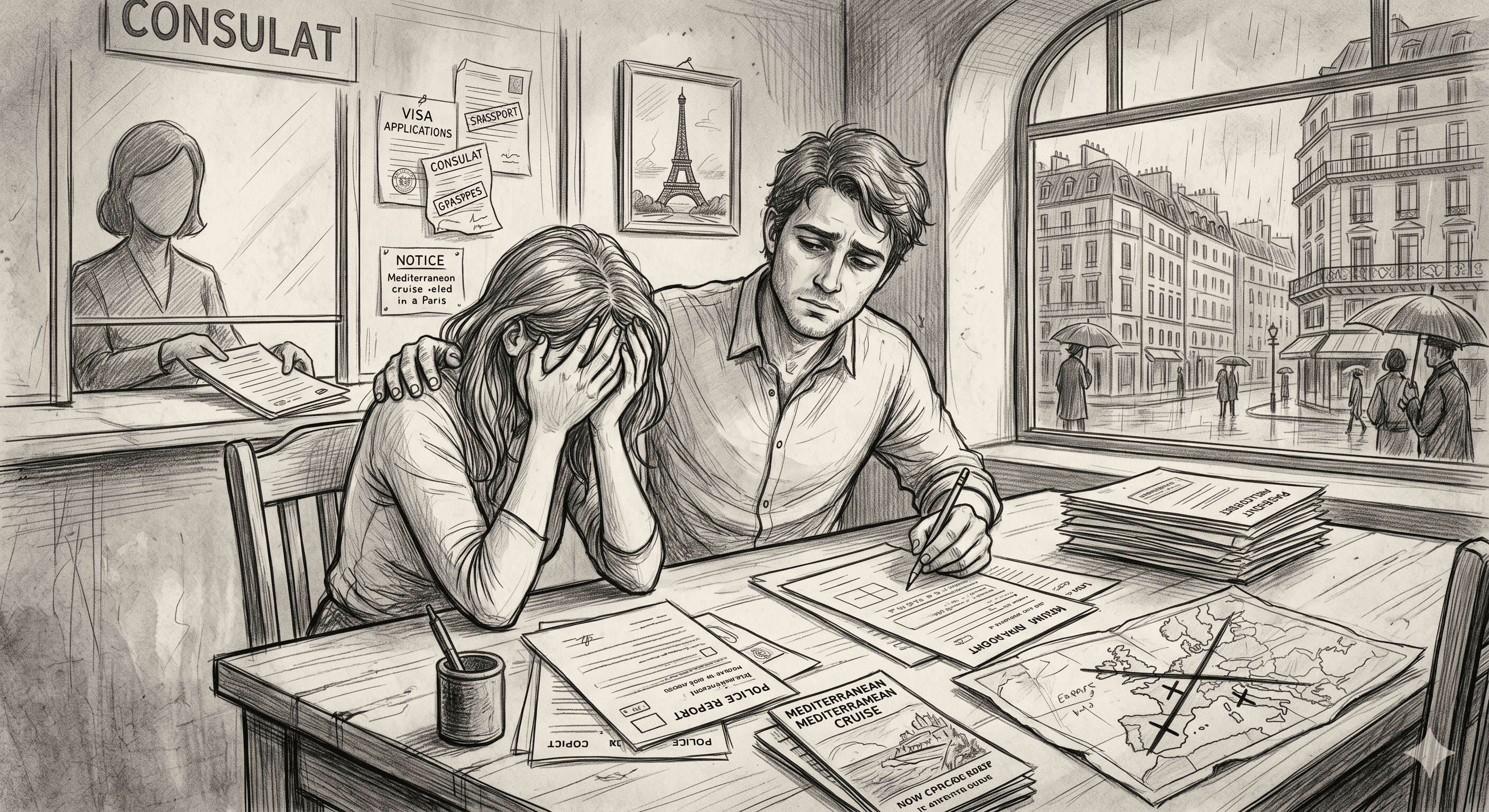
Every condition Kohlrieser describes was fully present. Loss, sudden and real. External dependency on systems beyond their control. Emotional vulnerability between two people in a foreign environment. The compounding weight of reliving the incident again and again for police documentation, embassy appointments, and official records. The persistent shadow of what should have been.
The conditions for self-hostage formation were complete. What did not happen is equally important. There was no collapse into blame, no withdrawal into helplessness, no paralysis of action. The absence of closure was shaped by specific behaviours under pressure.
What did not happen is where the real story begins.
When one partner broke down, the other did not reach for blame. He reached for her. That single choice, made in the first hours, set the tone for everything that followed.
This is what care looks like under pressure. It's the active channelling of it toward the person beside you rather than toward the situation that has gone wrong. A quiet decision to be present rather than reactive, to absorb rather than deflect, to make her steadiness his first priority before his own disappointment had any say in the matter.
Empathy followed care. Rather than managing her distress from a distance, he stayed inside it with her. He did not minimise what had been lost or accelerate her toward recovery before she was ready. He allowed her the time and space to grieve the holiday they had planned, even while he was quietly grieving it too. Empathy here was not a feeling. It was a discipline. The discipline of remaining genuinely curious about her experience rather than preoccupied with his own.
And underneath both was love, not as sentiment but as orientation. The decision, made repeatedly across eleven days, to treat her wellbeing as the frame within which every other decision was made. When the question was whether to push forward or pause, love answered. When the question was whether to name frustration or hold it, love answered. Not perfectly, not without cost, but consistently enough that the relationship became, in Kohlrieser's precise term, a secure base, not just for her but for both of them.
Because this is the dimension of secure base leadership that is most often underestimated: it moves in both directions. Her resilience, once it returned, her willingness to engage with the altered journey without bitterness, gave him permission to be present rather than merely functional. They held each other upright, in turns, across eleven days of constraint.
Without care, empathy and love as active forces in those first hours, older patterns would have been available. Blame is always available. Reactivity is always available. The self that existed before years of deliberate inner work is never entirely gone; it simply waits for conditions difficult enough to summon it. This situation was difficult enough.
What kept that older self at the door was not willpower. It was the quality of the bond between two people who chose, in the hardest moment, to turn toward each other rather than away.
The Mind's Eye and the Heart on the Table
Kohlrieser introduces two tools that are particularly relevant to understanding how the hostage state was avoided.
The first is what he calls the mind's eye: the disciplined capacity to direct attention toward what is possible rather than fixating on what has been lost. High performers under pressure consistently orient their mind's eye toward freedom and forward movement, toward the next step that can be taken, the next decision that can be made, the next experience that remains available. The alternative, focusing the mind's eye entirely on the clutter and pain of a crisis, is precisely what locks a hostage state in place. It narrows perception, degrades decision quality, and prevents the recognition of options that are genuinely present.
In the Italian scenario, the mind's eye remained, quietly and consistently, forward. New cities were still reachable. Galleries were still open. The relationship was still intact. None of this required denial of what had happened. It required the choice, made repeatedly, to keep attention moving rather than anchored in loss.
The second tool is what Kohlrieser calls putting the fish on the table: the willingness to bring difficult, uncomfortable realities into the open rather than managing them in silence. The metaphor is deliberately unglamorous. Unaddressed conflict, like an unrefrigerated fish, does not improve with time.
Here we might extend his metaphor slightly. Beyond the fish, there is also the heart on the table. Not just the conflict named, but the grief acknowledged openly between two people. The disappointment carried together rather than alone. The tears allowed rather than suppressed in the name of composure. That distinction, between shared acknowledgement and solitary containment, is often what separates a relationship that strengthens under pressure from one that quietly fractures.
Bonding as the Mechanism of Freedom
Kohlrieser's most fundamental insight is that bonding prevents hostage formation.
When genuine connection is maintained, whether with another person, with a meaningful goal, or with one's own values, the psychological conditions for self-captivity cannot fully consolidate.
Bonding under stress requires active choice. The choice not to introduce blame when blame would feel justified. The choice to stabilise another person's emotional state rather than escalating it. The choice to remain present to shared experience even when the experience is not what was planned.
The couple in Italy did not escape difficulty. They moved through it together, relational bond intact, which meant that when an unexpected resolution arrived, when the documents were recovered and returned by a stranger, the system was prepared to receive it without distortion or collapse. Plans were calmly rescheduled. The remaining days were entered with openness rather than exhaustion.

That is what freedom under constraint looks like.
What This Means for Leaders
Kohlrieser wrote Hostage at the Table for leaders, and his central argument applies to every person who carries responsibility for others under pressure.
What puts leaders most at risk is not the crisis itself, but the inward closure that follows. The shift from agency to helplessness, from curiosity to blame, from connection to withdrawal. Leadership, in this sense, is the discipline to remain free-moving when events cannot be controlled.
The hostage you need to watch for is in the gap between what you expected and what arrived, between who you were before the loss and who you are being asked to be now. It forms when blame becomes more available than curiosity, when helplessness feels more honest than agency, when the past speaks louder than the present.
George Kohlrieser suggests that difficulty is unavoidable. The question is whether you can encounter it without becoming captive to it yourself.
Staying free requires bonding. It requires directing the mind's eye forward while placing the heart honestly on the table. It requires understanding that loss is the beginning of every hostage situation but need not be its conclusion. And it requires the willingness to remain in genuine connection, through care, empathy and love, with the people beside you when the conditions make disconnection feel easier.
The invisible captor is always available. The choice not to open the door is made quietly, in the decisions that follow loss. That choice, made well, under pressure, in real time, is what leadership actually looks like from the inside.
The hostage you need to watch for is not the situation. It is the moment your own mind decides there is no way forward.



Leadership
Tags: Mindfulness, Growth Mindset, Self-regulation, Self-Agency

Arul Aruleswaran is a transformation architect, researcher, and author whose work explores leadership, human development, organisational transformation, and emerging technologies. Drawing on more than two decades of experience across supply chains, government services, and business transformation, he combines practitioner insight with interdisciplinary research to examine how individuals and organisations navigate complexity, uncertainty, and change. His current work focuses on discernment, stewardship, and Human-AI interaction through Emergence Mirror Labs (EML), where he is developing frameworks for leadership, organisational development, and responsible AI. Arul writes regularly on leadership, transformation, decision-making, and the human dimensions of technological change.