Culture is Built By Friction Managers

Macrovector from Magnific
Lately, I’ve been reflecting on how culture is often built by leaders who know how to manage friction.
The more desirable a behaviour is, the less friction there should be. The more undesirable a behaviour is, the more friction there should be. That sounds simple. But I think many organisations miss this entirely.
We spend a lot of time talking about values. About mindsets. About employee engagement. About transformation. But very little time asking a brutally practical question:
How hard is it for people to actually do the behaviour we claim we want?
Take most workplace programmes, recognition platforms, feedback tools, learning systems, wellness portals, and innovation channels. Most of them do not fail because the idea is bad.
They fail because the path is annoying.
An extra login. A clunky interface. A slow approval step. A page nobody can find. A form too long. A process that feels like applying for a visa just to say “thank you” to a colleague.
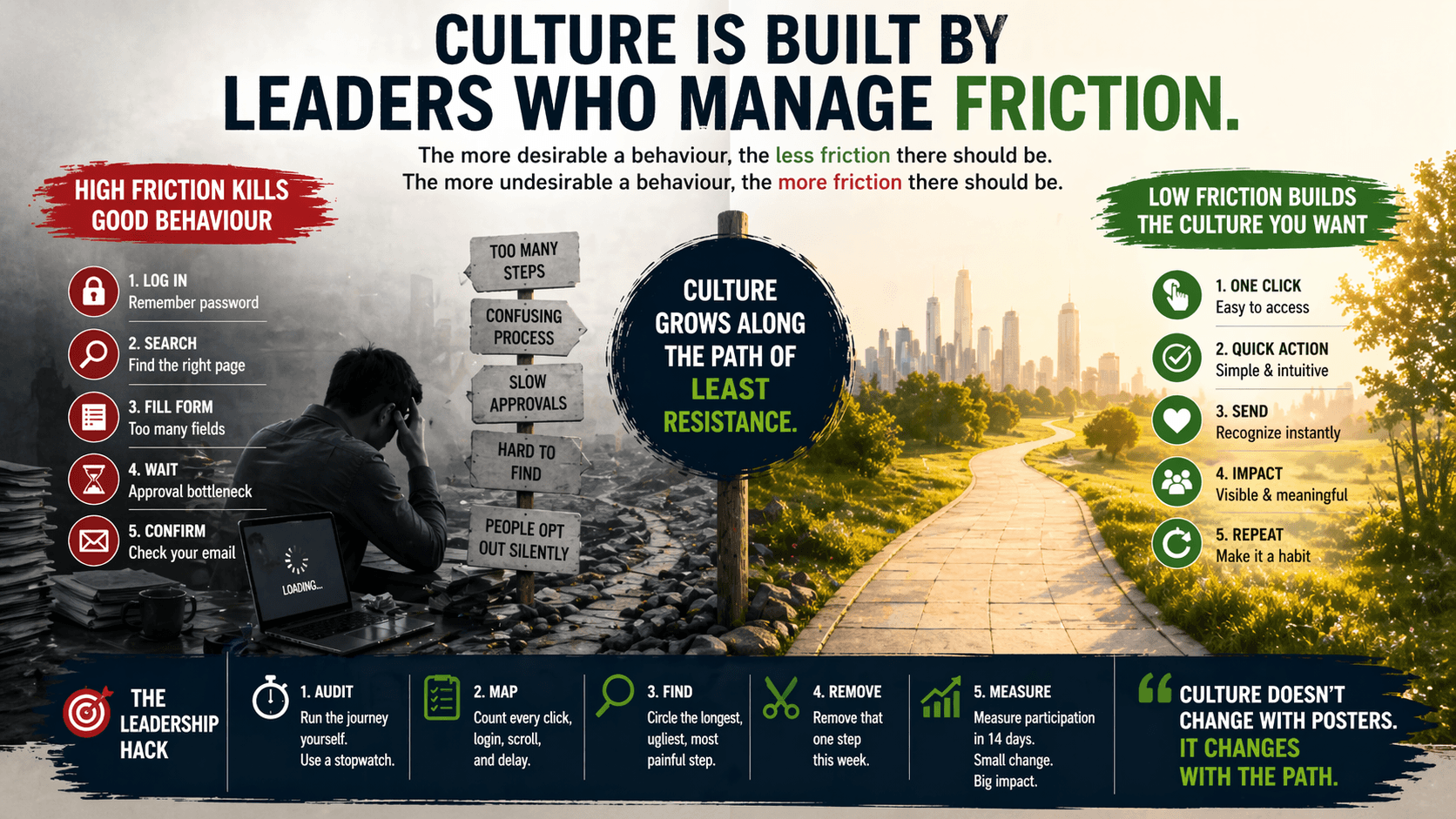
And then leaders sit in a room wondering why participation is so low. But the answer is often painfully unsexy: the behaviour did not fail. The path failed.
That is why I keep coming back to this idea that leaders are, whether they realise it or not, friction managers.
If you want a culture of recognition, but it takes six clicks, a login, a dropdown menu, and a manager approval to recognise someone, then let me save you some time: You do not have a recognition culture. You have a recognition obstacle course.
If you want a culture of feedback, but giving feedback feels risky, bureaucratic, or exhausting, people will not suddenly become noble warriors of candour. They will stay quiet.
If you want a culture of learning, but accessing the learning platform feels harder than watching a Netflix documentary, people will postpone it forever and then tell you they were “too busy.”
This is where a lot of leaders get culture wrong. They think culture is mostly an inspiration problem. So they communicate more. But culture is often a design problem.
And design, at its core, is about friction.
What do we make easy? What do we make difficult? What do we remove? What do we force? What do we automate? What do we bury under layers of process until only the most stubborn saints remain?
How Shared Meals Reduce Friction in Teams →
I have a strong belief that culture grows in the direction of the path of least resistance. So if you want more of a behaviour, reduce friction. If you want less of a behaviour, increase friction.
- Want more collaboration? Make cross-functional access easier.
- Want more recognition? Make appreciation immediate and simple.
- Want more coaching? Build it into the manager rhythm, not as an optional extra.
- Want less politics? Increase transparency. Add decision rules. Reduce hidden channels of influence.
- Want less reactive firefighting? Force a pause before escalation. Add reflection before action. Build friction into impulsive behaviour.
This is why some bad cultures are so resilient. Not because the people are evil or the values are wrong. But the system has made the wrong behaviours easy. Gossip is easy. Blame is easy. Escalation is easy. Silence is easy. Avoidance is easy.
Meanwhile, the right behaviours are expensive. Thoughtful feedback is hard. Recognition is buried. Learning is clunky. Collaboration is slow. Asking for help feels dangerous.
And then we wonder why culture does not change. Of course it does not. The system is coaching people every day.
So here is a very practical leadership exercise: Pick one voluntary behaviour that matters most in your culture right now. Recognition. Feedback. Learning. Coaching. Knowledge sharing. Collaboration.
Then do something radical: Run the journey yourself.
From the employee’s real starting point. Use a stopwatch. Count every click. Every login. Every page load. Every scroll. Every moment of confusion. Every step where a human being might say, “Aiya, forget it.”
Write each step down. Then circle the longest, ugliest, most irritating step. And remove that one step this week. Not next quarter. This week. Because the step that kills participation is almost never the one discussed in the strategy deck. It is the tiny bit of sludge in the middle. And sludge is deadly because it is silent.
People do not complain much. They just opt out quietly.
That is why leaders must become students of friction. Because culture is not only what you preach. It is what your systems permit with ease.
So yes, cast vision. Yes, talk about values. Yes, inspire people. But after the speech, go audit the clicks. Because in the end, great leaders are the ones who set the path toward expectations.
Finally, that is how culture is actually built.
Budaya (powered by Happily.ai) help HR surface early signs of tension through real-time pulse checks and sentiment insights. Explore Budaya today.


Leadership
Tags: HR

Roshan is the Founder and “Kuli” of the Leaderonomics Group of companies. He believes that everyone can be a leader and "make a dent in the universe," in their own special ways. He is featured on TV, radio and numerous publications sharing the Science of Building Leaders and on leadership development. Follow him at www.roshanthiran.com