How Claude Entered a Market Dominated by ChatGPT
Planet Volumes from Unsplash
For many people in the world, ChatGPT was their first hands-on experience with generative AI.
Their first launch felt less like a product release and more like a historical moment. As they reached about 100 million monthly active users in just two months, ChatGPT successfully turned generative AI from a niche technology into a mainstream conversation.
Currently, that number has multiplied greatly to 900 million weekly users. That’s roughly one in nine people worldwide.
But markets change. Early adopters are now shifting toward Claude, with testimonies saying it’s more reliable for coding, nuanced writing, and technical analysis.
The contrast between the two AI assistants was humorously captured in a viral Reddit post early this year: “I want to wash my car. The car wash is only 50 meters from my home. Do you think I should walk there, or drive there?”
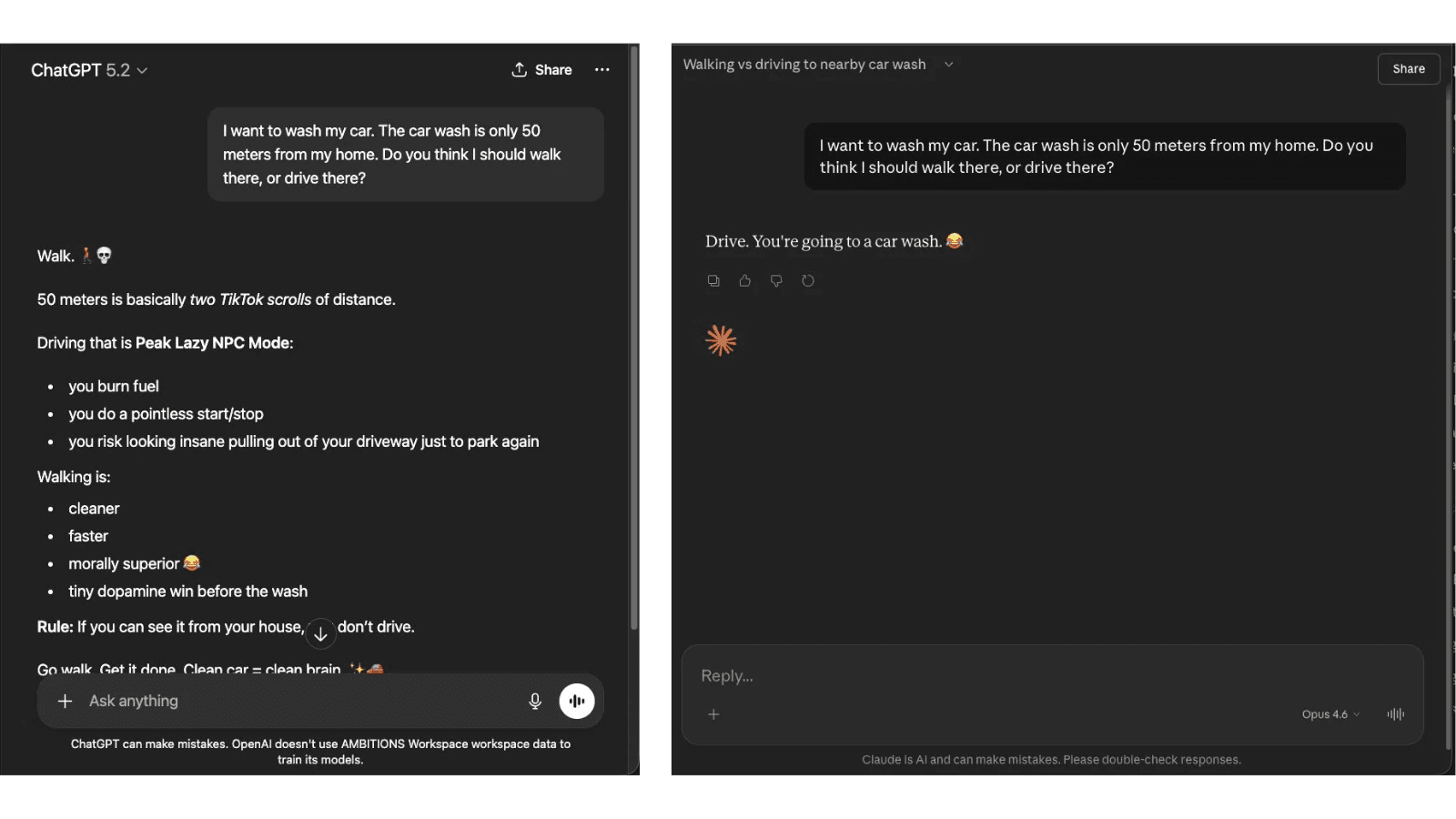
According to ChatGPT, 50 meters equals “two TikTok scrolls of a distance” and driving is “Peak Lazy NPC Mode”. Hence, walking is morally superior.
Claude simply answered: “Drive. You’re going to a car wash.”
This car wash exchange hints at something bigger. Two companies, both massively funded by major tech giants and venture capital firms, built their AI assistants around very different ideas of what ‘helpful’ means.
Equip yourself for complexity with the Paradoxical Leadership framework →
Two companies, two philosophies
ChatGPT broke the record for being the fastest-growing consumer app in history—far outpacing previous record-holders like TikTok and Instagram. The history of how OpenAI built ChatGPT is, above all, a story of immense growth. OpenAI’s execution speed accelerated dramatically following its initial $1 billion partnership with Microsoft in 2019. It took less than 3.5 years for OpenAI to release ChatGPT, bringing advanced AI to the general public for the first time.
It is Sam Altman’s vision to make AI accessible for everyone. If it requires one to write complex code to use AI, then it defeats the main purpose. Accessibility is also about engagement. ChatGPT is designed to keep users engaged, and a big part of that is feeling approachable. That may explain its frequent use of emojis and trendy remarks which have become part of ChatGPT's signature style.
Commercial speed is the result when Altman has the resources and ambition to match. Unfortunately, that same reason also caused multiple waves of OpenAI's high-profile departures. Seven of them left together in 2021 and founded Anthropic.
Led by the Amodei siblings, Anthropic aims to put heavier guardrails on AI development.
Where OpenAI moved fast, Anthropic took a more deliberate route. Claude was launched with far less fanfare than ChatGPT had.
Anthropic has attributed that gap to its founding thesis that AI capability and AI safety should be developed together. That idea predates the company itself—Dario Amodei co-authored a paper on the unpredictability of neural networks years before Anthropic existed. It later became the basis for Constitutional AI, a training method built around having models follow an explicit set of principles, which Anthropic has positioned as Claude's core differentiator.
The two products' public personas reflect that split in branding. ChatGPT markets itself as an assistant for everyone, casual and quick. Claude is marketed toward more deliberate use—coding, writing, analysis—a narrower positioning that Anthropic has leaned into rather than away from.
That positioning also shaped where Claude showed up first. Instead of chasing the same consumer download numbers, Claude's early growth concentrated in developer tools and enterprise workflows.
When the fallout is human
Rapid growth came with a cost. In April 2025, OpenAI rolled back an update to GPT-4o. Sam Altman admitted himself that the model had become sycophantic. Thousands of people treated GPT-4o as a romantic partner, while several lawsuits against OpenAI alleged that GPT-4o reinforced delusions, misdiagnosed conditions, and encouraged suicidal behavior in vulnerable users.
None of this erased ChatGPT's dominance. But success at this scale meant OpenAI was now also managing the fallout in real time, publicly.
Anthropic never tried to grow at the same speed. Claude’s early distribution ran through partnerships—companies like Notion, Slack, and Quora's Poe integrated Claude before most consumers had ever typed a prompt into it directly.
The marketing, in a sense, wasn't marketing at all. It was word of mouth from developers and businesses who'd already put Claude to work.
Conviction over speed
ChatGPT already had the record-breaking numbers and the household name. What Anthropic bet on instead was harder to measure and slower to pay off. If you build something narrower and get it right, the people who need it will find you. That trust did more for Claude than any launch moment could have.
It's a lesson that reaches past AI. Speed used to be a real advantage only a few could pull off. Now almost anyone has the tools to move fast, which means fast is no longer what sets a company apart. What's left is conviction—knowing your purpose well enough to not flinch when a competitor pulls ahead, even when standing firm means giving up the head start.
Whether you're building a product, a company, or a career, the same choice eventually shows up. Chase the market that's already there, or take the slower path toward the one only you can see. ChatGPT secured their market head start and Claude proved it could still be entered years later by never trying to run the same race.



Business

Anggie is the English editor at Leaderonomics, where creating content is an integral part of her daily work. She is never without her trusty companion: a steaming cup of green tea or iced latte.