Culture Dies Because of Friction
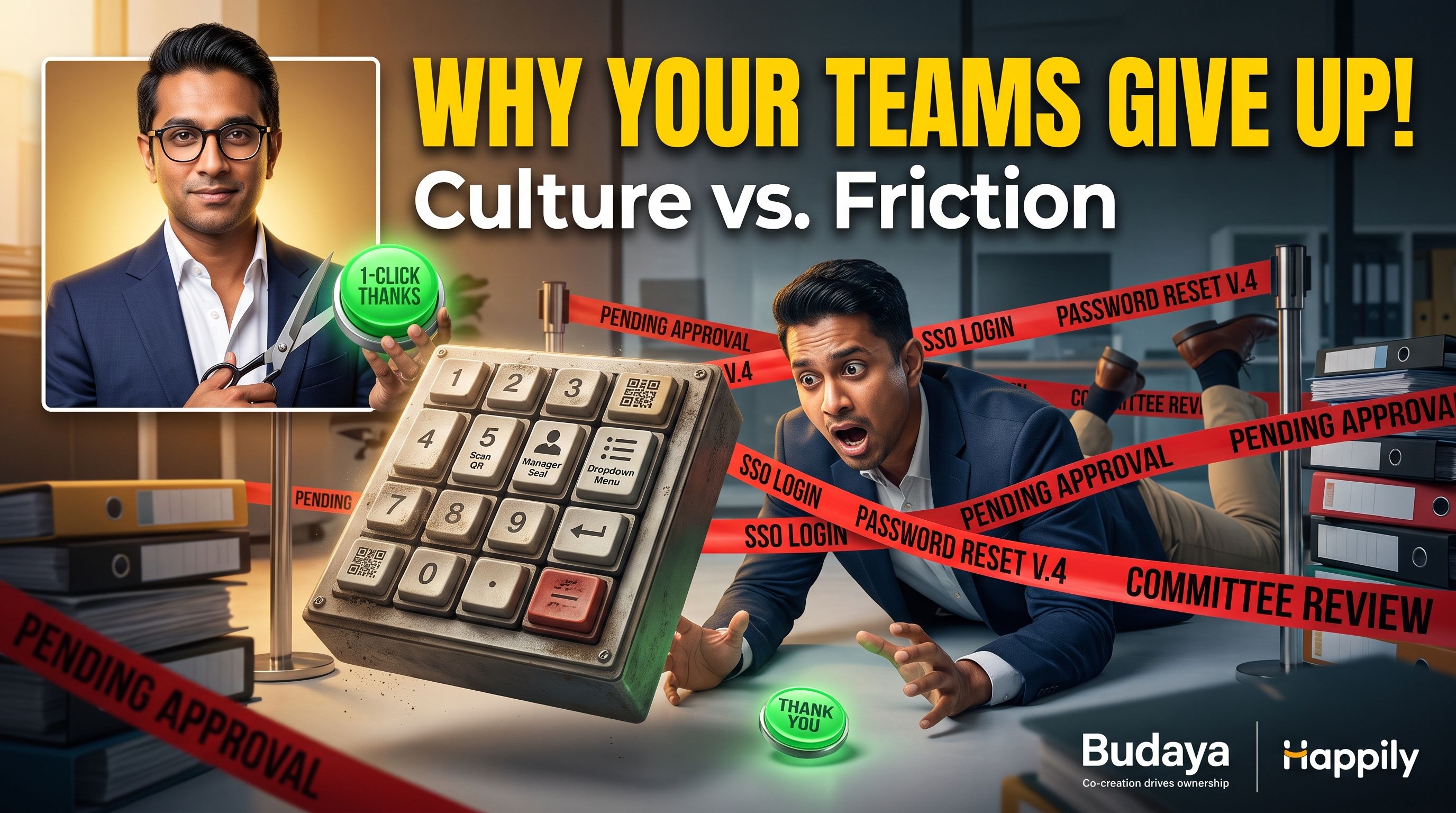
(Watch the 30-second video above before reading on)
We laugh at the video above because if we didn’t laugh, we would probably weep softly into our spreadsheets. Watching a grown professional hurdle an ergonomic office chair, belly-crawl under a web of literal red tape, and get stamped right on the forehead with a giant red "PENDING APPROVAL" seal just to tell a teammate "Thank you" feels like an absurd comedy sketch.
Except it isn’t a sketch. For millions of employees waking up every morning across Asia and the world, that obstacle course is an exact replica of their company intranet. Let me paint you a picture of a tragedy that happens in your organisation more often that you like every single day (maybe in a different form but very similar!).
An engineer—let’s call him Jason—has just survived a brutal product launch. His colleague, Sarah from marketing, stayed back two hours without being asked just to help him fix a broken client deck. Jason feels a sudden, genuine surge of human gratitude. He wants to recognize her. He wants to tell her—and the company—that she is a rockstar.
In behavioral psychology, that warm surge of intent is what we call a Spark. And here is the most important scientific fact you will ever learn about workplace culture: A human spark at 4:45 PM has a half-life of roughly thirty seconds.
Jason turns to his laptop to officially recognise Sarah on the company’s shiny new "Culture & Recognition Portal."
- Second 1 to 10: He searches his inbox for the URL because nobody knows where the portal actually lives.
- Second 11 to 20: He clicks the link and is greeted by a Single Sign-On (SSO) screen demanding a password he was forced to change 90 days ago using one uppercase letter, a prime number, a hieroglyphic, and the maiden name of his childhood pet.
- Second 21 to 30: After resetting his password via a two-factor authentication code sent to his phone, the portal finally loads. It asks him to select which of the "7 Corporate Pillars of Excellence" Sarah demonstrated from a dropdown menu, write a minimum 150-word business justification, attach supporting evidence, and route it to his Department Head for Tier-1 budget validation.
- At Second 31, Jason stares at the screen, sighs, closes the tab, and goes home.
Sarah never hears a word. And two months later, in the boardroom, the CEO turns to the Chief HR Officer, points to a dashboard showing an 11% adoption rate on the recognition portal, and says: “See? I told you. Our people just aren’t engaged. Our managers don’t care about culture. We need to bring in a motivational speaker.”
No, you don’t need a motivational speaker. You need a machete.
Confessions of a Reformed Bureaucratic Architect
Before you think I am throwing stones at HR leaders and executives from an ivory tower, let me make a confession. I spent decades as one of the chief architects of that obstacle course. Early in my career at ExxonMobil, and later across my 15+ years at General Electric (GE) and then leading Global Talent Management at Johnson & Johnson for a few more years, I was trained in the dark arts of corporate governance. I was a Six Sigma Black Belt. I loved processes. I loved control matrices. Whenever a business problem arose—whether in finance, operations, or HR—my instinct was to build a "bulletproof" framework.
If we were launching a new learning initiative, a talent mobility programme, or a peer-recognition system, we would gather in a cold room and ask: “How could someone abuse this?”
"Wait," someone in Finance or HR would say. “What if two friends in the Penang office just keep nominating each other for the RM50 coffee voucher every week? We need a rule! Let’s add a mandatory manager sign-off, a quarterly cap, and a cross-departmental review committee!”
And just like that, out of pure, well-intentioned corporate paranoia, we added three hurdles, two velvet ropes, and a password prompt. It took me years—and the humbling journey of founding Leaderonomics and serving as the chief Kuli (servant-laborer) building culture tech ventures like Budaya—to realise the fatal flaw in how we run organizations: We design our corporate systems to prevent the 1% of bad actors from gaming the process—and in doing so, we paralyze the 99% of good people who are just trying to do the right thing.
Think about the madness of that math. Because we are terrified that one mischievous employee might steal RM50 worth of unearned praise or claim a RM30 taxi ride without three original ink signatures, we inflict RM500,000 worth of administrative misery and lost productivity on the entire workforce. We treat adults like toddlers, and then we hold strategy retreats wondering why they don't act like owners.
The Rocket Science of Why Good Intentions Die
When CEOs and HR practitioners try to transform an organisation, we almost always diagnose inaction as a motivation problem. We assume that if people aren't collaborating, sharing feedback, completing their learning modules, or recognizing their peers, it’s because they don't want to.
So what do we do? We push harder. We launch internal marketing campaigns. We put posters of eagles soaring over mountains on the pantry wall. We tie the behavior to year-end KPIs.
In the 1940s, the legendary social psychologist Kurt Lewin proved why this approach almost always backfires. In his pioneering Force Field Analysis, Lewin demonstrated that any human behavior exists in a state of equilibrium between two opposing forces:
- Driving Forces: The pushes toward action (ambition, incentives, leadership speeches, KPI mandates, guilt).
- Restraining Forces: The barriers standing in the way (complexity, clunky software, fear of looking foolish, bureaucracy, time wasted).
Here is Lewin’s breakthrough insight: When you try to change behavior solely by cranking up the Driving Forces, you automatically increase tension, exhaustion, and organizational resistance. It is like pressing the accelerator of your car all the way to the floor while the handbrake is still engaged. You make a lot of noise, burn a lot of smoke, and ruin the engine.
The secret to effortless transformation, Lewin proved, is not to push the accelerator harder. It is to release the handbrake. Stanford University behavioral scientist Dr. BJ Fogg later codified this into a simple mathematical formula that every CEO and HR leader should tattoo on the inside of their eyelids: B = MAP
A Behavior (B) happens only at the exact split-second when three elements converge: Motivation (M), Ability (A), and a Prompt (P).
When an action requires high effort—when it is buried behind six clicks, a cumbersome form, and an approval chain—Ability (A) plummets toward zero. When Ability is near zero, even sky-high Motivation cannot save the behavior. Conversely, when you make a behavior ridiculously easy (high Ability), you only need a tiny spark of Motivation to trigger massive action.
Nobel Prize-winning economist Richard Thaler and Harvard Law professor Cass Sunstein have a specific word for the friction that kills Ability. In their work on behavioral economics, they call positive behavioral design a "Nudge." They call unnecessary friction "Sludge." Sludge is the thick, sticky administrative mud that clogs the arteries of your company. And the data on what happens when you remove sludge is staggering:
- The $100 Billion Single Click: In the late 1990s, e-commerce was plagued by a nearly 70% shopping cart abandonment rate. Traditional retail executives thought consumers just didn't trust the internet yet. Jeff Bezos realized it wasn't a trust problem; it was a friction problem. Filling out 14 billing and shipping fields every time you wanted to buy a book gave your brain 14 separate opportunities to change its mind. When Amazon patented 1-Click Ordering in 1999, they didn't make books cheaper or write better marketing copy. They simply vaporized the space between desire and completion. That single removal of friction became one of the most lucrative patents in business history.
- The Organ Donation Paradox: In a famous 2003 study by researchers Eric Johnson and Dan Goldstein, they examined why two culturally similar neighboring countries had wildly different organ donation rates. In Germany, only 12% of citizens consented to be organ donors. Just across the border in Austria, 99.98% of citizens consented. Were Austrians eight times more noble and altruistic than Germans? Not at all. Germany used an opt-in form (if you wanted to donate, you had to check the box). Austria used an opt-out form (you were a donor by default unless you checked the box). One micro-second of friction determined whether millions of lives would be saved.
If a single checkbox can alter life-and-death moral decisions across an entire nation, what do you think your 12-page competency assessment form is doing to your performance management culture?
Ancient Wisdom on Modern Red Tape
This battle between human vitality and bureaucratic sludge is not new. In fact, it is one of the oldest leadership struggles in human history. Throughout the ancient narratives, whenever a community lost its way or fell into stagnation, the call to leaders was never to invent more rules. I was reading an ancient passage (written maybe 3000 years ago) when a spokesman called his country leaders to restore their broken society, he used the metaphor of civil engineering: "Build up, build up, prepare the road! Remove the obstacles out of the way of my people."
Notice the job description of the leader: Obstacle Remover. Your people already want to walk toward purpose, community, and excellence. Your job isn't to whip them down the road; your job is to clear the boulders off the highway. A number of years ago, I read in this book written by my old Stanford Professor, Huggy Rao and Robert Sutton called “The Friction Project” who in their book reserve blistering leadership critique not for lazy employees but for bureaucrats and leaders who do not remove obstacles for their employees but create more friction. Many leaders today keep creating extensive hyper-legalistic regulations and procedures and are so obsessed with protecting the sanctity of the rules that they crush the very humans the rules were meant to serve calling these rules "Standard Operating Procedures," "Governance Matrixes," and "Change Management Protocols."
I saw the antidote to this firsthand during my years at GE through a revolutionary process called GE Work-Out. Jack Welch realised that as GE had grown into an industrial giant, it had accumulated decades of bureaucratic sludge. Frontline engineers and factory workers couldn't make common-sense decisions without waiting six weeks for signatures from headquarters.
So, we instituted Work-Out. We would take a cross-functional team off the factory floor or out of the back office for three days and ask them one question: "What are the dumbest, most pointless approvals, reports, and meetings stopping you from serving the customer today?"
On Day 3, the Senior Vice President had to stand in front of the room while the team pitched their list of friction points. The boss had only three legal responses on the spot: Yes, No, or I’ll get you an answer in 48 hours (and over 80% had to be an immediate Yes). We literally tore up thousands of pointless forms and sign-offs live in the room. The speed, energy, and ownership that erupted from those sessions didn't come from a new strategy—it came from cutting the red tape off our people's wrists.
Where Micro-Friction Is Quietly Killing Your Company Today
You might be thinking, "Roshan, we aren't as bureaucratic as your old conglomerate. We are digital! We have an app for everything!"
Actually, that might be making your friction worse. According to a Harvard Business Review study investigating digital exhaustion, the average corporate employee now toggles between different software applications and windows roughly 1,200 times every single day. That adds up to nearly four hours a week spent just reorienting their brain after switching screens—costing roughly 9% of total annual work time. Gartner research similarly confirms that employees are drowning in an average of 11+ applications just to execute their daily work.
Through our research in the Science of Transforming Organisations (SOTO) and our data from scaling Budaya across enterprises in Asia, we consistently see three critical areas where digital and operational sludge silently destroys business performance:
| Cultural Goal | How Leaders Accidentally Add Friction ("The Sludge") | The Frictionless Redesign ("The 1-Click Standard") |
| Peer Recognition & Gratitude | Standalone web portals; quarterly nomination cycles; mandatory 100-word essays mapping to corporate values; manager approval workflows. | Instant 1-click micro-appreciation embedded directly inside daily communication tools (Slack, Teams, mobile) with zero approval needed - Budaya has this already in their system |
| Frontline Innovation & Psychological Safety | Requiring a 15-slide PowerPoint business case, ROI spreadsheet, and steering committee pitch before testing a small operational improvement. | A 60-second voice-note or single-sentence prompt ("What frustrated a customer today?") paired with a RM500 autonomous "fix-it" budget. |
| Leadership & Continuous Learning | Clunky Learning Management Systems (LMS) requiring 7 clicks to find a 90-minute mandatory video course disconnected from daily reality. | Bite-sized, 2-minute behavioral nudges and AI-coached reflections delivered right before a manager walks into a 1-on-1 meeting all integrated in 1 standard organisational app |
When we strip away the obstacle course for our client organizations using Budaya, something magical happens. We don't have to send nagging emails from HR begging managers to recognize their teams or engage in feedback. Activity often jumps by 300% to 500% within weeks. Why? Because we didn't change the people. We changed the physics of the environment.
The Executive Playbook: 4 Ways to Become a "Chief Friction Hunter"
Whether you are a CEO responsible for the P&L or an HR practitioner responsible for the soul and capability of the workforce, you have a choice. You can keep acting as a Policy Architect (adding bricks to the wall), or you can become a Friction Hunter (knocking the wall down).
Here are four practical ways you can start clearing the road on Monday morning:
1. Impose the "30-Second / 3-Click Rule" on Every People Process
Pull your leadership or HR team into a room this week with a stopwatch. Put your core cultural behaviors to the test:
- Recognising a peer.
- Giving upward feedback or flagging a risk.
- Accessing a critical learning resource.
- Approving a routine frontline request.
Have an actual employee (not the vendor who sold you the software!) attempt the task from scratch while you time them. If a good behavior takes more than 3 clicks or 30 seconds, consider it broken. Do not launch the campaign until you have shaved the friction down to the bone.
2. Audit Your "1% Paranoia Rules"
Look at every policy requiring more than one signature in your company. Ask yourself two ruthless questions:
- What is the actual financial loss if someone abuses this?
- What is the hidden cost in executive time, delayed speed, and insulted human dignity of policing everyone else?
Years ago, Reed Hastings at Netflix realized their complex travel and expense policy was costing millions in administrative enforcement and making world-class engineers feel like untrustworthy teenagers. So he replaced the entire binder with five words: "Act in Netflix's best interest." Now, you might need slightly more structure than five words depending on your industry, but the principle holds: stop punishing the 99% to catch the 1%. Deal with the 1% when they misbehave, and let the 99% run free.
3. Stop Building "Destinations"—Put Culture in the Flow of Work
Here is a secret that software vendors hate admitting: Nobody wakes up in the morning excited to log into an HR portal.
Every time you force an employee to leave their primary workspace (where they serve customers, write code, or manage projects) to visit a separate "Culture Destination," you introduce massive cognitive friction. Bring the culture to where the humans already live. If your people live on Microsoft Teams, WhatsApp, or their mobile phones, your recognition, pulse checks, and coaching nudges must happen right there, in ten seconds or less.
4. Host a Quarterly "Red Tape Demolition Derby"
Take a page out of our old GE Work-Out playbook. Once a quarter, create a celebration around subtraction. Most companies only reward people for adding things—new projects, new committees, new reports, new rules. Over time, organizations suffer from institutional hoarding. Reverse the incentive. Offer a prize—a trophy, a cash bonus, or dinner with the CEO—to the employee or team that identifies the most ridiculous, time-wasting bureaucratic obstacle in the company and proposes how to kill it. When leaders visibly tear up red tape in front of the whole organization, psychological safety and energy go through the roof.
Building Organisations of Love by Getting Out of the Way
At the heart of everything we do at Leaderonomics and Budaya is a belief that business can—and must—be a vehicle for human flourishing. As I often share, our ultimate mission is to build leaders who build organisations of love.
Wait—what does "friction" have to do with love? Everything.
When you love and respect the people you lead, you value their time, their energy, and their dignity. Forcing a dedicated nurse, a tired factory supervisor, or a passionate young analyst to jump through ten bureaucratic hoops just to do their job—or just to express kindness to a colleague—is a subtle form of disrespect. It tells them: "Our administrative convenience matters more than your human contribution."
Removing friction is one of the most practical acts of servant leadership in the modern workplace. It requires humility. It requires us as leaders to step down from our thrones as the "Grand Approvers of Everything" and pick up the broom of a Kuli—sweeping the pebbles, clearing the tangled red tape, and smoothing the path so our people can shine.
Take a walk across your office floor this week. Look closely at your people. They aren't lazy. They aren't apathetic. Most of them came to work wanting to do something meaningful, wanting to connect, and wanting to win.
They are just exhausted from jumping over the chairs we left in the hallway. Clear the obstacles. Hand them a one-click path. And watch what happens when good intentions finally have room to run.

Business
Tags: Culture

Roshan is the Founder and “Kuli” of the Leaderonomics Group of companies. He believes that everyone can be a leader and "make a dent in the universe," in their own special ways. He is featured on TV, radio and numerous publications sharing the Science of Building Leaders and on leadership development. Follow him at www.roshanthiran.com