New Wine, Old Wineskins: The Real Reason AI Isn't Working for Your Business
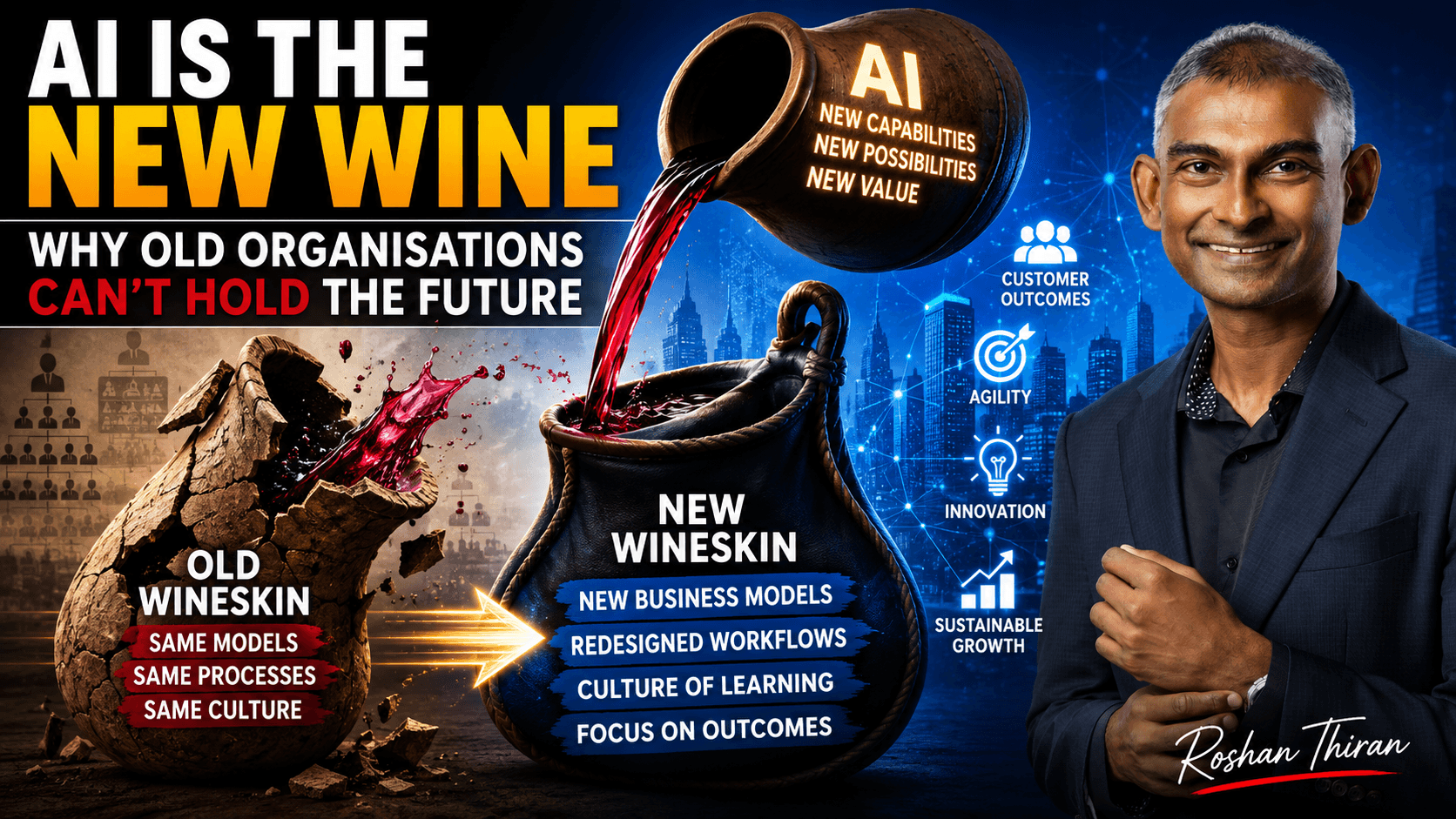
Have you noticed the absolute frenzy around artificial intelligence lately? Companies are rushing to deploy AI, spending billions of dollars, and sadly, laying off tens of thousands of workers in the name of "efficiency." But here's the kicker: we might be doing it all wrong.
In my latest video (which you can watch above!), I dive deep into what I call the AI Productivity Paradox. Despite all the hype and investment, MIT researchers recently analyzed hundreds of enterprise GenAI deployments and found something startling: 95% of generative AI pilot programs produced zero measurable impact on the bottom line.
Why? Because we are dealing with the classic New Wine, Old Wineskin problem.
The Ghost of Technology Past
We love to think our modern challenges are unique, but history tells a very different story. Back in the 1880s, factory owners began replacing steam power with electric motors. You’d think productivity would have skyrocketed overnight, right? Instead, it flatlined for decades. Why? Because they kept the exact same convoluted, belt-driven factory layouts. They swapped the engine but kept the outdated system.
A century later, the desktop computer arrived. As Nobel Prize-winning economist Robert Solow famously quipped in 1987: "You can see the computer age everywhere but in the productivity statistics."
The data shows us it historically takes businesses about 20 years to actually realize the gains of a new technology. The technology itself rarely fails; the delay happens because we try to layer lightning-fast new tools onto a foundation that wasn't built to handle them.
The Ancient Blueprint: Expanding Wine in Rigid Skins
As a leader who frequently looks to my faith for timeless wisdom, I'm reminded of a powerful warning given 2,000 years ago: "You do not pour new wine into old wineskins."
New wine actively ferments. As it expands, it creates immense internal pressure. If you pour it into an old, rigid, dried-out container that has already been stretched to its limit, the skin shatters—and you lose both the container and the wine.
Our old corporate containers—rigid hierarchies, strict approval processes, and functional silos—were brilliant for the Industrial Age. They created order and allowed us to scale human coordination across the globe. But today, AI is that expanding new wine. When we force it into rigid legacy structures, its immense power is stifled by layers of management and fragmented data.
Redesigning the Container: The 4 Layers of Transformation
If we want to survive and thrive, the essential leadership challenge is having the courage to build new containers. At Leaderonomics, we've found that you have to redesign across four critical layers:
The Business Model: We need to move away from "legacy thinking" (How do we make this workflow 10% cheaper?) to "AI-native thinking" (How do we guarantee a completely different outcome?). Look at John Deere—they are shifting from simply selling tractors to selling autonomous crop yields. They are using intelligence to make their own legacy products obsolete!
Organizational Structure: The traditional corporate hierarchy was built to manage the limits of human communication, requiring heavy middle management just to move data between isolated departments. AI changes all of that by acting as an instant central nervous system. We need to tear down silos and restructure into cross-functional "outcome pods" where leaders manage parameters, not data flow.
Processes (Beware the Task Composition Effect): If you just use AI to automate the easy, repetitive parts of a job, you leave your human workers with only the most complex, emotionally exhausting edge cases. MIT calls this the "task composition effect," and it is a fast track to burnout. We must systemically redesign workflows rather than just bolting AI onto broken processes.
Organizational Culture: When a company rewards sheer "busyness" over intelligent experimentation, it creates a massive "silence tax." Frontline workers spot the huge inefficiencies but keep their ideas to themselves, assuming leadership won't listen. A true culture of innovation reflects what the system actually rewards and measures.
The Human Advantage
Let me be clear: simply flattening a hierarchy and firing managers without redesigning how decisions are made doesn't make you agile. It just creates chaos with fewer adults in the room!
As software takes over the predictable outputs, our uniquely human skills—navigating complex exceptions, applying ethical judgment, and building trust across teams—become our true strategic advantage. Artificial intelligence is simply a mirror, exposing the legacy assumptions we still cling to.
The new wine is already here. Do you have the courage to build the new containers that can hold it?
I’d love to hear your thoughts! Are you seeing this productivity paradox play out in your organization? Let's connect, share some stories, and figure this out together. Drop a comment below!
BTW - you can read my full article with details and ideas and insights here


Business
Tags: Artificial Intelligence, Science & Tech, Transformation & Change

Roshan is the Founder and “Kuli” of the Leaderonomics Group of companies. He believes that everyone can be a leader and "make a dent in the universe," in their own special ways. He is featured on TV, radio and numerous publications sharing the Science of Building Leaders and on leadership development. Follow him at www.roshanthiran.com