The Roman Protocol: Three Laws That Built an Empire and One Mistake That Destroyed It
Start reading from Part 1: The Deming Revolution.
Most organisations think about command as a single system, a hierarchy, a reporting structure, a chain of authority. Rome thought differently. It built three interlocking infrastructures, each solving a different flow problem. Together, they made manual management unnecessary at civilisational scale.
The roads solved the information flow. 299,171 kilometres connecting every province. Strategic intent travelled from Rome to the frontier reliably and without distortion.
The Legion solved command flow. The centurion system put full decision-making authority at the edge: 80 men, one commander, fully empowered to act without waiting for approval from above.
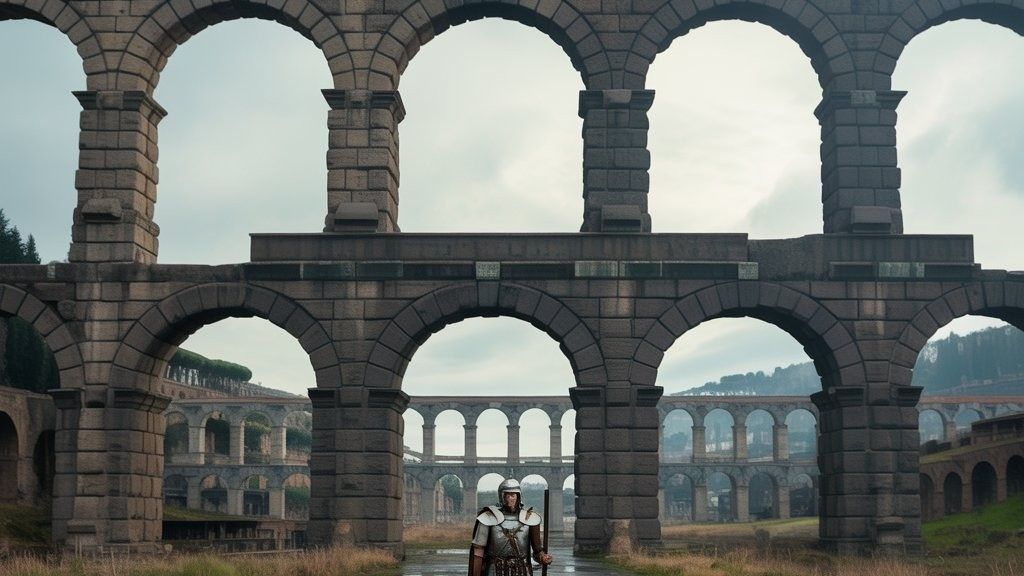
The aqueducts solved the resource flow. At its peak, Rome’s 11 aqueducts delivered nearly 40 million gallons of fresh water daily to one million people—all without a single pump. Powered by gravity and precision engineering, the system worked invisibly and reliably every day. Nobody had to carry buckets. The infrastructure did the work.
Together, they created a system that could operate at scale without constant intervention from the centre.
How to build teams that can thrive without constant intervention →
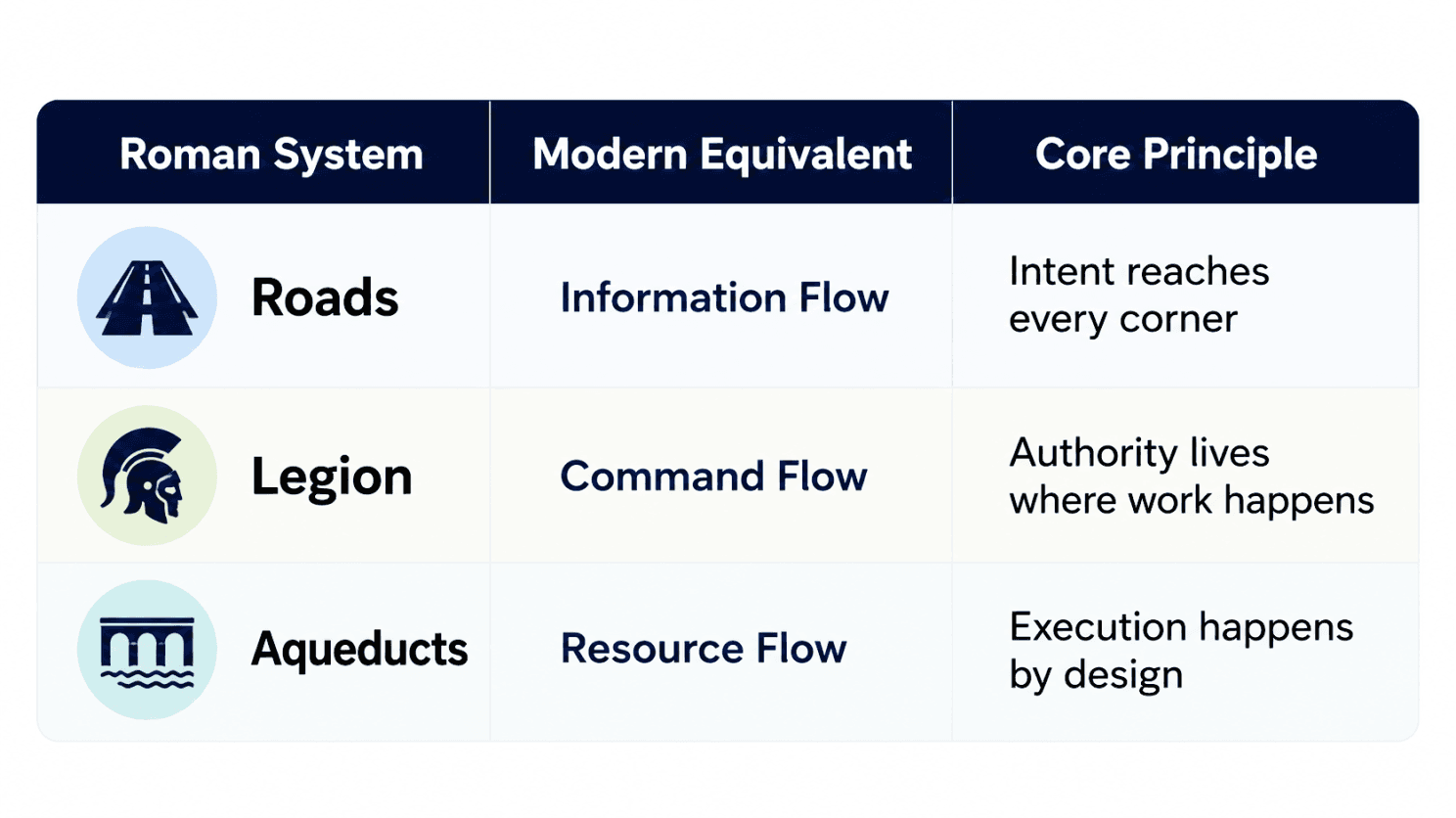
Which of these three does your organisation have?
Most have fragments of one, almost none have all three. The gap is architecture. Most companies are stuck in bucket-brigade mode, manually moving information, alignment, and decisions from person to person, meeting to meeting, approval to approval. Exhausting, but completely avoidable.
The corporate data that should make you uncomfortable
The bucket-brigade problem is destroying modern organisations right now, and the data is unambiguous.
A McKinsey & Company survey of 1,200 global business leaders found that inefficient decision-making costs a typical Fortune 500 company 530,000 days of managers’ time each year, equivalent to $250 million in annual wages.
Nearly 20% of every executive’s time is wasted because decisions travel upward instead of being made at the edge.
A 14,000-person global study by Oracle and data scientist Seth Stephens-Davidowitz indicates a significant workplace bottleneck, with 74% of leaders experiencing a tenfold increase in daily decisions over three years. This surge highlights a critical failure in organisational systems to automate routine choices, resulting in operational decisions overwhelming management desks.
The result: 72% say the sheer volume of decisions prevents them from making any decision at all. Decision paralysis, even in the world’s most resourced organisations. Rome solved this in 300 BC.
The three Roman laws
Roman Law I: Communicate intent, not instructions
The Legate told centurions what to achieve, not how to fight. The ethod would follow if the mission was clear. Most leaders do the opposite: they describe the how so precisely that the team stops thinking and starts executing blindly. When the situation changes, they’re lost because nobody told them why. Communicate the intent. Trust the edge to find the method.
Interestingly, McKinsey reports that 20% of executive time is lost to decisions that should have been made two levels below.
Roman Law II: Authority must live where the work lives
The centurion had full authority over his 80 men, training, discipline, and battlefield decisions. He didn’t escalate. He acted because the system was designed for him to act. In your organisation right now, who is your centurion, and do they actually have that authority?
Or are they writing emails upward for decisions they should be making themselves? If more than 30–40% of operational decisions are flowing through you, you are the bottleneck.
Not because you’re a bad leader. Because you haven’t designed the system that makes you unnecessary for routine decisions.
According to Oracle, 74% of leaders say daily decisions increased 10x because authority never reached the edge.
Roman Law III: Standardise the values
Every Roman legionary was trained to the same standard. That standardisation is what made decentralisation safe—when a centurion made an autonomous decision, it was shaped by shared values and shared training. Without that, delegation is just chaos with a management title on top. You cannot give your team autonomy if they don’t share a deep understanding of what you stand for. That understanding comes from how you train, how you onboard, and how you respond when someone makes the wrong call.
As Deming argued, 85% of failures are system failures. Shared standards are the system that makes autonomy work.
Marcus Aurelius on all of this
He governed the most complex organisation in history. Fought two wars simultaneously. Managed a plague that killed up to 10 million Romans. Every morning, before any of that, he wrote in his private journal as a daily act of self-governance.
Waste no more time arguing about what a good man should be. Be one.
As a leader, read that differently. Stop debating what kind of organisation you want to be. Stop arguing about culture and values in rooms where nothing gets decided. Build it. Encode it into your architecture. Stop describing the destination and start engineering the infrastructure that gets you there by design.
Marcus Aurelius didn’t micromanage Rome. He governed himself, rigorously, daily, privately, and trusted the architecture to do the rest.
Govern yourself first. Then trust the system you built.
Learn how leaders can unite people around a shared vision:
Why Rome fell and why this matters more than the rise
Most leadership content about Rome conveniently skips this part.
Rome fell. Not to barbarians first. To itself.
After Marcus Aurelius, leaders who didn’t trust the centurion system centralised authority back upward. The bureaucracy swelled until it cost more than it produced. Roads fell into disrepair. The Legion’s quality declined as Rome hired foreign mercenaries who shared none of the training and values that made autonomous command safe.
The architecture was abandoned from the inside, by leaders who stopped trusting it.
Rome's decline began when three things happened:
1. Authority moved upward
Decisions that once happened at the edge became trapped in bureaucracy.
2. Information flow weakened
The infrastructure connecting the empire slowly deteriorated.
3. Shared standards disappeared
Trust broke down because people no longer operated from the same values and discipline.
Many modern organisations repeat the same mistakes.
The most dangerous leader is not the one who never builds a system. It’s the one who builds a great system, watches it work, and then slowly dismantles it, because they can’t tolerate not being in every decision.
The Monday morning audit
Three questions. Answer them as the organisation you actually have, not the one you want to believe you have.
1. How many decisions landed on your desk this week that should have been made two levels below you?
If the answer is more than a handful, you haven’t built the centurion system. You’ve built a system where people bring you their decisions because you’ve trained them that their own judgement isn’t trusted. That training happened gradually, through every time you overruled them or took the decision back.
McKinsey says this costs Fortune 500 companies $250 million annually. It’s costing your organisation something too. You just haven’t measured it.
2. Can every person on your team articulate your strategic intent in one sentence, right now, without reading a document?
If they can’t, your roads are broken. Strategic intent that lives in a deck is not strategic intent; it’s a document. Rome’s soldiers didn’t carry a mission statement into battle. They had internalised it through training and daily practice. If your team can’t say it without prompting, you haven’t communicated it. You’ve announced it. There is a significant difference.
3. Is your organisation in bucket-brigade mode, or have you built the infrastructure that moves information, alignment, and resources by design?
Rome delivered 40 million gallons of water daily without a single person carrying a bucket. Your organisation has more technology than Rome had in its entire existence. And yet most of your information still travels through people and meetings rather than systems designed to move it automatically. If removing one person from your team would cause information to stop flowing, that’s a bucket brigade dressed up as a process.
The conclusion
Rome didn’t last 500 years because it had the best soldiers. It lasted because it built three infrastructures that made alignment automatic, authority distributed, and resources self-flowing.
Ironically, it fell when leaders stopped trusting those infrastructures and pulled everything back toward the centre.
Your organisation is somewhere on that arc right now, either building toward Rome’s peak or quietly sliding toward its decline. The audit above will tell you which.
Build the roads. Empower the centurion. Design the aqueduct. Then, and this is the hardest part, trust the system enough to let it run without you.
Continue reading Part 3: The Madinah Protocol.
This article was firstly published on Syed Muddassir's LinkedIn.



Leadership

Syed Muddassir is an Enterprise Architect, organisational transformation leader, and author of The Architecture of Impact and The Curvions Architect. Drawing on more than two decades of experience in enterprise architecture, governance, organisational design, and business transformation, his work explores how institutions can be intentionally designed to build trust, strengthen decision-making, and sustain performance beyond individual leaders.