The Deming Revolution: When Brilliant Teams Still Fail

In 2006, Airbus announced that delays in its A380 programme, the world's largest passenger aircraft, would cost €4.8 billion in lost earnings by 2010. Thousands of engineers. Four countries. Years of development. It unravelled because of a software version mismatch.
The A380 involved 16 development sites across France, Germany, Spain, and the UK. Each aircraft contained 530 kilometres of wiring, roughly the distance from London to Paris, comprising 98,000 wires and 40,000 connectors. German and Spanish teams designed the wiring in CATIA version 4. French and British teams had upgraded to version 5. The two were incompatible. Neither side knew.
When assembly began in Toulouse, a mechanic discovered the harnesses were a few centimetres too short to reach their connectors. Across the entire aircraft. The programme was delayed nearly two years.
Airbus had the world's most sophisticated aerospace engineers, the most advanced manufacturing technology on earth, and the combined industrial ambition of four nations. What it had broken was its system.

A bad system will beat a good person every time.
The Man Who Predicted This, Four Decades Earlier
W. Edwards Deming was a statistician from Wyoming who, in 1950, taught 450 Japanese engineers and executives one idea that would remake global industry: the problem with your teams is rarely your people. It is almost always your system.
Japan listened. Between 1950 and 1973, Japan's GDP grew at 10% annually, more than double America's 4%. Toyota, Sony, and Ricoh built their dominance entirely on Deming's system-design principles. The result wasn't an incremental improvement. It was an economic miracle that dismantled American industrial supremacy within a single generation.
Deming's finding was devastating in its simplicity:
Eighty-five percent of the reasons for failure are deficiencies in the systems and processes rather than the employee. The role of management is to change the process rather than badgering individuals to do better.
In his later work, he revised this upward: 94% of all problems belong to the system. Only 6% are attributable to individuals. The Airbus A380 is the most precise modern proof.
Field Leadership: Why It's More Relevant Than Ever →
People Deliver What Systems Enable
What makes Airbus the perfect case study is what happened next. They didn't fire anyone. They didn't hire differently. They redesigned the system.
The A350 was built on a completely overhauled architecture: a unified PLM platform used by 6,000+ developers across all four countries, with teams in Toulouse, Hamburg, Bristol, and Madrid working on the same virtual 3D model in real time, concurrently, not sequentially.
A380 — Broken System
€4.8B lost
Fragmented CAD versions. Sequential handoffs. Two-year delay.
A350 — Redesigned System
1,380+ orders
Unified platform. Concurrent engineering. Broke even in 2019.
Same Airbus. Same four countries. Same engineers. A different system produced a radically different outcome.
This is Deming's theorem made visible. But the question is:
What exactly did Deming prescribe, and how do you apply it to your team starting Monday?
Japan Proved It at the National Scale
Airbus is the micro-proof. Japan from 1950 to 1980 is the macro-proof.
Same workforce. Former war economy. No natural resources. One difference: they redesigned the system through which people worked together.
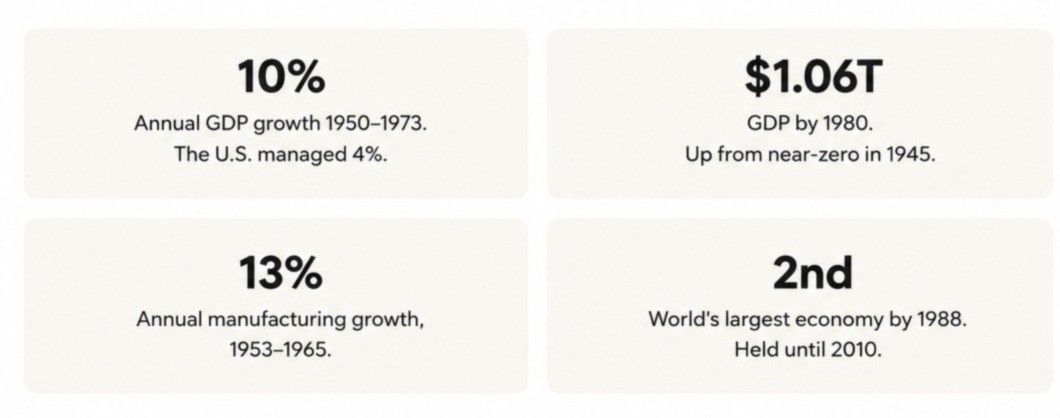
Toyota. Sony. Ricoh. None of them hired different people. They built different systems. The Deming Prize, established in 1951, wasn't a trophy. It was an architectural mandate.
The Real Problem With Blame
When the A380 wiring failed, Airbus's first instinct was to blame across national lines. French management blamed German engineers. German engineers felt French practices were being imposed on them.
Both sides spent months managing the 15%. Neither touched the 85%, the system that silently allowed two teams to work in incompatible software for years without a single alert.
Blame feels productive. It isn't. It is the most expensive management habit in the world.
Eighty-five percent of the reasons for failure are deficiencies in the systems and processes rather than the employee.
Relay Race vs. Concurrent Sync: The Only Analogy That Matters
Most organisations run their teams like a relay race. One function finishes. Hand the baton to the next. That function runs. Hand it on.
Clean in theory. Catastrophic in practice. Every baton change is a misalignment event. Every handoff amplifies the error from the previous leg. By the time the problem surfaces, it has passed through four departments and is now someone else's catastrophe.
Airbus ran the A380 as a relay race. Sixteen sites. Sequential handoffs. Four countries running separate legs, in different shoes, on different tracks, with different maps.
The A350 was built differently. Concurrent synchronisation. Every team, every country, every function — working on the same model, in the same environment, at the same time.
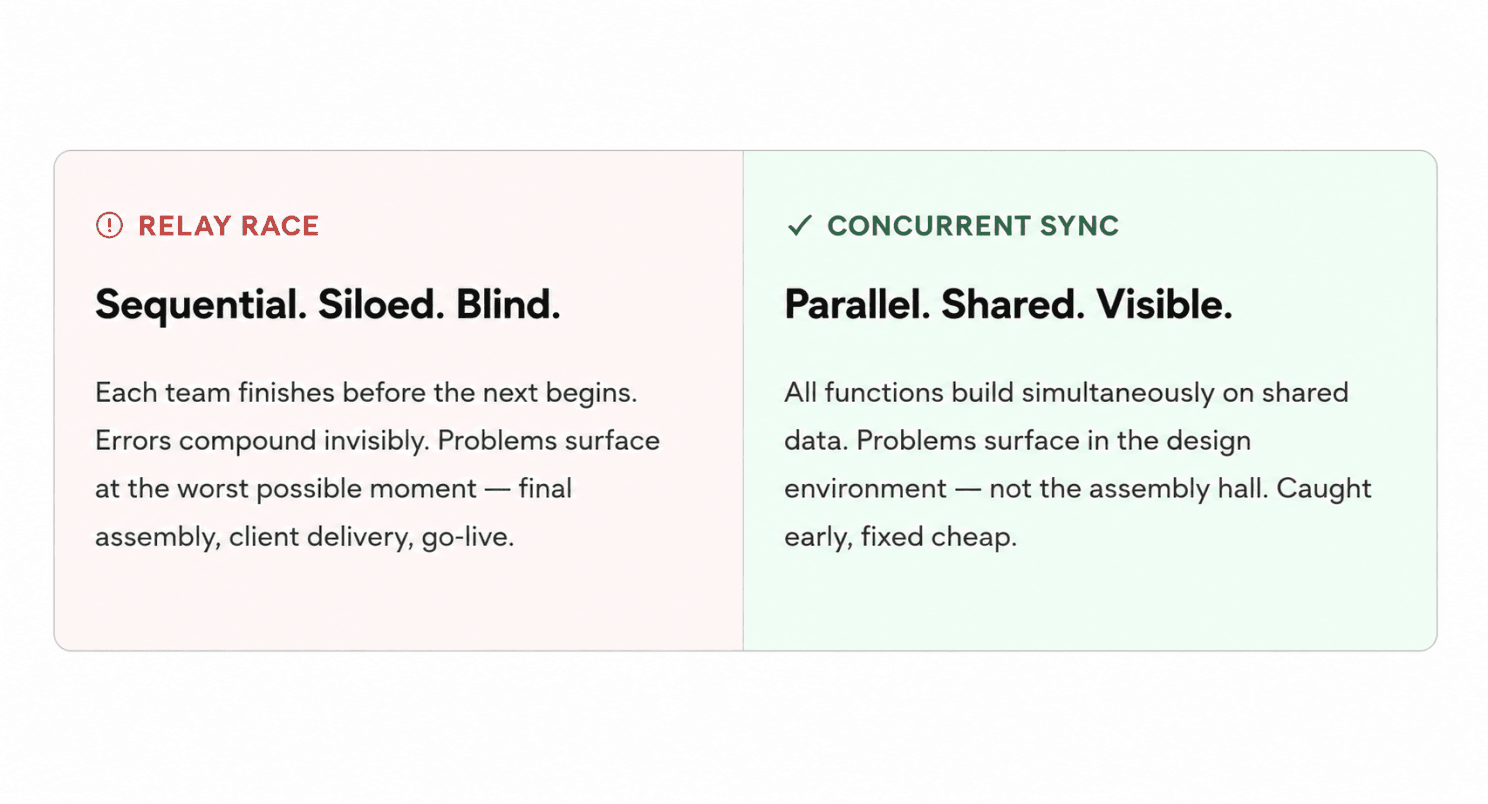
If you are running a Relay Race, you aren't managing a team; you’re managing a series of unprotected handoffs. Every baton change is a silent profit leak. In a high-complexity world, the Relay Race is an obsolete architecture for failure.
Most Teams Use PDCA Wrong
Plan. Do. Check. Act. Most leaders treat PDCA as a process checklist. It isn't. It is a rhythm of shared inquiry — the mechanism through which teams synchronise around evidence rather than authority.
When teams plan together, they build shared reality. When they check together, they develop a shared understanding of variance. When they act together on data, not on seniority, collective intelligence emerges.
Airbus embedded this into the A350 after the A380 disaster. A potential three-month delay in wing manufacturing was caught in the planning loop — not on the factory floor. Same complexity. Completely different outcome. Because the loop was running.
The Three Laws
Law 1 — Deming Point 8
Drive out fear. Before you demand anything else.
The A380 teams were aware of the software incompatibility. They didn't escalate. They filtered upward instead of flagging laterally, because the system punished the messenger. Fear doesn't just affect culture. It corrupts your data. Every performance metric you collect from a fear-driven team is a lie.
Law 2 — Deming Point 9
Break down silos. Not with team-building. With architecture.
Silos are not attitude problems. They are structural ones. The A380's 16 sites communicated vertically, up and down national command structures, not laterally across functions. You cannot fix that with an off-site. You redesign the information architecture. That's it.
Law 3 — Deming Point 3
Stop inspecting for quality. Start building it in.
A380 wiring fault discovered at final assembly. The single most expensive moment to find a problem. The A350's unified digital mock-up caught the same class of errors before a single physical component was made. Post-mortems are not quality systems. They are eulogies. Build the architecture that prevents death.
How to create a culture that moves everyone forward →
The Monday Morning Audit
Three questions. Answer them honestly, not as the leader you want to be, but as the organisation you actually have.
1. When your team last failed, what did you fix first: the person or the system?
If you change the person and leave the system as is, the next person will encounter the same issue. You already know this. You've seen it happen. You did it anyway.
2. Can every team that touches a project see what every other team is doing, right now, in real time?
If the answer is no, you are running a relay race. You have baton changes happening invisibly every day. You won't find out until final assembly. That's what Airbus thought too.
3. How many approval layers stand between a problem being spotted and a decision being made?
Every layer is a delay. Every delay compounds the problem. You built those layers. They felt like governance. They are actually the reason your teams can't move.
The Conclusion
The same engineers who built an aircraft with wiring too short to reach its connectors built one of the most commercially successful jets in aviation history. Nothing changed about them. Everything changed about the system they worked in.
The $10 trillion collaboration leak from Part 1 is not a people problem. It never was. It is what happens when capable people are placed inside systems that were never designed to let them succeed.
Fix the system. The people are fine.
The question is not whether your team can perform better. It is whether you are willing to look at what you built and own what you find.
This article was firstly published on Syed Muddassir's LinkedIn.
Coming in this series
Part 3: The Roman Protocol — How Marcus Aurelius engineered a synchronised command structure across 70 million people.
Part 4: The Prophet's Mawakhat — How Prophet Muhammad engineered the first truly synchronised diverse team at scale.
Part 5: The Synthesis — Your 2026 team operating system.



Functional
Tags: Transformation & Change, Culture, Systems & Structures

Syed Muddassir is an Enterprise Architect, organisational transformation leader, and author of The Architecture of Impact and The Curvions Architect. Drawing on more than two decades of experience in enterprise architecture, governance, organisational design, and business transformation, his work explores how institutions can be intentionally designed to build trust, strengthen decision-making, and sustain performance beyond individual leaders.