Executive Assistant Staffing Companies for C-Suite Leaders: Cost vs Fit vs Speed

Photo by Kampus @ freepik
Think back to the last time an urgent email yanked you out of deep work. Now picture a partner who blocks the noise, anticipates next week's fire drill, and keeps every meeting, deck, and flight aligned. That partner is a senior executive assistant, and demand for them has never been stronger. Today, 72 per cent of EAs say strategic support, not calendar wrangling, is their core job, up from 55 per cent just a few years ago (Zipdo).
The catch? Elite assistants rarely post résumés. CEOs and founders often rely on specialist recruiters to connect with this hidden talent. Yet every agency trade-off boils down to three variables: cost, fit, and speed. We compared a dozen leading firms on those exact factors so you can reclaim your calendar with confidence.
Ready? Let's see why the role has become mission-critical for the modern C-suite.
Why the right EA (and the right agency) matters
Your calendar is finite. Every meeting you skip, every email you never see, hands back minutes you can spend on strategy, product, or investors. A skilled executive assistant delivers that relief daily.
The market proves the value. Average U.S. EA pay climbed to about $78,000 in 2025, and unemployment in the field sits below 2 per cent—clear signs of a talent shortage. The best assistants already support high-profile leaders, so they are not scrolling job boards.
Read more: The Role of Executive Assistants in an Organisation
Quality counts as much as availability. Modern EAs juggle project management, data prep, and stakeholder communications, work that shapes executive decisions. A poor hire stalls productivity and risks exposing sensitive information. Replacing an ill-fitting assistant drains cash, trust, and momentum.
Specialised staffing agencies solve this risk. They keep curated networks, run multi-step vetting, and know the gap between someone who only books flights and someone who anticipates board-meeting politics. The right match can turn into a multiyear partnership that compounds value over time.
Hiring an EA is not routine admin work; it is a strategic investment. Choose an agency that lines up with your priorities (cost, fit, speed), and you will secure an assistant who shields your time and multiplies your impact. Next, we break down those three decision lenses so you can weigh them wisely.
Cost, fit, and speed: The three pillars of a smart search
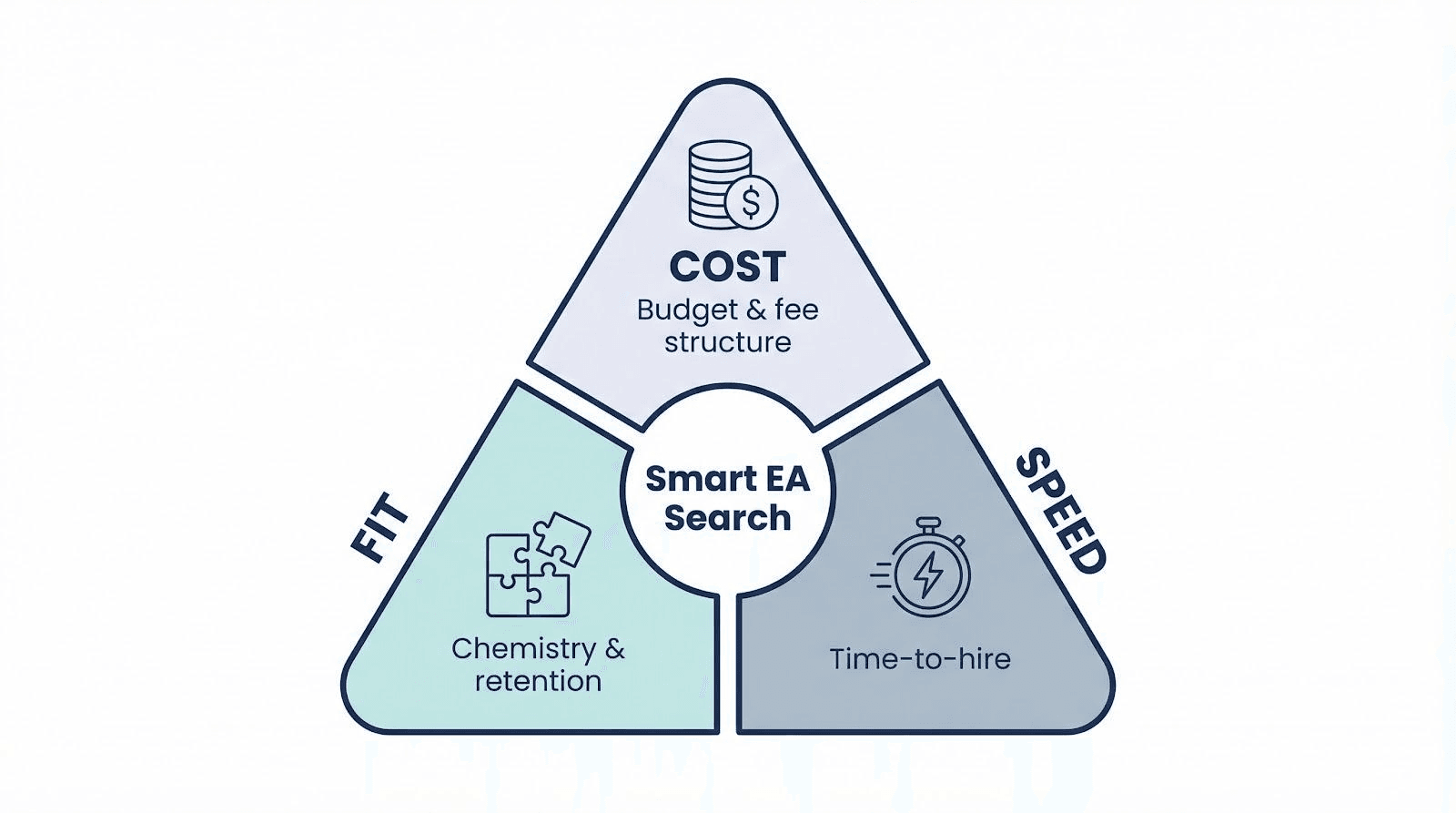
Cost – know exactly what you are paying for.
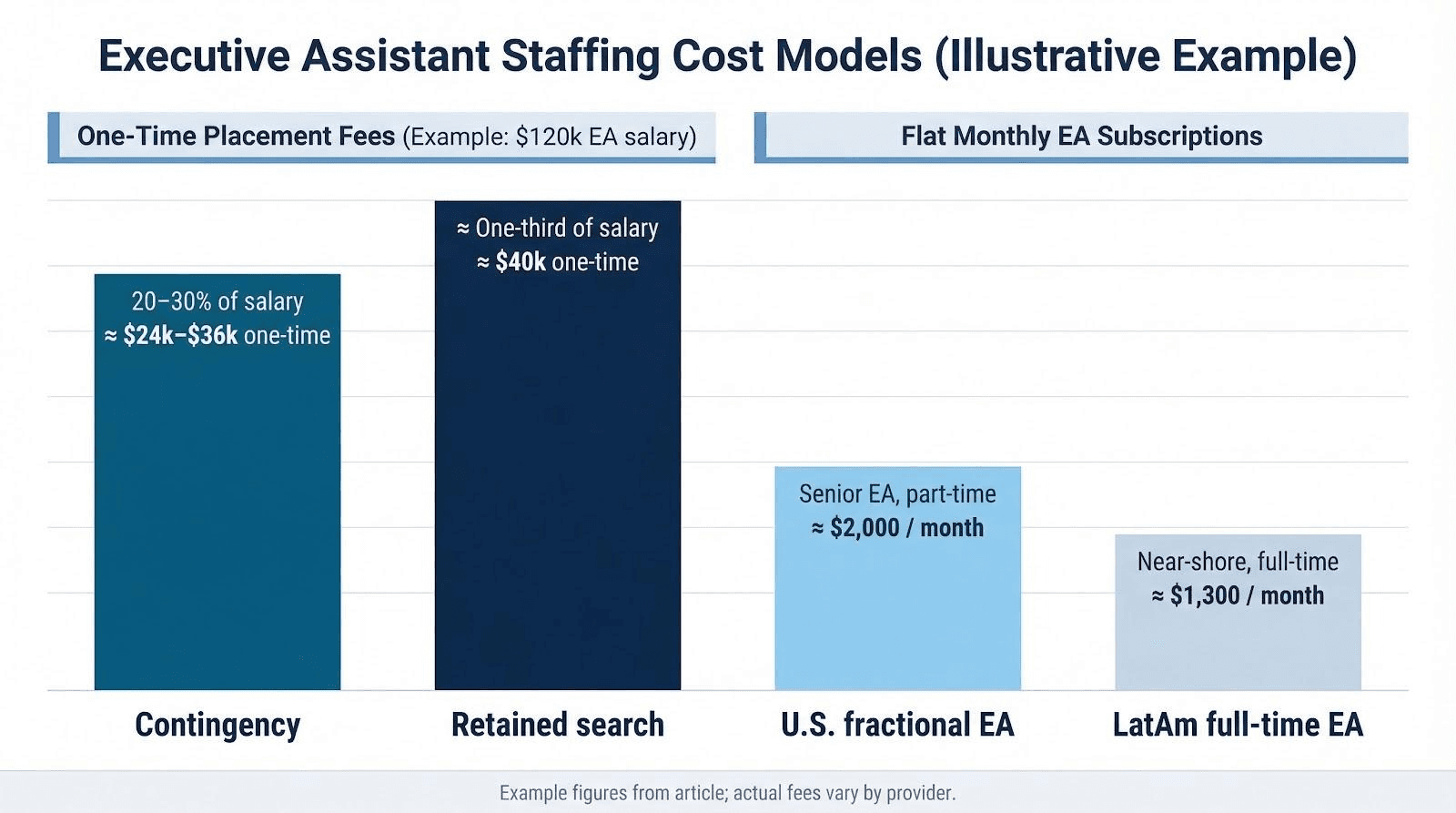
Fees in the staffing world look simple until you read the fine print. Traditional contingency firms charge a one-time placement fee between 20 and 30 per cent of your EA's first-year salary, payable only when you hire (AIJourn). On a $120,000 assistant, that equals about $24,000–$36,000.
Retained-search boutiques sit higher, collecting roughly one-third of compensation in staged payments. That premium funds deeper head-hunting, psychometric tests, and a longer replacement guarantee, a safety net when failure is not an option.
Subscription or near-shore models change the equation. Instead of an upfront fee, you pay a flat monthly rate that bundles salary, benefits, and the service's margin. A fractional U.S.-based EA often runs about $2,000 per month, while a full-time assistant in Latin America can cost closer to $1,300. These plans suit leaders who need fewer than forty hours of help each week or who value cash-flow flexibility.
Whichever path you pick, insist on transparency. Ask the recruiter to list every cost, from background-check surcharges to conversion fees on temp-to-hire contracts. Clear numbers today prevent budget shocks tomorrow.
Fit – because chemistry beats résumé padding.
A flawless résumé means little if the assistant's working style clashes with yours. Fit is about chemistry, judgment, and staying power, the invisible qualities that let an EA finish your sentences and flag issues before they explode.
Elite staffing firms treat cultural alignment like a science. They interview you first, decoding how you think, communicate, and decide. Next, they pressure-test candidates with scenario drills: handle a double-booked board call, triage investor emails, and manage a travel delay while keeping a launch on track. Only the few who stay calm and show sharp judgment reach your shortlist.
Selectivity speaks volumes. Boutique agencies reject more than 90 per cent of applicants, sending you only career assistants who thrive in high-stakes settings. That rigour pays off; assistants placed through deep vetting stay longer, preserving institutional knowledge and sparing you costly churn.
Fit also covers logistics. Do you need someone in the office each morning, or will a remote partner suit your hybrid rhythm? Clarify that first, then press the recruiter on retention data and replacement guarantees. Strong numbers signal that their matchmaking process works.
Speed – time is your scarcest asset.
Vacancies create ripple effects fast. Calendar conflicts sneak in, travel misfires, loose ends multiply. Turnaround time can matter as much as quality.
Large contingency firms keep digital benches of screened talent. Ask on Monday, and you might see résumés by Wednesday. Robert Half even claims it can surface executive-assistant candidates within forty-eight hours, a lifesaver when your current EA gives two weeks' notice.
Remote-first platforms move even faster by matching from a standing pool. Persona promises an initial candidate interview within forty-eight hours; Near fills a role in about three weeks, still quicker than a traditional search.
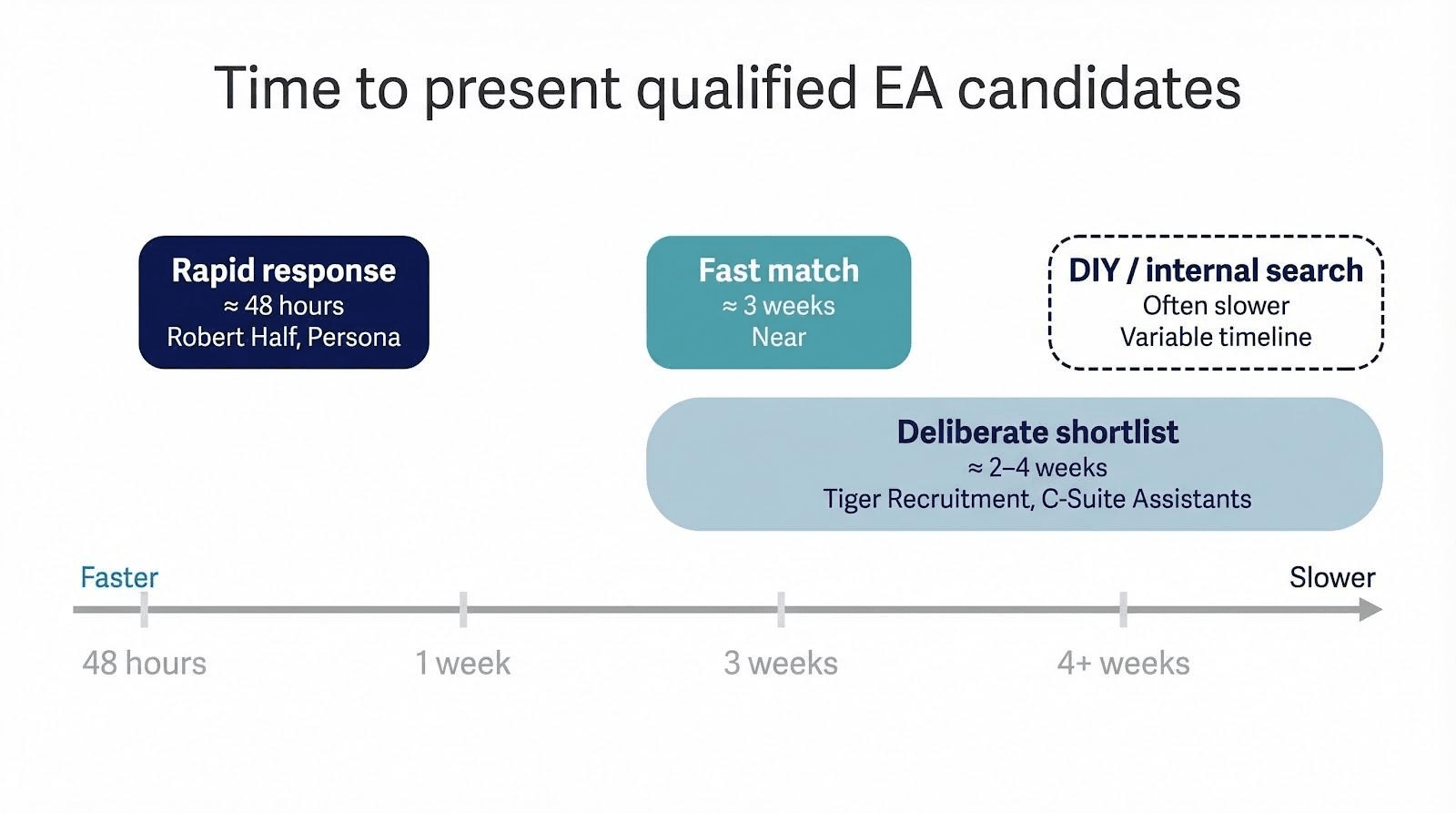
Boutiques work more deliberately yet still beat do-it-yourself hiring. A curated agency such as Tiger Recruitment or C-Suite Assistants usually delivers a refined shortlist in two to four weeks, a window many leaders accept when long-term fit matters.
Takeaway: decide how long you can run without support. If the answer is "not a day," keep a rapid-response provider on call or request an interim temp while a boutique firm completes its deeper search.
Quick comparison at a glance
Choosing an agency is easier when you can see the trade-offs side by side. Use the table below as your cheat sheet. Scan for the column that reflects your biggest constraint (cost, fit, or speed) and read across to spot the firms that match it best.
| Agency | Model & scope | Cost* | Fit** | Speed*** | Stand-out strength |
| C-Suite Assistants | Contingency, U.S. nationwide, EA-only | ●●● | ●●●●● | ●●●● | Laser focus on C-suite chemistry |
| Robert Half | Contingency + temp, global network | ●●● | ●● | ●●●●● | Résumés in 48 hours for emergency cover |
| Kelly Services | Contingency + contract, global | ●●●● | ●●● | ●●●● | Flexible temp-to-hire terms |
| Randstad | Contingency, 38 countries | ●●● | ●● | ●●●●● | Multilocation reach in one call |
| Tiger Recruitment | Contingency/retained, US & EMEA | ●● | ●●●●● | ●●● | White-glove support for UHNW execs |
| Pocketbook Agency | Contingency, U.S. coastal hubs | ●●● | ●●●●● | ●●● | Culture-first "Smarter Staffing" method |
| Boldly | Subscription, remote fractional | ●● | ●●●● | ●●●● | Senior EAs on pay-as-you-scale plans |
| Maven Recruiting | Contingency, West Coast tech | ●●● | ●●●● | ●●● | Silicon Valley insider network |
| Caldwell Partners | Retained search, global | ● | ●●●●● | ●● | Headhunter rigor with 12-month guarantee |
| Career Group | Contingency + temp, U.S. major cities | ●●● | ●●● | ●●●● | Decades-old admin talent pipeline |
| Near (HirewithNear) | Flat monthly, LatAm remote | ●●●●● | ●● | ●●●● | Full-time EAs ≈ $1.3k per month |
| Persona | Subscription, remote dedicated | ●●● | ●●●● | ●●●●● | 0.1 percent acceptance; match in 48 h |
* Cost scale: ● = highest, ●●●●● = lowest out-of-pocket
** Fit scale measures vetting depth and retention focus
*** Speed scale measures time to present a qualified shortlist
No single row will cover every need. Decide which column matters most right now. Need someone tomorrow? Robert Half or Persona tops the speed list. Building a long-term partnership? C-Suite Assistants, Tiger, or Caldwell rank highest for fit. Watching dollars? Near's near-shore model trims cost while still covering U.S. hours.
Use this grid to pick two or three contenders, then move on to the profiles that follow.
1. C-Suite Assistants: Elite focus, flawless chemistry

C-Suite Assistants executive assistant staffing homepage screenshot
Finding an EA who can keep pace with a high-pressure board meeting one minute and a turbulent travel day the next calls for more than keyword matching. For more than twenty years, C-Suite Assistants has focused exclusively on executive assistant staffing and recruiting, building a coast-to-coast talent network that lets leaders hand off logistics and reclaim strategic time. That singular mission means every recruiter spends the day talking to career EAs and the executives who rely on them.
Their biggest advantage is specialisation. Every recruiter spends the day talking to career EAs and the executives who rely on them. That singular focus lets the team spot the subtle difference between a strong administrator and a strategic partner who anticipates a CEO's unspoken priorities.
Selectivity backs up that focus. Fewer than 5 per cent of applicants clear C-Suite Assistants' multi-round vetting, which includes scenario interviews, reference deep-dives, and skills tests. For you, that means a shortlist of three or four candidates who already operate at the altitude you need, not a pile of look-alike résumés.
Cost lands in the industry's middle. Engagements run on a contingency basis at roughly 25 per cent of first-year salary, and you pay only when the hire starts. A 90-day replacement guarantee adds insurance, although the firm's retention record suggests you will not need it.
Speed balances thoroughness with urgency. Most clients receive an initial slate within two to four weeks, quick enough to keep your calendar steady yet deliberate enough to protect cultural fit.
Bottom line: if long-term chemistry tops your wish list and you are ready to pay standard market fees to secure it, C-Suite Assistants sets the benchmark for boutique EA recruiting.
2. Robert Half: Résumés tomorrow, hires next week
When the clock is ticking, volume and reach win. Robert Half has both. With hundreds of offices worldwide and a database refreshed around the clock, the firm can surface qualified executive-assistant candidates in as little as forty-eight hours.
That speed comes from scale. The OfficeTeam division interviews thousands of admin professionals each month, running skills tests, background checks, and reference calls before anyone reaches your inbox. You still interview the finalists, but the screening is complete.
Pricing sits in the industry's middle: a contingency fee of roughly 25 per cent for permanent placements. Need a stopgap? Robert Half can payroll a temporary EA by tomorrow, then convert that person to full-time later, folding part of the temp bill into the placement fee.
Fit is more self-service. Recruiters learn your must-haves, yet with such a large funnel, cultural nuance rests on your interview process. That is the exchange for turnaround measured in days, not weeks.
Call Robert Half when continuity matters more than deep curation. They keep the trains running while you plan for a longer-term solution or discover your interim hire is the perfect match.
3. Kelly Services: Flexibility for shifting workloads
Maybe you are scaling a new business unit and are unsure whether EA demand will stay full steam. Kelly Services thrives in that grey zone between temporary cover and permanent hire.
The company pioneered modern temp staffing in 1946, and that legacy shows in its menu of options. You can bring in an executive assistant for a three-month sprint, extend the contract as projects pile up, then convert the EA to your payroll when budgets firm. Conversion fees are modest and often waived after a set number of hours, keeping future costs predictable.
Kelly's national footprint mirrors Robert Half's, but fees trend lower. Direct-hire placements sit near 20 per cent of first-year salary, a tidy savings if you expect dozens of support hires over time. For contractors, the bill rate is transparent: the assistant's wage plus a clear markup that covers taxes, benefits, and recruiter support.
On fit, Kelly offers solid baseline screening—skills tests, reference checks, and I-9 verification. Cultural nuance rests on your interview team, yet the breadth of the candidate pool means you can request niche skills, such as SAP expense reporting or bilingual support, and still get options fast.
Choose Kelly Services when workload and headcount shift quarter to quarter. Their contract-to-hire model lets you dial executive support up or down without locking in permanent salaries before you are ready.
4. Randstad: Global reach, local delivery
If your leadership team spans continents, hiring piecemeal in each market wastes time. Randstad fixes that with one vendor agreement covering more than thirty-eight countries.
You still work with a local recruiter who understands language, labour law, and salary norms, but behind the scenes, Randstad's shared database tracks every vetted administrative professional worldwide. That setup lets a U.S.-based CHRO launch a Tokyo or London EA search without hunting for new suppliers.
Cost follows familiar patterns: about 25 per cent for direct hires, plus hourly markups for temporary cover. Where Randstad shines is volume pricing. Multi-role or multi-country agreements unlock sliding-scale fees that sit below boutique rates, helpful for organisations standardising support roles across offices.
Because recruiters juggle many role types, EA vetting is thorough yet broad. Expect skills testing and reference checks, then plan to probe culture fit yourself. On speed, local teams often present interim temps within days and permanent shortlists in two to three weeks for major metros.
Choose Randstad when consistency across borders matters most. One master contract, one invoice format, one point of escalation; the administrative lift disappears so your new assistants can focus on yours.
5. Tiger Recruitment: Premium polish for high-profile lives
Some executives need an assistant who can brief investors at 9 am and arrange a last-minute Gulfstream at 5 pm. Tiger Recruitment was built for that level of complexity.
Headquartered in London with hubs in New York, Dubai, and Zurich, Tiger blends corporate and private-household experience. Recruiters screen for poise, discretion, and the ability to switch between business and personal tasks without missing a beat. Scenario interviews put candidates under real-world pressure: crisis travel changes, confidential board materials, and high-net-worth logistics.
Because the search is white glove, fees sit in the mid-twenties for contingency or move to a retained model for confidential mandates. The premium includes a longer-than-average guarantee, giving you peace of mind that the match will last beyond the honeymoon phase.
Speed is deliberate. Expect a curated shortlist in about three weeks. Clients say the wait feels worth it when the final hire operates like a seasoned chief of staff in waiting.
Choose Tiger when optics and adaptability matter as much as inbox zero. From global time zones to high-net-worth lifestyle details, they make seamless support look effortless.
6. Pocketbook Agency: Culture-first matches for modern teams
Fast-growing startups run on chemistry. Pocketbook Agency makes that their North Star. Founded in Los Angeles and now active in New York and beyond, the boutique built a "Smarter Staffing" framework that maps leadership style, company values, and pace before a single résumé leaves the desk.
Candidates face behavioural interviews and personality assessments that probe soft skills such as adaptability, humour under stress, and readiness to handle blended business and personal tasks. Only about one in ten clear the bar, giving founders a short list that already feels like part of the team.
Engagements use a standard contingency fee of around 25 per cent and include a 90-day replacement guarantee. That investment fuels the discovery process, which clients say spares them from costly cultural misfires later.
Timing mirrors other high-touch boutiques: initial profiles in two to three weeks, with final interviews soon after. It is not instant, but when an assistant slips into a Slack-heavy, meme-sharing product crew, you will be glad you waited.
Pocketbook shines when vibe matters as much as résumé bullets. If your company culture balances hustle and heart, its matchmaking keeps both alive.
7. Boldly: Fractional firepower on a subscription
Not every leader needs forty hours of help each week. Boldly fills that gap with a premium subscription model that delivers senior-level EAs in clear, right-sized time blocks.
The service hires its assistants as W-2 employees, screens out 98 per cent of applicants, and assigns each to just a handful of clients. You choose an hours package—often twenty or forty per month—and pay a flat rate around $2,000. Scale up, pause, or cancel, with thirty days' notice. No payroll, no benefits admin, no long-term contract.
Quality stays high because experience is non-negotiable; the average Boldly EA brings over ten years of experience supporting Fortune 500 leaders. If your dedicated assistant takes a vacation, a trained backup steps in, so coverage never lapses.
Onboarding is fast. After a discovery call, most clients meet their proposed EA within a week and start delegating shortly after. All work is remote, so pick Boldly when tasks live in the cloud and outcomes matter more than office presence.
In short, Boldly turns executive support into a utility: always on, sized to fit, and easy to budget.
8. Maven Recruiting Group: Silicon Valley's insider pipeline
In the Bay Area, speed means nothing without startup savvy. Maven Recruiting Group delivers both, pairing deep community roots with boutique curation.
Founded by former tech recruiters, Maven sponsors EA roundtables, hosts the popular "REACH" podcast, and publishes annual salary guides. Those touchpoints attract career assistants before they hit LinkedIn, giving clients first crack at talent tuned to hyper-growth chaos.
Fees align with standard contingency rates, and the extras feel premium. Recruiters walk into your office or connect on Zoom to observe rhythms, then translate that vibe into a candidate brief rich in soft skills like context switching and comfort with ambiguity. Placements can begin on a contract basis, letting cash-conscious startups test the match before committing equity or benefits.
Turnaround averages two weeks for permanent roles in San Francisco, Seattle, or other tech hubs, faster if you tap Maven's temp bench. Because the firm works almost exclusively in tech, your shortlist often includes assistants who have already scaled a Series B company or wrangled investor roadshows.
If you lead a product-driven organisation where priorities pivot overnight, Maven supplies EAs who treat volatility as a feature, not a bug.
9. Caldwell Partners: Retained search for mission-critical hires
When the executive-assistant seat carries board-level visibility, shortcuts will not cut it. Caldwell Partners applies Fortune 100 head-hunting rigour to administrative roles, treating your EA search like a C-suite placement.
The process starts with stakeholder interviews to define success metrics beyond tasks: influence on decision flow, gatekeeping finesse, and leadership chemistry. Researchers then map the market, approaching top EAs who rarely browse job ads. Psychometric testing and 360-degree referencing follow before any candidate meets you.
That depth requires a retained model. Expect a fee of roughly one-third of first-year compensation, split across project milestones. The investment includes an extensive guarantee of up to twelve months, along with full confidentiality if you are replacing a long-tenured assistant quietly.
Speed is measured in thoroughness, not hours. Most searches finish in four to six weeks, fast given the passive-talent focus. Clients report placements who stay five years or more, validating the up-front cost.
Choose Caldwell when failure is not an option: publicly listed companies, family offices managing billions, or founders planning a future chief-of-staff track. It is the Rolls-Royce of EA recruiting, priced accordingly.
10. Career Group: Decades-old admin talent pipeline
If you prefer a proven brand with deep roots, Career Group has staffed administrative roles since 1981. The firm keeps a nationwide database of assistants vetted for communication skills, software fluency, and polish under pressure.
Model: contingency plus temp. You can request a contract EA within a day, then convert to permanent once the match clicks. Direct-hire fees sit near 25 per cent of first-year salary, and the temp bill rate lists the assistant's wage, payroll taxes, benefits, and a transparent markup.
Career Group leans on hard skills testing—typing speed, Excel drills, travel coordination scenarios—followed by reference checks. Culture fit rests on your interviews, yet the long operating history means recruiters often know candidates' track records across multiple roles.
Timing feels balanced. In major U.S. cities, you will see temp options within 48 hours and a permanent shortlist in about two weeks.
Choose Career Group when you value institutional memory and a steady flow of pre-screened talent for both temporary and long-term needs.
11. Near (HirewithNear): Flat monthly, LatAm remote
If budget tops your priority list, Near's near-shore model puts a full-time EA in your Slack for about $1,300 per month—roughly one-quarter of a typical U.S. salary. Assistants live in Latin America, work U.S. hours, and speak fluent English.
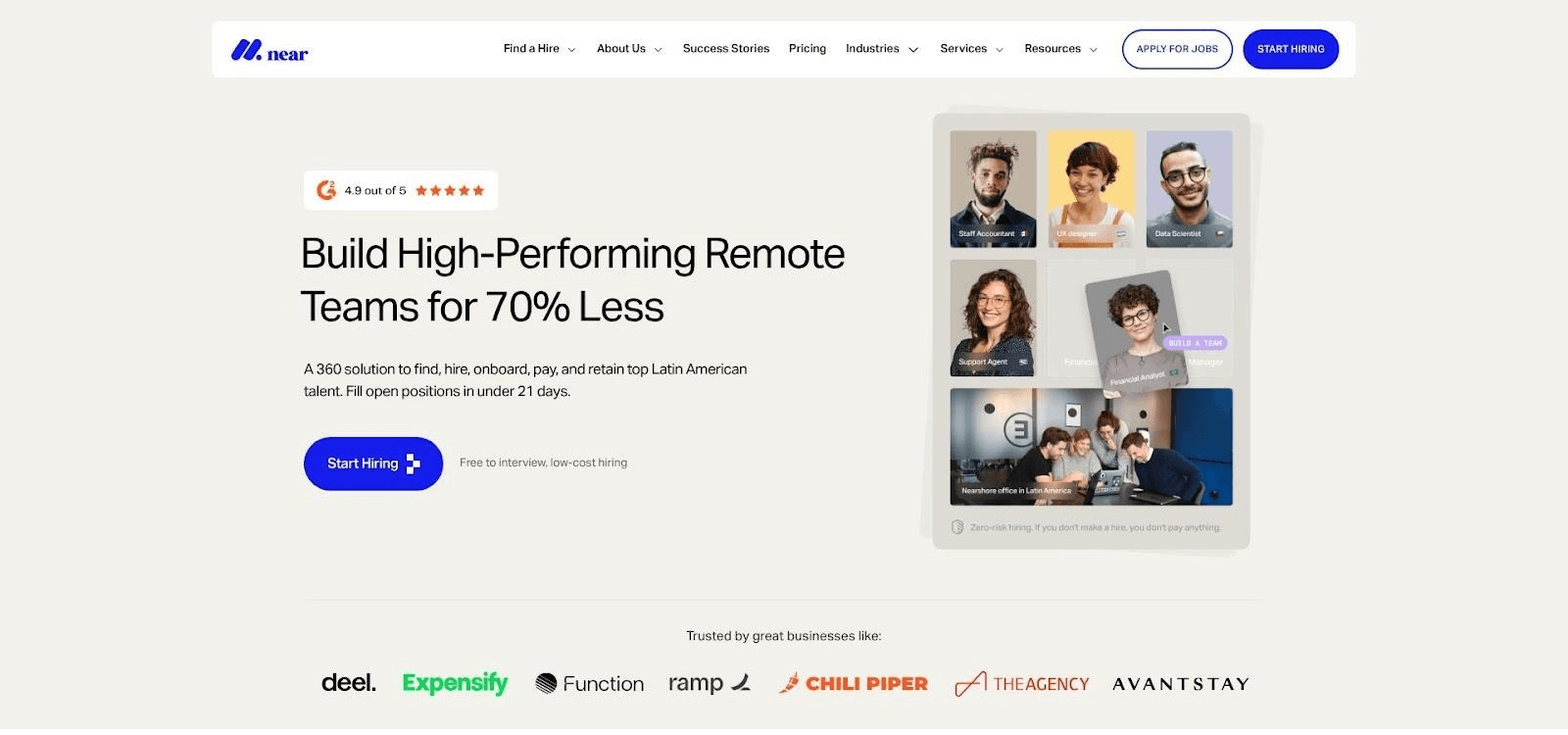
Near (HireWithNear) LatAm remote executive assistant service homepage screenshot
Near draws from a standing talent pool, so you can meet candidates within a week and start within three. Screening covers language tests, cognitive assessments, and reference calls, then you interview finalists on video. Engagements run month to month, and you may convert the EA to a direct hire later without surprise fees.
The constraint is location. If you need someone in the office to run errands or prep board materials, Near will not fit. Cultural nuances can surface, so invest time in onboarding rituals and regular video check-ins to build rapport.
Choose Near when cost savings outrank on-site presence. You will gain a dedicated EA who shares your time zone without straining payroll.
12. Persona: Dedicated subscription at startup speed
Persona sits at the far end of the vetting spectrum. Only about 0.1 per cent of applicants pass its background checks, skills tests, and behavioural interviews, so the firm starts with an elite pool. From that bench, you receive one or two candidate profiles within forty-eight hours.
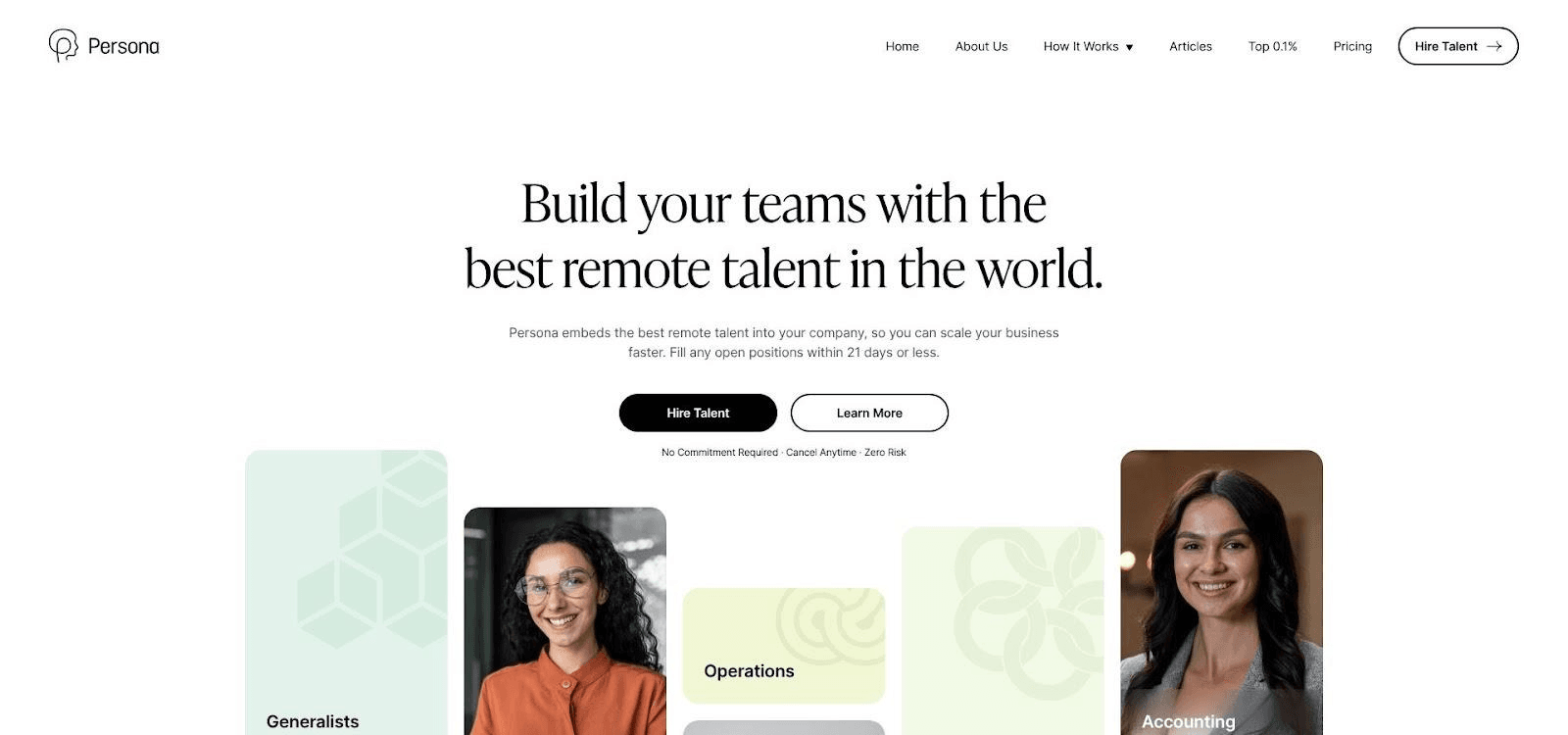
Persona Talent top 0.1 per cent executive assistant subscription service homepage screenshot
Model: flat monthly subscription of roughly $3,000 for a full-time EA who works exclusively for you. Persona hires assistants as W-2 employees and handles payroll, benefits, and equipment. You pay a single invoice and gain the flexibility to pause or cancel with thirty days' notice.
Each assistant supports just one client, so focus is undivided. If your EA is out sick, a trained backup steps in, and quarterly business reviews help you adjust scope before bottlenecks appear.
The trade-off is remote-only service. If you need on-site briefing binders or personal errands, Persona will not fit. For cloud-native teams that prize speed and depth of skill, though, it feels like an instant extension of leadership.
Choose Persona when you want enterprise-grade talent matched in days, wrapped in a subscription that scales with company milestones.
Conclusion
Hiring the right executive assistant is one of the highest-leverage decisions a C-suite leader can make. The agency you choose shapes how quickly you find talent, how well they fit your culture, and how much you pay over time. Whether you need a résumé by tomorrow from Robert Half, a fractional pro through Boldly, or a long-term career EA matched with boutique precision, the best choice starts with knowing your biggest constraint—cost, fit, or speed.
Use the comparison in this guide to narrow your options to two or three firms, then go deep on each. For leaders who treat the EA seat as a strategic role rather than a support function, working with a specialist in executive assistant staffing and recruiting ensures the shortlist reflects that ambition from the very first conversation.


Business
Tags: Building Functional Competencies, Business Management, Companies, Competence, Consultant Corner, Executing Leadership, Emerging Leadership

Ahmad Shahmir is the Founder & CEO of Backylinks and a strategic content specialist who writes SEO-driven guest posts for leading SaaS and tech sites.