8 Best Training Platforms for Professional Development That Offer Real Credentials

Photo by macrovector @ freepik
The skills gap isn’t approaching—it’s already on your doorstep. A 2024 Credly study found that 87 per cent of companies face, or will soon face, a shortage of critical skills, even as global corporate learning budgets swell to roughly $352.7 billion. We’re pouring more money into training, yet still lack proof that it sticks.
Credentials fix the measurement problem. When a course issues an employer-recognised certificate, badge, or continuing-education credit, both you and your learners walk away with portable proof of skill—not just a completed video. That evidence is why this guide exists.
This may interest you: Is a Blended Learning Platform the Future of Corporate Training?
We sifted through dozens of providers and narrowed the field to eight platforms that blend quality content, employer-recognised credentials, and enterprise-ready admin tools. You’ll meet giants like Coursera and edX, marketplace behemoths like Udemy Business, and focused specialists such as DataCamp and Pluralsight. We also spotlight GoSkills’ bite-sized, CPD-accredited courses, which make the training platform a smart pick for small and midsize teams that need results fast.
Here’s what to expect as you read:
- A quick look at how we judged each contender—no black-box rankings
- A single comparison table you can screenshot for tomorrow’s budget meeting
- Segment-by-segment breakdowns so you can jump straight to the best-fit option
- A short FAQ that answers the questions leadership will ask you next
Ready to turn that budget into verified skills? Start below.
How we chose each platform
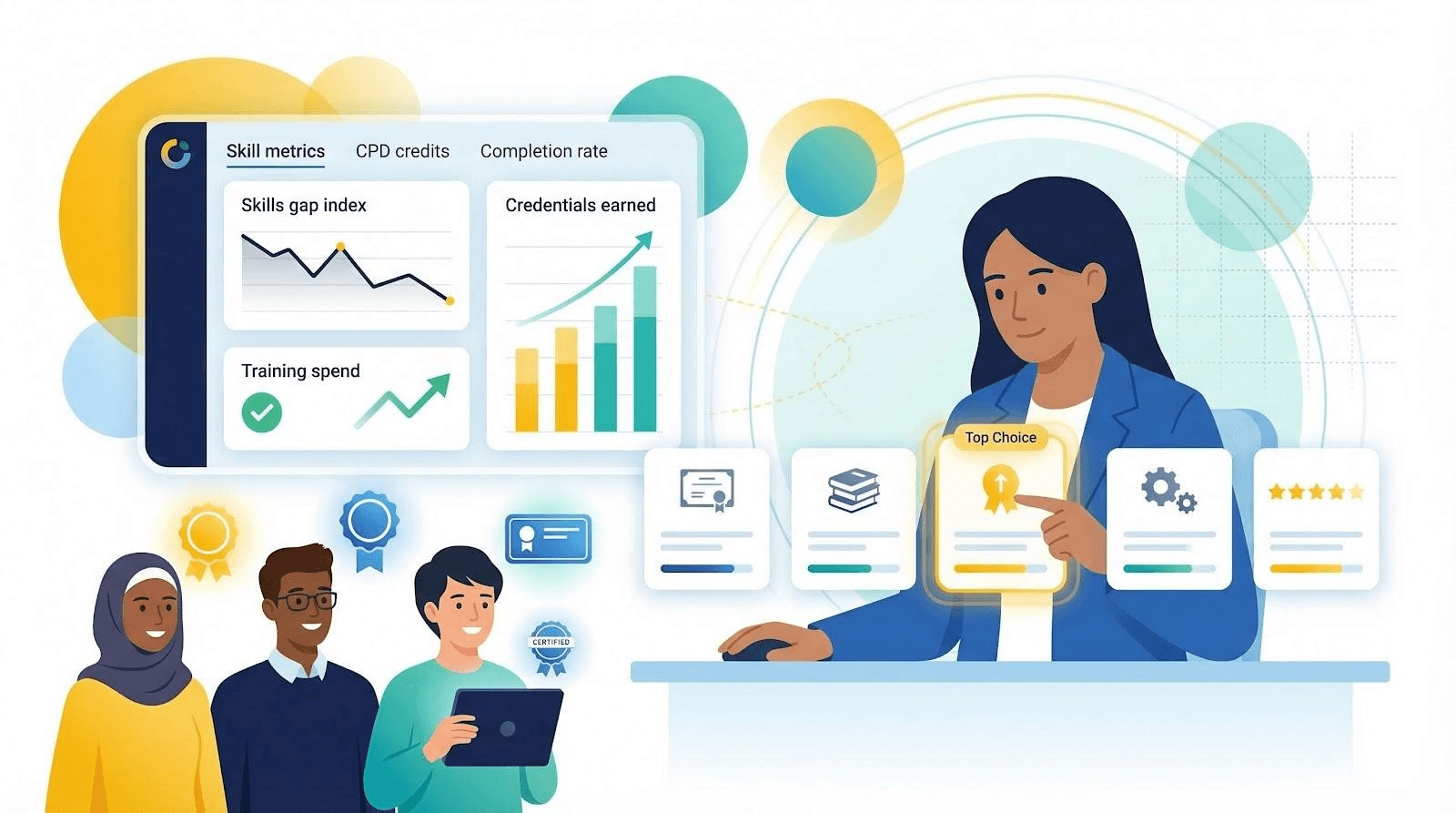
Before we recommend a single course or credential, we run every platform through the same rigorous process. That uniform approach proves our picks aren’t random or paid placements.
We started with a long list of providers surfaced by search rankings, G2 and Capterra grids, analyst reports, and community chatter in L&D circles. From there, we applied four hard filters. A platform had to:
- Issue an employer-recognised credential—certificate, badge, CEU, or CPD credit.
- Offer team-grade admin controls, including reporting, plus either SSO or SCORM/xAPI support.
- Publish transparent pricing for a Business or Enterprise tier.
- Maintain an aggregate rating of at least 4.4 out of 5 on a major review site.
Anything that missed even one criterion was out.
For the survivors, we built a scoring matrix that weights what matters most in corporate learning:
- Credential quality and legitimacy (30 per cent)
- Breadth and freshness of the course library (25 per cent)
- Enterprise readiness, including analytics, integrations, and user management (25 per cent)
- Pricing clarity and fairness (10 per cent)
- Customer satisfaction across verified reviews (10 per cent)
Credentials and course diversity carry the most weight because they decide whether learning is recognised and relevant. Features and price follow close behind, while user feedback keeps us honest.
Finally, we grouped the winners by the core problem they solve—academic degrees, marketplace variety, micro-learning for SMBs, deep tech skills, or data specialisation. That segmentation helps you jump straight to the platforms built for your exact pain point. If you want to evaluate a broader spectrum of LMS solutions, FindLM Software can assist you with detailed comparisons and user reviews.
With the criteria clear, let’s compare the contenders side by side.
Snapshot: compare the eight platforms at a glance
Here is the quick-scan reference you can drop into tomorrow’s budget deck. Review the rows to see which platform matches your team's credential type, price point, and enterprise features, then keep reading for a deeper look at each segment.
| Platform | Credential type | Library size* | Core differentiator | Team price** | Trial | Enterprise features | G2 / Capterra score |
| Coursera for Business | University-issued Professional Certificates and degrees | 10,600+ courses | Ivy-league and Big Tech partners | $399 user / year | 14 days | Skill metrics, SSO (Ent) | 4.5 / 4.5 |
| edX for Business | MicroMasters, Professional Certificates | 2,300+ courses | Credit-eligible micro-credentials | $33 user / month | Demo | SSO, LMS/LXP hooks | 4.5 / 4.8 |
| LinkedIn Learning | Certificates of Completion, some CEUs | 25,000+ courses | Personalisation via LinkedIn data | $29.99 user / month | 30 days (indiv.) | Content upload, LMS outbound | 4.4 / 4.6 |
| Udemy Business | Certificates of Completion, exam prep PDUs | 28,000–30,000 courses | Broad marketplace variety | $30 user / month | 7 days | API, SCORM via partners | 4.5 / 4.5 |
| GoSkills | CPD-certified micro-credentials | 489 courses | Bite-sized, accredited lessons | ~ $15 user / month | 7 days | SCORM/xAPI, AI authoring | 4.8 / 4.8 |
| Pluralsight | Certificates, Role IQ benchmarks | 8,500+ courses | Deep tech and cloud paths | ~ $29 user / month | 10 days | Skill IQ analytics, SSO | 4.6 / 4.6 |
| DataCamp | Course and track certificates | 400+ courses | In-browser coding labs | $14 user / month | 14 days | Live dashboards, SSO | 4.7 / 4.9 |
| FutureLearn*** | University certificates and micro-credentials | 1,400+ courses | UK-centric academic partners | Custom (teams) | Varies | SSO, community forums | 4.4 / 4.4 |
*Library size counts English-language courses available to business plans as of Q1 2026.
**Listed prices use annual billing where required. Enterprise tiers are custom unless noted.
***Listed as a niche option for EU/UK audiences; skip if you only train North American teams.
Numbers rarely tell the full story, but they help filter choices fast. If your budget tops out at around $15 per seat, GoSkills or DataCamp lead the pack. Seeking degree-level prestige? Coursera and edX should be next on your list. Keep this table handy; we will reference it as we unpack each segment.
University-grade credentials for large learners
Coursera for Business
Coursera began in Stanford classrooms and grew into a global hub for university-backed credentials. That lineage still matters because the certificates your employees earn carry the seals of Yale, Google, or Imperial College London. When the next promotion cycle arrives, those names stand out on a résumé.
The catalogue is huge: more than 10,000 courses, plus single-semester MasterTrack modules and full stackable degrees. That range lets you solve three needs at once. New hires close foundational gaps, mid-career staff pursue a Google Cybersecurity certificate, and leadership candidates start a part-time MBA, all under one agreement.
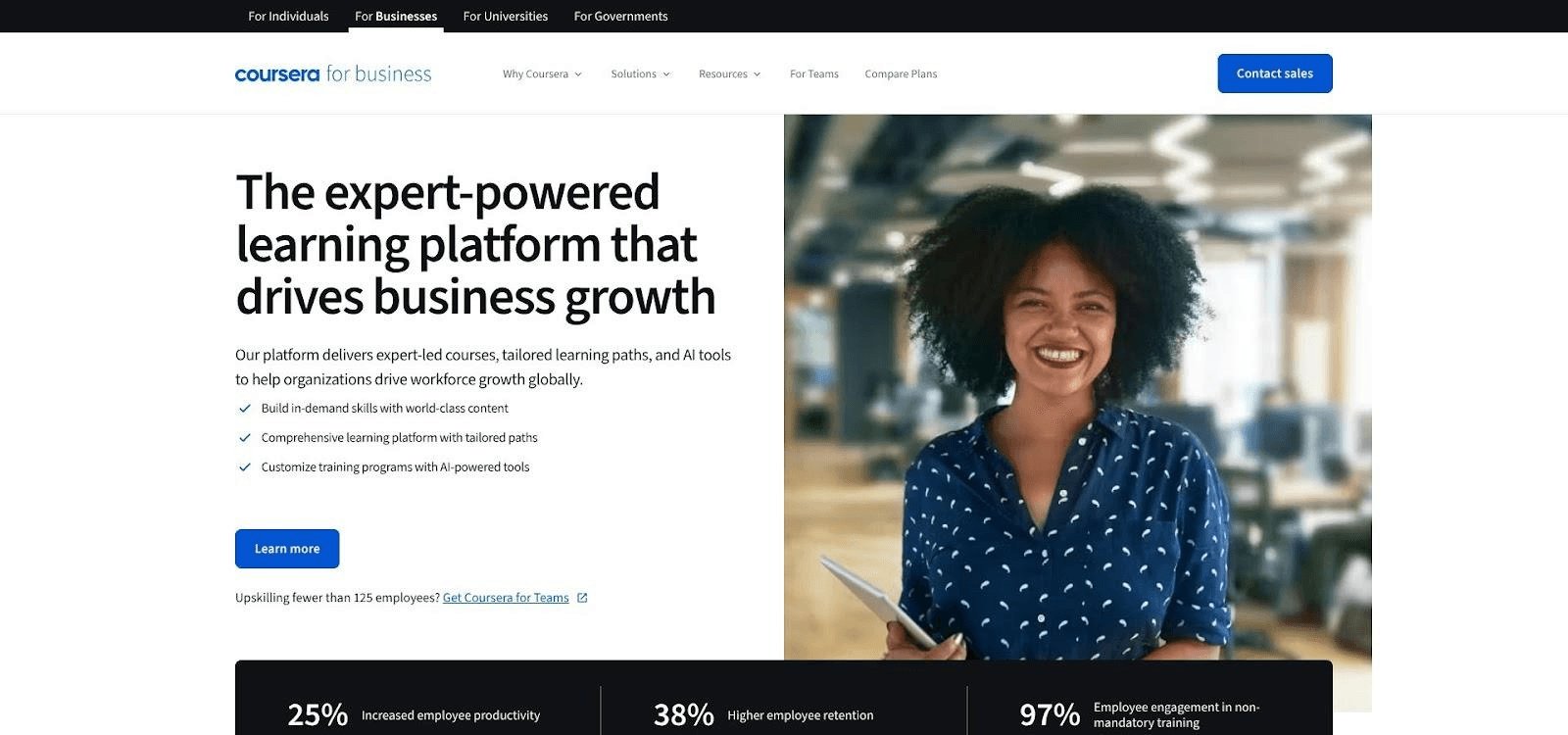
Coursera for Business enterprise learning platform screenshot
Administration is equally enterprise-ready. The Teams plan provides a dashboard with progress charts tied to Coursera’s skill taxonomy. Step up to the Enterprise tier, and you gain SSO, API connections, and the option to map Coursera skills to your competency framework. Reporting sends granular data, including completion rates, quiz scores, and time on task, directly to Power BI or Tableau, so ROI debates rely on numbers, not anecdotes.
Pricing is straightforward: $399 per user per year on the Team tier. Each learner can take as many courses as they want, including Professional Certificate tracks from Google, IBM, and Meta. A fourteen-day trial lets you test engagement before approving the spend.
Credibility is Coursera’s strongest asset. Certificates arrive co-branded with the issuing university or partner and include an employer-verifiable URL. Several Professional Certificates even convert to academic credit, which helps when tuition-assistance budgets enter the conversation.
The prestige comes with quirks. Many university courses still follow fixed schedules, so learners must meet weekly deadlines or wait for the next cohort. If your culture prefers fully self-paced learning, expect a few missed due dates. Interactive elements rarely go beyond video lectures and auto-graded quizzes; there are no live coding sandboxes here.
Bottom line: pick Coursera when brand-name credentials and degree pathways top your list. You will pay more and navigate some academic red tape, but you will also hand your workforce credentials that hiring managers recognise at a glance.
edX for Business
If Coursera is the global showroom, edX feels like the faculty lounge. Founded at MIT and Harvard, the platform focuses on academic depth over viral reach. That DNA appears in its MicroMasters and Professional Certificate programs, which bundle four to six graduate-level courses into a credential that often converts to university credit.
The catalogue is smaller than Coursera’s, about twenty-three hundred business-eligible courses, but you trade volume for structure. Each academy group's courses are organised into themed stacks, such as Digital Leadership or Supply Chain Management, so learners see a staircase rather than a maze. This guided approach benefits busy professionals who want direction, not just access.
edX Teams costs $33 per user per month, billed annually. The price unlocks every course plus eight curated academies. For example, a finance analyst can start an MIT-backed FinTech certificate without upgrading later. For organisations that track tuition assistance, the credit pathways streamline reimbursement paperwork.
Administration is straightforward. Managers assign courses, build learning paths, and export progress reports in a few clicks. Enterprise customers add SSO and connect completions to HRIS or LXP dashboards. The data is less granular than Coursera’s skill metrics, but it still shows engagement and completion rates in the next review.
edX excels in rigour. University partners design the assessments, so quizzes feel like graduate problem sets rather than pop trivia. Learners can choose a verified track and submit an ID for proctored exams, which are mandatory in regulated industries that treat CEUs as compliance records.
A few quirks deserve mention. Video quality ranges from studio polish to webcam lectures. The platform also offers less soft-skill content than marketplace giants. While most courses are self-paced, some MicroMasters cohorts still follow set start dates, which can clash with rolling enrolment policies.
Choose edX when you need credit-worthy depth without committing to full degrees. It serves employers who value university legitimacy but prefer a more guided, modular path than Coursera’s broad buffet.
Marketplace variety for ongoing upskilling
LinkedIn Learning
LinkedIn Learning sits at the intersection of professional networking and just-in-time education. Every action on the platform—searching a course, taking a skills quiz, sharing a certificate—feeds data back into your LinkedIn profile. That feedback loop makes discovery feel almost automatic. Change your headline to “Project Coordinator,” and a playlist on Gantt charts and stakeholder communication appears before your coffee cools.
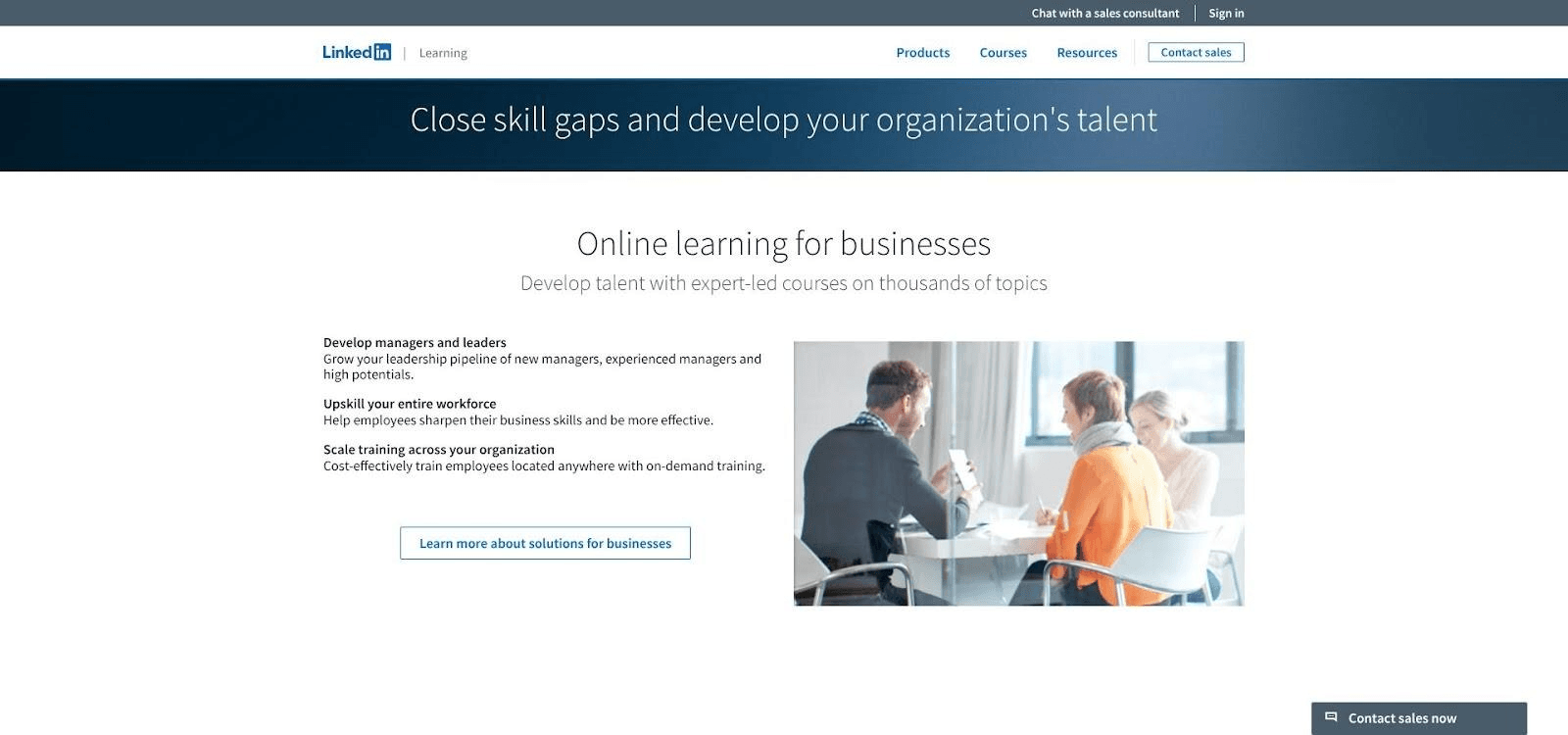
LinkedIn Learning business learning solutions screenshot
The catalogue is large: roughly twenty-five thousand courses in seven languages. Unlike academic MOOCs, these lessons focus on workplace tasks. Most videos run under five minutes, and many close with practice files you can open in Excel or Figma the same day.
Teams pricing is $29.90 per user per month, billed annually. The rate includes CEU credit for select courses and shareable certificates that post to each learner’s profile. Few perks motivate participation like a public badge that recruiters can view.
Administration feels lightweight. Invite users, assign learning paths, and watch adoption dashboards refresh in real time. If you authenticate with Azure or Okta, single sign-on is a tick-box away. Companies with their own LMS can push completion data downstream, so nobody double-tracks progress.
Quality varies because instructors range from Fortune 500 executives to passionate hobbyists. The rating system surfaces top material quickly, and LinkedIn retires underperforming content each quarter.
Choose LinkedIn Learning when you need breadth, constant freshness, and social proof in one licence. It suits sales, marketing, and knowledge-worker teams who already live on the platform, and HR leaders eager to track skill growth without new analytics tools.
Udemy Business
If LinkedIn Learning is a curated bookstore, Udemy Business feels like a warehouse club. The Team plan provides access to 28,000 courses (30,000 on Enterprise) covering topics from Kubernetes to watercolour painting. That sprawl can seem chaotic, yet it is exactly why many companies subscribe. When a niche request appears—say, “Power BI for Non-profits in Spanish”—Udemy usually has a match.
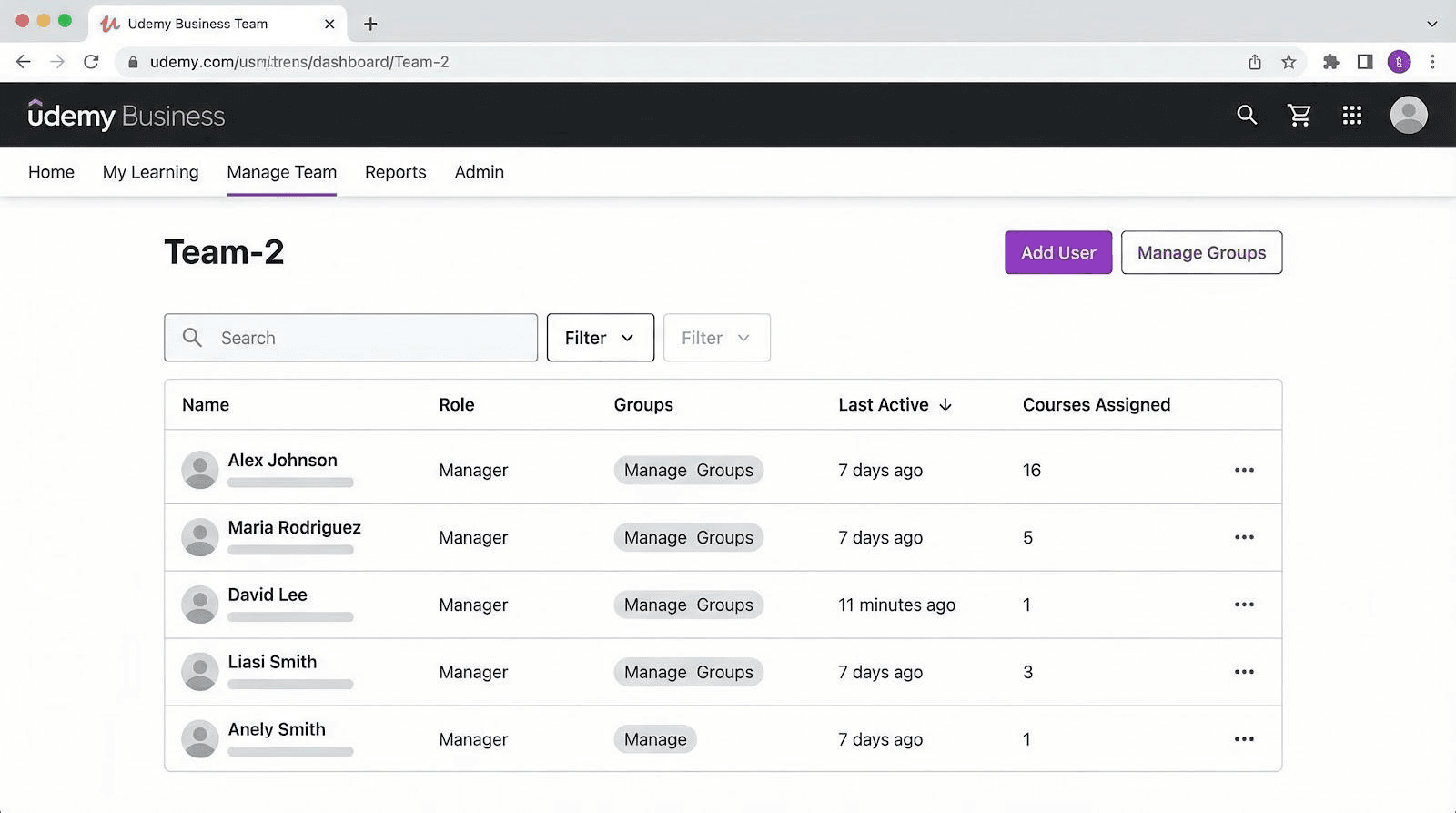
Udemy Business Team Plan online learning screenshot
The price is simple: $30 per user per month, billed annually, with a 7-day trial for engagement testing. The cost mirrors LinkedIn Learning, but Udemy offsets it with sheer choice and monthly library updates through its instructor marketplace.
Variety brings uneven quality, so Udemy curates the top 1 per cent of consumer courses for business plans. Each candidate must meet standards for instructor rating, production value, and learner reviews. The result removes shaky screen recordings and highlights polished content from certified pros.
A standout feature is certification prep. More than two hundred courses map to industry exams—AWS, PMP, Scrum, Salesforce—and include practice tests that mimic the real thing. For teams chasing billable credentials, that alone can justify the licence.
Admin controls include role-based dashboards, goal tracking, and API connections that send completions to your HRIS or learning record store. Enterprise clients add single sign-on and a customer success manager who analyses adoption data.
Interactive elements continue to improve. Some courses now ship with AI code labs and scenario-based role plays, although these tools sit outside the core video player. If your culture values hands-on labs over lecture, flag that gap during your pilot.
Select Udemy Business when speed and breadth outrank academic polish. It fits high-growth firms where new tech lands in the stack each quarter and self-directed learners thrive on choice. Budget an hour for a team lead to build playlists; with this much content, careful curation is a skill of its own.
GoSkills – bite-sized, CPD-certified courses for busy teams
GoSkills proves you do not need a massive library to drive measurable upskilling. Beyond its micro-course catalogue, the GoSkills training platform doubles as a lightweight LMS; most admins import users, assign paths, and start seeing progress in under an hour. That quick setup keeps small L&D teams focused on coaching rather than configuring software.
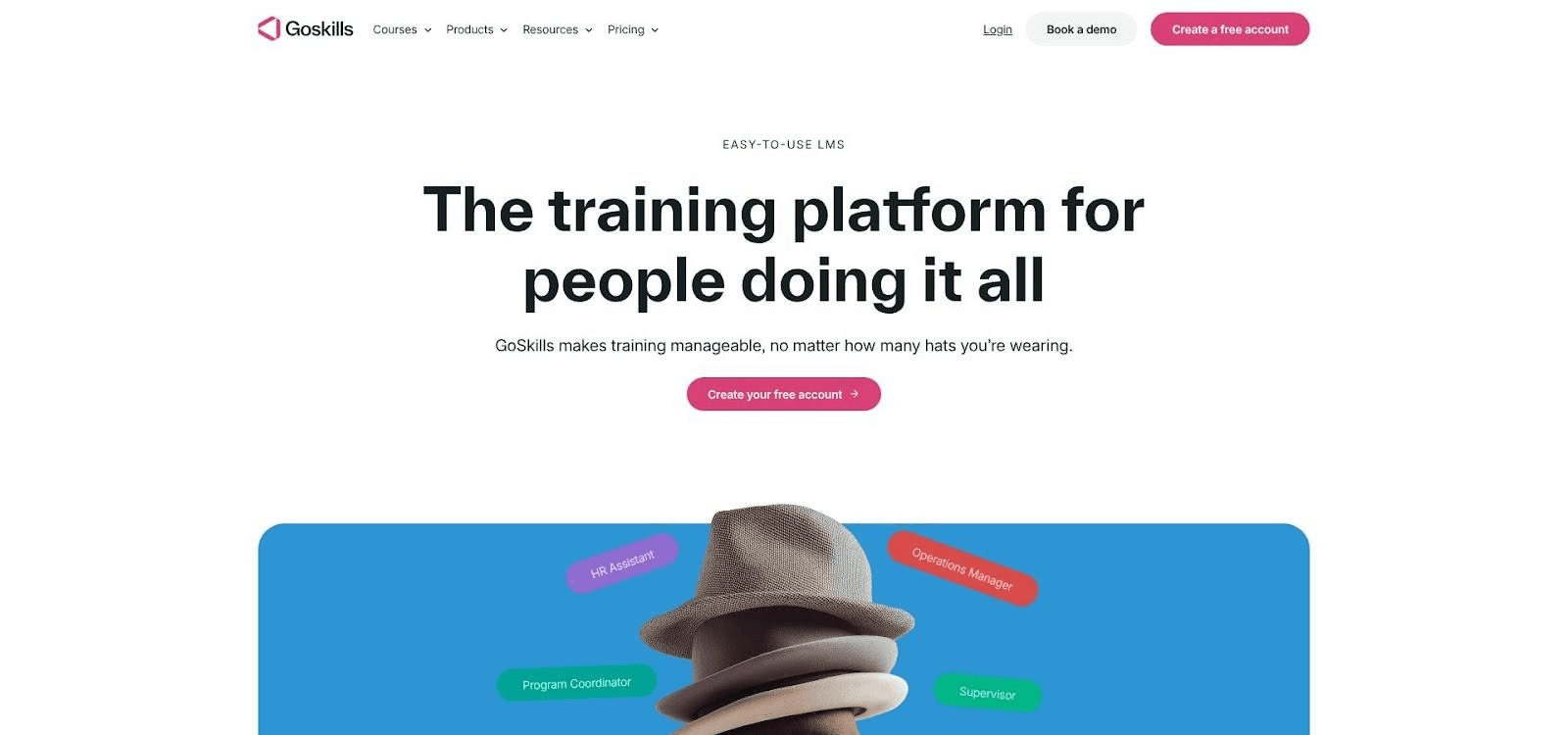
GoSkills employee training software dashboard screenshot
Instead, it focuses on quality over quantity—about five hundred micro-courses, each broken into three- to seven-minute lessons that fit between meetings. Every course carries the UK CPD Service stamp, so completions translate into continuing-professional-development credits your compliance officer can track without extra paperwork.
Pricing is straightforward. The Business “Courses” plan is about $15 per user per month with annual billing and includes the full catalogue plus analytics. Move to LMS Pro—roughly ten dollars more—and you can upload SCORM or xAPI files, create custom lessons with GoSkills’ AI authoring tool, and brand the learner portal to match your intranet.
Micro-learning only works if learners return. GoSkills encourages repeat visits through adaptive paths based on quiz results, light gamification points, and instant certificates upon passing the final quiz. Progress always feels bite-sized and doable, which keeps adoption high.
Admins use a single dashboard that blends surface metrics—logins, time spent—with actionable details, such as question-level accuracy and skill-gap heat maps. Slice data by team, role, or location, then export a clean CSV to HR. Single sign-on integrates with Azure, Okta, and Google Workspace in minutes.
The catalogue shines in business essentials: Excel, project management, finance basics, and soft skills like conflict resolution. Subject-matter experts film every course, and each lesson ends with a micro-quiz to reinforce recall. If you crave bleeding-edge tech such as Quantum Python, look elsewhere, but for core productivity and leadership skills, GoSkills covers ninety per cent of what SMBs need.
The main drawback is scope. Five hundred courses feel generous until you compare them with marketplace giants, yet the limit doubles as a filter. You spend less time vetting questionable content and more time assigning paths that align with quarterly goals.
Choose GoSkills when your team ranges from 10 to 500 employees, budgets are tight, and you want accredited learning that your people can complete before the next calendar reminder pops up. It is the classic small-but-mighty option that moves new skills into play fast.
Deep tech and data specialisation
Pluralsight
Pluralsight is the platform engineers turn to for rapid skill growth. Its catalogue holds about 8,500 courses focused on software development, cloud, security, and data. You will not find watercolour classes here, and that clarity appeals to CTOs who would rather skip unrelated topics.
The standout feature is Role IQ. Learners take a timed assessment that places them on a skill graph—think “Java developer, level 3.” The system then prescribes a learning path that closes the biggest gaps first. Managers see the delta on a dashboard, so skills conversations shift from gut feel to numbers that fit in a board packet.
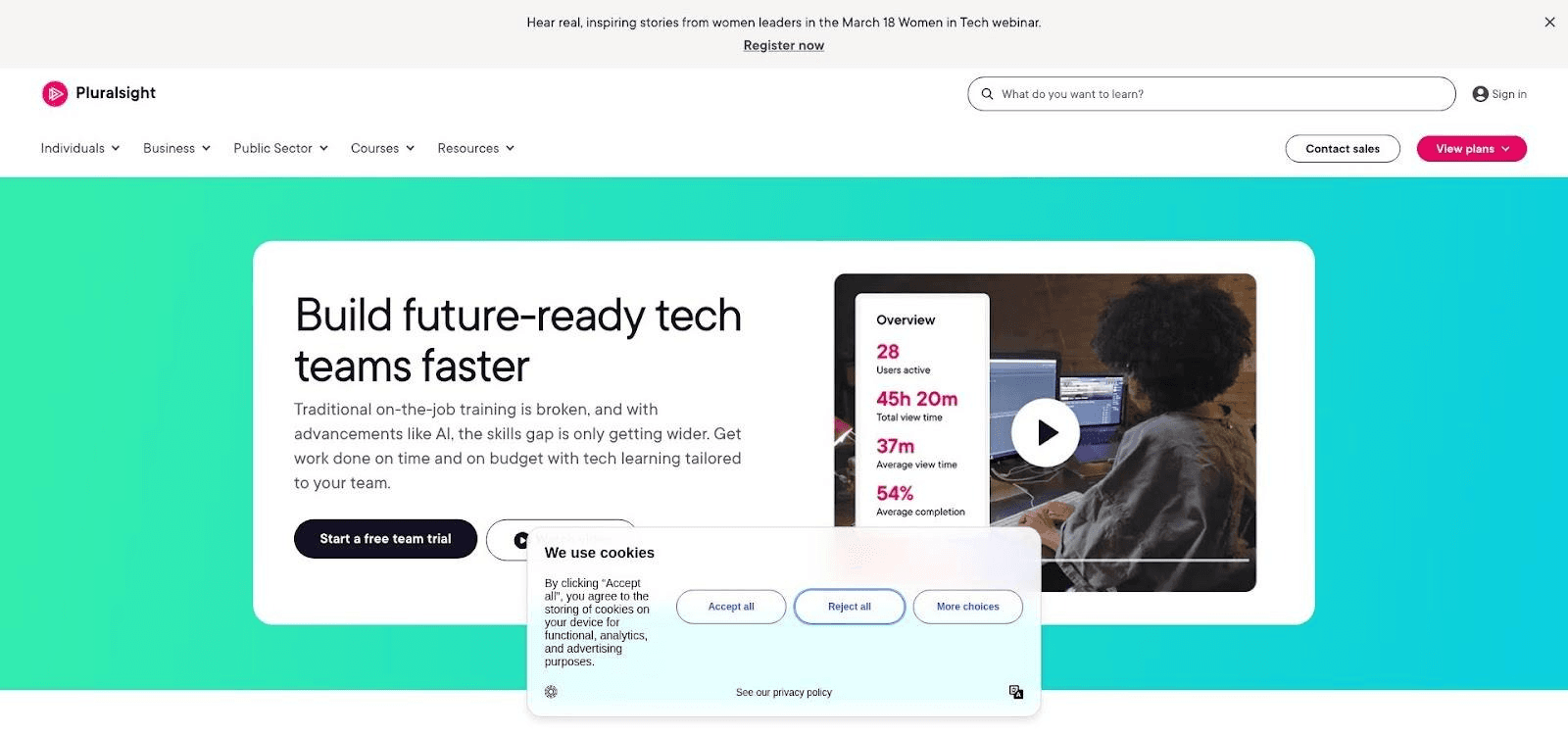
Pluralsight tech skills and Role IQ dashboard screenshot
Pricing ranges from $29 to $33 per user per month, depending on contract size, with a 10-day trial. The licence includes interactive code sandboxes, exercise files, and certification prep for AWS, Azure, CompTIA, and Cisco exams. Employees tend to use the platform both as a daily reference and as a study buddy before an exam.
Administration is enterprise-ready. Single sign-on works with every major identity provider, and SCORM connectors surface Pluralsight courses inside an existing LMS. Analytics track both completion and Skill IQ delta, so you see whether knowledge is rising rather than just hours watched.
Scope is the trade-off. Business soft skills are sparse, and creative suites like Adobe receive minimal coverage. Video length can stretch past fifty minutes, so plan checkpoints to maintain momentum.
Choose Pluralsight when code quality, cloud migrations, or security posture are top priorities for your talent risks. The focus is narrow but deep, which often outweighs the smaller catalogue.
DataCamp
DataCamp narrows its lens even further, zeroing in on data literacy from spreadsheet basics to deep learning pipelines. The hook is instant practice. Every lesson opens beside an in-browser console, so learners run Python, R, or SQL as they watch. No local setup, no version conflicts—just a green check mark with each correct snippet.
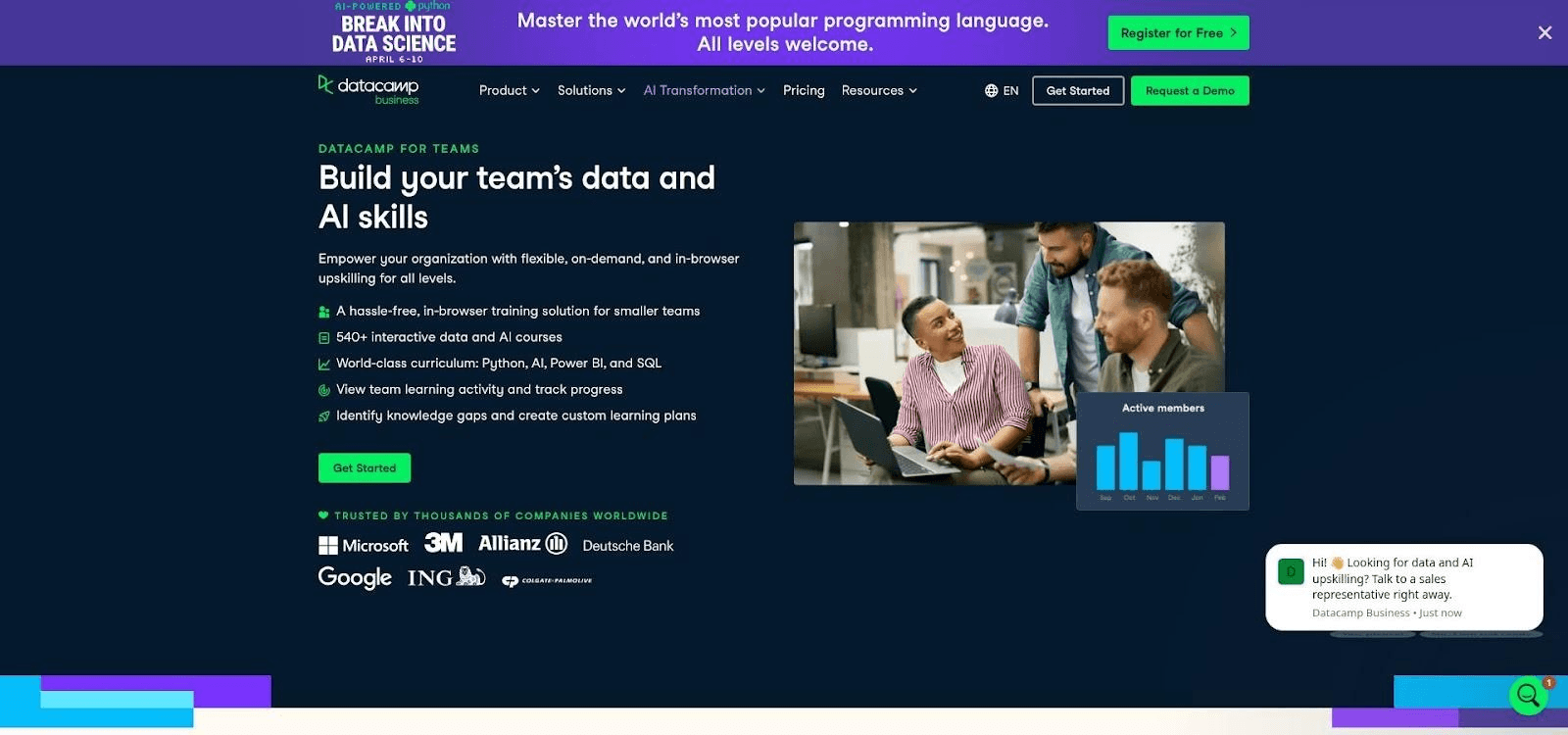
DataCamp for Teams in-browser coding workspace screenshot
The catalogue lists roughly four hundred courses plus career tracks that string lessons into multi-month journeys. Each track ends with a capstone project drawn from real datasets, such as bike-share trips or supermarket sales, demonstrating that learners can wrangle messy data, not just recall syntax.
Teams pricing is fourteen dollars per user per month, billed annually. That undercuts every other platform on the list except GoSkills while still covering interactive workspaces, graded projects, and the new DataLab sandbox, where users explore their own CSVs with AI guidance.
Admin life is simple. A dashboard shows completion, time in the IDE, and skill assessments. Single sign-on connects to Okta or Azure in minutes, and you can export usage data to Snowflake or BigQuery for deeper analysis—fitting for a tool that preaches data culture.
The limitation is scope. You will buy additional content for project management or presentation skills. Some advanced machine learning theory trails Coursera’s university courses, though DataCamp remains strong on practical application.
Pick DataCamp when your goal is to raise the organisation’s data IQ without straining the budget.
FutureLearn – European-flavoured micro-credentials and degree pathways
FutureLearn rewards global teams, especially those operating across the UK and EU. Co-founded by The Open University, the platform curates university-led short courses, micro-credentials, and online degrees. The experience feels like a digital extension of campus life: discussion forums stay active, faculty drop into threads, and peer reviews count toward grades.
The catalogue tops one thousand four hundred courses, modest on paper, yet each aligns to a recognised academic outcome. Many management and healthcare courses grant Continuing Professional Development credits, while longer micro-credentials offer European Credit Transfer and Accumulation System points you can carry into a master’s program.
Pricing is flexible. Individuals pay about $350 per year for Unlimited access; organisations negotiate custom rates based on headcount and credential mix. Cohort-based courses open on set dates, and weekly milestones nudge learners into forum debates where a Monash lecturer or IBM product manager weighs in. The social layer boosts completion rates but demands calendar discipline.
Admin features cover enrolment, progress dashboards, and single sign-on through SAML. Integrations with Moodle and Blackboard reflect FutureLearn’s higher-ed roots. Reporting blends completion data with qualitative metrics such as forum engagement—helpful for L&D teams tracking collaboration and reflective practice.
Limitations mirror strengths. Content skews European, so compliance examples cite the GDPR rather than the CCPA. You will also supplement with other platforms for cutting-edge tech or creative suites. Yet for companies with EMEA staff who value academic recognition, FutureLearn fills a gap left open by the US-centric giants.
Select FutureLearn when you need EU-approved credentials, rich peer discussion, and a clear path from short course to postgraduate certificate.
FAQ: quick answers for stakeholders
What is the difference between an online training platform and a traditional LMS?
Think of an LMS as the filing cabinet: it stores content, tracks completions, and produces reports. A training platform layers a ready-made course library, credential engine, and discovery tools on top of that core. In short, an LMS asks you to bring the content; a platform brings the content to you.
Which providers issue credentials that employers actually recognise?
All eight on our shortlist do. Coursera and edX lean on university seals, GoSkills offers UK-backed CPD credits, while LinkedIn Learning, Udemy, Pluralsight, and DataCamp supply shareable certificates and, in many cases, exam-prep PDUs or CEUs that industry bodies accept.
How do I pick the right platform for my organisation?
Match the tool to the job. Need brand-name prestige? Coursera or edX. Want breadth and constant freshness? LinkedIn Learning or Udemy. Looking for bite-sized, accredited business skills on a budget? GoSkills. Deep tech or data fluency? Pluralsight and DataCamp have you covered. Use our comparison table to weigh credentials, price, and integrations against your current pain points.
Is corporate training worth the spend?
Yes, when you can prove it. Studies show companies that invest in credential-backed learning see higher retention and faster time-to-productivity. Every platform here provides analytics dashboards, so that you can link completions to promotion rates, project velocity, or certification passes.
Are there free options?
Free trials abound, and GoSkills even offers a Basic tier with limited lessons. Just remember: truly free rarely equals credentialed, so budget for seats if you need proof of skill.
Still have an unanswered question? Add it to your pilot survey—the data you collect will outshine any generic advice online.
Read more: Professional Development And Why It Is Essential
Conclusion and next steps
We covered a wide range of options, from Ivy League certificates to bite-sized quizzes your team can finish before lunch. The theme that ties every platform together is proof: evidence that learning occurred, skills improved, and money was well spent.
So where do you steer the ship now?
- Clarify the finish line. Decide whether you need career-making credentials, rapid upskilling, or deep technical mastery. That single choice narrows the shortlist to two or three contenders.
- Pilot with purpose. Launch a 30-day trial and invite a focused mix of learners. Set clear goals: one credential earned, one exam passed, and track progress daily.
- Measure what matters. Feed completion data into the same dashboards you use for turnover, promotion, or project velocity. When the learning line rises alongside those KPIs, you have permission to scale.
- Plan the rhythm. Credentials fade if they sit untouched. Schedule quarterly skill audits, refresh learning paths, and celebrate every badge or certificate in Slack or at all-hands meetings. Recognition fuels adoption.
This guide helps you match platform strengths to real-world limits such as budget, time, and the persistent skills gap. Use it, adapt it, and broadcast each success. When your next hire ramps faster or a veteran developer lands a cloud cert in half the usual time, you will have proof that speaks louder than any sales deck.
Now, pick your pilot and let the learning compound.


Functional
Tags: Abundance Mindset, Alignment & Clarity, Be A Leader, Brain Bulletin, Building Functional Competencies, Business Management, Communication, Competence, Consultant Corner, Crucible Moments, Growth, Growth Mindset, Executing Leadership

Ahmad Shahmir is the Founder & CEO of Backylinks and a strategic content specialist who writes SEO-driven guest posts for leading SaaS and tech sites.