7 Best Retained CMO Search Firms & Marketing Executive Recruiters in 2026

Photo by freepik @ Magnific
There's a reason boardrooms are fixated on the CMO seat this year. Fortune 500 chief marketers last only 4.3 years on average—shorter than any other C-suite peer—so every mis-hire resets growth plans. To reduce that risk, CEOs and CHROs are turning to retained search partners who stress-test strategy fit, cultural chemistry, and future-proof skills.
In this guide, we rank seven firms—global powerhouses and boutique specialists—using verified metrics such as days to fill, retention rates, diversity performance, and documented client outcomes. If you need Silicon Valley-calibre talent, keep an eye on SPMB, the executive search firm many founders quietly trust. Let’s turn the revolving CMO seat into a long-term growth engine.
How we scored and ranked each search partner
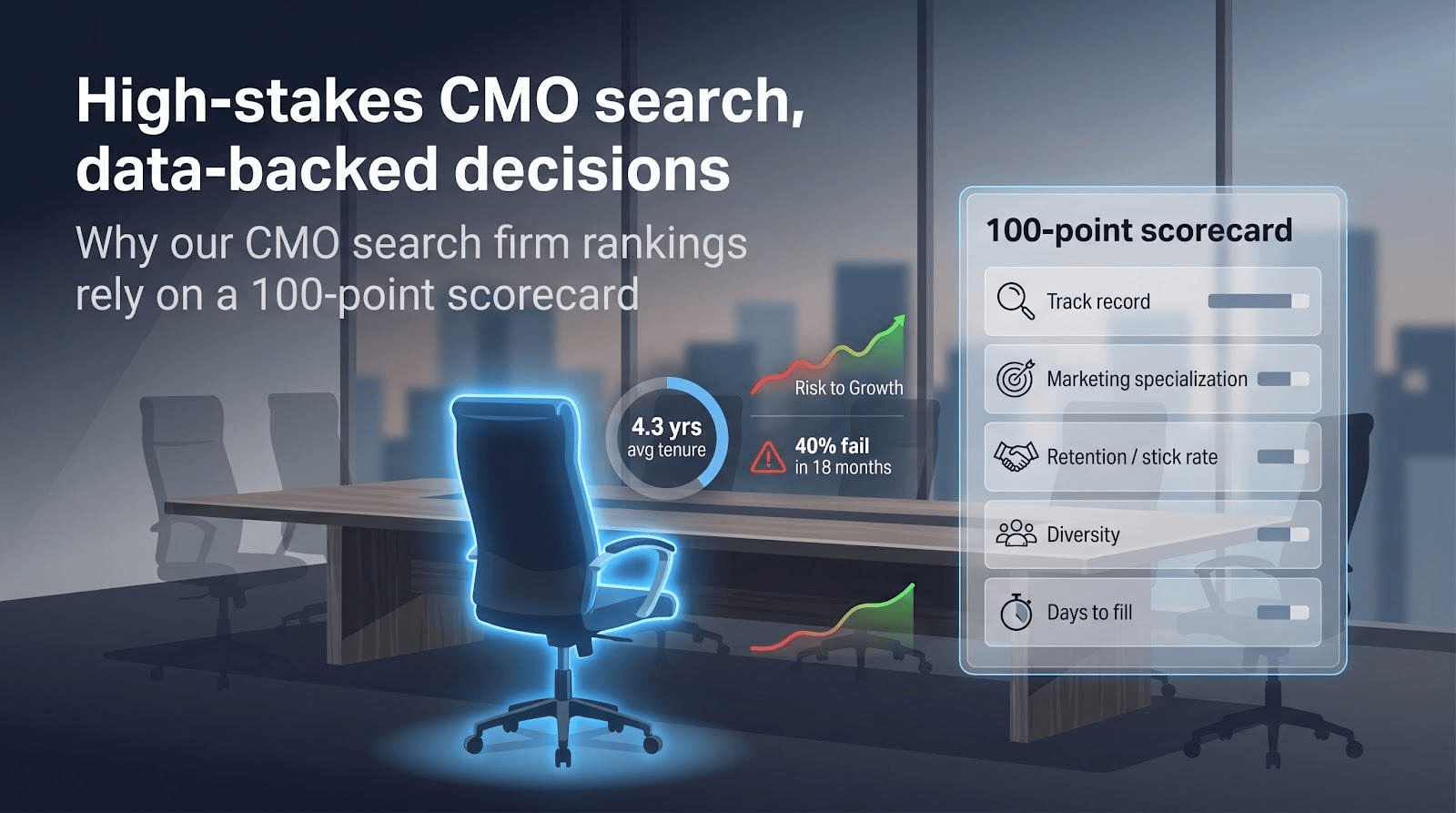
Before we spotlight the firms, you deserve to know exactly how we chose them. A list is only as strong as its criteria.
We built a 100-point scorecard based on what CEOs and CHROs say they value most when a CMO seat opens. Two factors carry the heaviest weight: a verified track record of successful CMO placements and deep specialisation in marketing leadership. According to Spencer Stuart’s 2025 CMO Tenure Study, nearly 40 per cent of new CMOs fail within 18 months, so pedigree and focus come first.
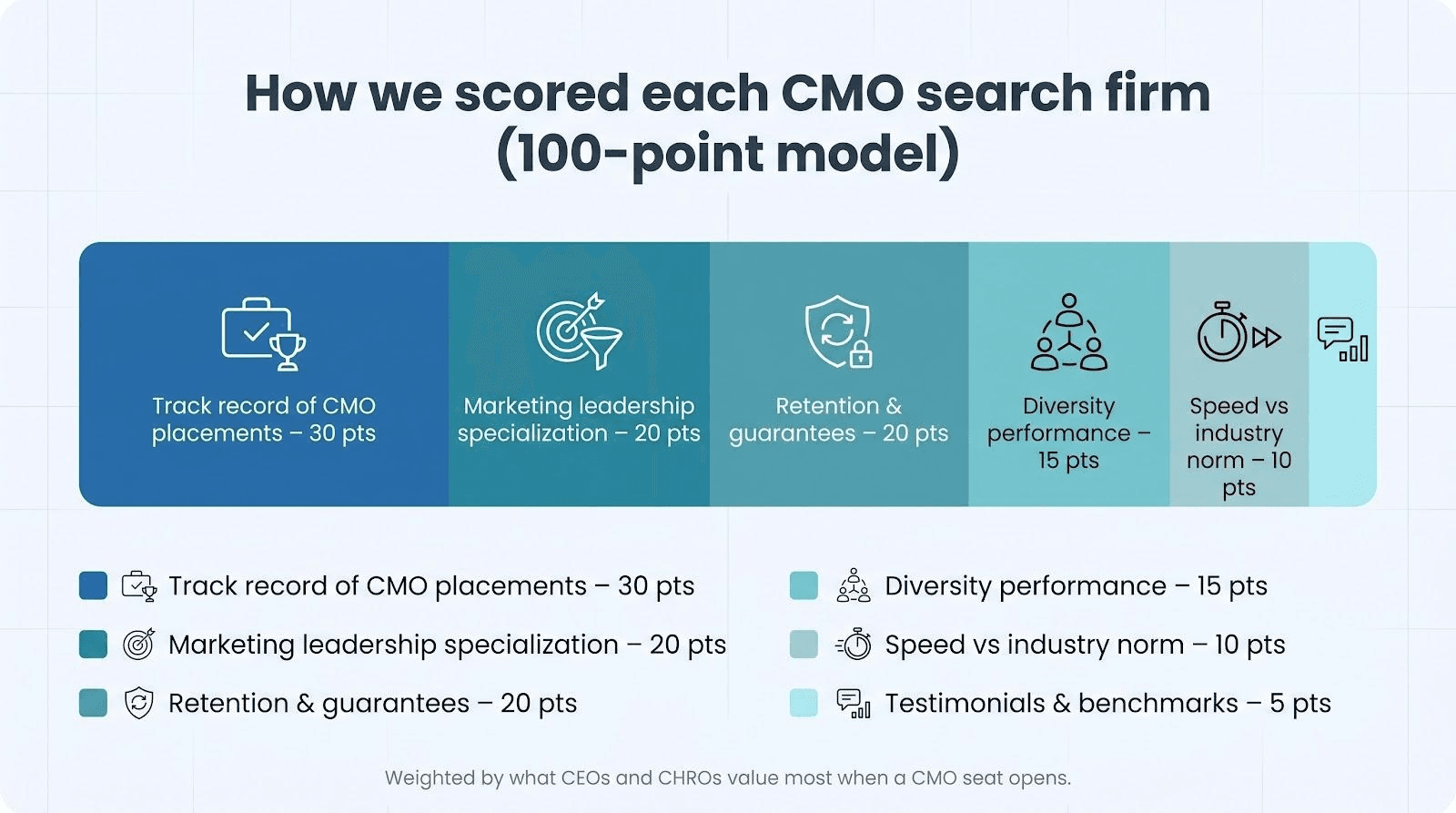
Beyond those pillars, we measured placement quality. We gathered every retention or “stick” metric we could confirm, along with the length of any replacement guarantees. Diversity performance counted too. After two consecutive years of declining representation at the top of marketing, firms that consistently present balanced slates received extra credit.
Speed came next. We compared each firm’s average days to fill against the industry norm of three to four months. Faster isn’t always better, but a partner with an engaged network should not need a full quarter to present a shortlist.
Finally, we reviewed public client testimonials, case studies, and third-party benchmarks. For instance, Talentfoot’s 2026 rankings disclose its complete scoring table and a 95/100 composite rating, proof that transparent data exists and that we expect it.
All seven firms met every bar, but their composite scores set them apart. In the sections that follow, you’ll see where each one excels, where it lags, and why the order makes sense for companies pursuing sustainable growth.
1. SPMB: the tech world’s go-to for transformational CMOs
SPMB executive search homepage screenshot for transformational CMOs
Walk into any Bay Area boardroom, mention SPMB, and you’ll see heads nod. SPMB’s own site frames its “sweet spot” as the intersection of innovation and scale—one more reason decision-makers rank the firm as a top executive search firm. Founded in 1977 and still partner-owned in the San Francisco Bay Area, SPMB has spent four decades matching growth-hungry tech companies with executives who move markets, not just metrics.
What sets them apart is focus. While most large firms juggle every C-suite role, SPMB concentrates on marketing and growth leadership, such as CMO, chief growth officer, and chief product officer. That niche ensures your search never competes with a Fortune 50 CFO mandate in another vertical. The team’s network of modern marketers is warmed up, reference-checked, and ready to talk.
Speed follows focus. Clients often receive an initial shortlist in six weeks and a signed offer within ten, compared with the 90-day industry norm reported by the Association of Executive Search Consultants.
Quality doesn’t slip. SPMB tracks placement “stick” rates closely; partners note that most of their CMO hires are still in seat when the companies either IPO or exit. A one-year replacement guarantee rarely comes into play.
Service feels boutique, yet capacity feels enterprise-class. A senior partner leads every engagement, supported by a 40-person research bench that maps talent across SaaS, fintech, health-tech, and climate tech daily. If your ideal candidate is growing revenue at a private tech firm in Austin or steering a brand at a lab in Zurich, SPMB likely knows them.
Who should call SPMB? Founders seeking their first enterprise-ready CMO. Public tech companies are pivoting from product-led roots to global brand scale. Private-equity operators who need a demand-gen expert now but refuse to compromise on cultural fit later.
Bottom line: if your next marketing chief must deliver Silicon Valley speed and Wall Street scale, SPMB belongs on your shortlist before you draft the job spec.
2. Spencer Stuart: global scale with brand-builder DNA
Spencer Stuart sits at the top tier of executive search, but size doesn’t create distance. When Fortune 100 brands face a high-profile CMO exit, this is the firm they call.
Why? Reach. More than sixty offices feed the Marketing Officer Practice a steady stream of talent data from every major market. If you need a CMO who has launched a category-defining product in Shanghai and guided a Super Bowl spot in the same career, the candidate is probably already in their files.
Depth matters too. The firm has tracked CMO tenure for nearly two decades, dissecting why some leaders thrive while others flame out. That research mindset shapes every search. Partners open with pointed questions about board pressure, P&L control, and data-stack maturity. They aren’t fishing; they’re calibrating fit so you avoid another churn cycle.
The process feels like enterprise-grade diligence. Candidates complete competency interviews, psychometric assessments, and multi-angle referencing before you see a résumé. Yet timelines remain reasonable; 12–16 weeks to signature is common according to Spencer Stuart’s 2025 Marketing Officer Practice report.
Spencer Stuart also shows leadership in diversity. A majority of its recent CMO placements have been women, and every slate includes qualified underrepresented talent, as noted in the firm’s 2024 Board Diversity Index. In an era of heightened stakeholder scrutiny, that proactive stance removes friction before it starts.
Choose Spencer Stuart when the brand stake is measured in billions and failure is not an option. The fee is higher, but so is the cost of a mis-hire on the global stage.
3. Talentfoot: boutique specialists who speak fluent marketing
If a recruiter has never sat through an end-of-quarter funnel review, can they truly judge a CMO? Talentfoot thinks not, and their model proves the point.
Every search is led by former marketing operators who traded campaign KPIs for candidate slates. That empathy shows in the brief: conversations dive into attribution models, MarTech stacks, and the craft of brand storytelling long before compensation enters the chat.
The payoff is speed without shortcuts. According to Talentfoot’s 2026 performance report, the firm averages five weeks to place a CMO, well under the industry norm. Clients receive weekly pipeline snapshots and scorecards that map each candidate’s skills to the role spec. This rigour earned the firm a 95/100 composite score in an independent marketing-search benchmark.
Breadth is not sacrificed for focus. From direct-to-consumer start-ups to legacy B2B manufacturers in digital transformation, Talentfoot has placed leaders who pivot entire go-to-market engines. Diversity is intentional: more than half of its 2024 CMO placements were women, and multichannel sourcing keeps underrepresented talent in the mix.
Engagement feels collaborative, almost agency-like. Expect Slack threads with live candidate feedback and real-time intel on compensation bands. By the time you pick finalists, you will also understand peer hiring trends and the channels likely to absorb next year’s budget.
Call Talentfoot when you want a partner who already knows the difference between ROAS and ROMI and why your next marketing chief must master both.
4. MarketPro: marketers recruiting marketers, fast
MarketPro began as an Atlanta startup in the late nineties. Today, it is the largest woman-owned executive search firm devoted solely to marketing talent, and speed is its hallmark.
Because every recruiter once carried a revenue target or brand P&L, intake calls go straight to the real issues. Industries, personas, funnel math, and even media-mix quirks all translate clearly, trimming weeks from the search.
Timelines prove it. MarketPro averages 10–12 weeks from kickoff to signed offer for permanent CMOs, and interim leaders often start in fewer than 30 days.
Clients span higher education, logistics, and blue-chip finance, showing that the process travels well beyond its B2C roots. Diversity results stand out, too: as a certified woman-owned business, MarketPro delivers balanced slates that help boards meet DEI goals.
Engagements feel transparent. Expect weekly emails that list active candidate counts, interview status, and reasons for pass decisions. If momentum stalls, you see it immediately and adjust together.
Call MarketPro when you need a CMO quickly but refuse to sacrifice fit. The team will keep jargon in check and the calendar on track.
5. Christian & Timbers: operator-focused search for high-growth tech
Christian & Timbers, relaunched by veteran headhunter Jeff Christian, follows a simple rule: place leaders who have already scaled something hard. That operator bias shapes every CMO search they run in SaaS, AI, cybersecurity, and deep-tech markets.
Engagement starts with a working session that feels more like a product-strategy sprint than a recruiting brief. The team dissects revenue motion, PLG maturity, and pipeline velocity to pinpoint which levers a new CMO must pull in year one. Those insights become a scorecard that screens candidates for proof, such as moving ARR from 10 million to 100 million dollars, not vague brand “uplift.”
Speed stays solid at eight to twelve weeks, supported by a curated bench of go-to-market executives who have weathered hyper-growth. Yet rigour never slips. Finalists complete scenario interviews, psychometric testing, and deep back-channel referencing with past CEOs and board members. Cultural fit is pattern-matched evidence, not a vibe.
C&T also advises on compensation, equity, and onboarding. That support matters in founder-led settings where handing the microphone to a seasoned marketer can feel risky. Partners stay close through the CMO’s first 100 days, smoothing integration with sales and product to protect the hire’s runway.
Choose Christian & Timbers when your tech company is sprinting toward an IPO or strategic exit, and you need a CMO who has already run that exact race, preferably twice.
6. True Search: data-driven talent engine for VC and PE portfolios
True Search data-driven executive search platform screenshot
True Search emerged inside venture and private-equity ecosystems, where hiring cycles move at sprint speed. That urgency inspired the firm to build a tech stack that feels closer to Salesforce than a traditional Rolodex.
Its proprietary intelligence platform tracks millions of career moves, funding rounds, and board changes. When a sponsor approves a CMO upgrade, True can instantly filter for leaders who have grown customer acquisition at similar rates, in matching ACV bands, and within the same burn limits.
The result is fast. According to the firm’s 2025 portfolio report, most clients receive finalist slates in four to six weeks, even for niche specs such as “B2B fintech CMO with LATAM and DACH launch experience.” Speed never compromises diligence; every candidate’s operating metrics are benchmarked against functional peers before you schedule a call.
Global reach is real. Offices from Philadelphia to Singapore share one database, so cross-border searches do not stall while regions “check coverage.” This matters as more North American scale-ups look to hire EMEA or APAC demand generation leaders.
Diversity is measured, not promised. True’s analytics dashboard flags slate composition in real time, and partners are held to targets that align with limited-partner expectations. It appears on their quarterly scorecard, not just in marketing copy.
Engagement feels modern. You receive Slack threads, live dashboards, and a shared Q&A document that captures every assumption, keeping the leadership team aligned. If your culture prizes async, data-rich collaboration, True will feel native.
Call True Search when you want fast hiring powered by clean data, especially if investors watch the timeline as closely as the term sheet.
7. Korn Ferry: big-data assessments for enterprise-grade hires
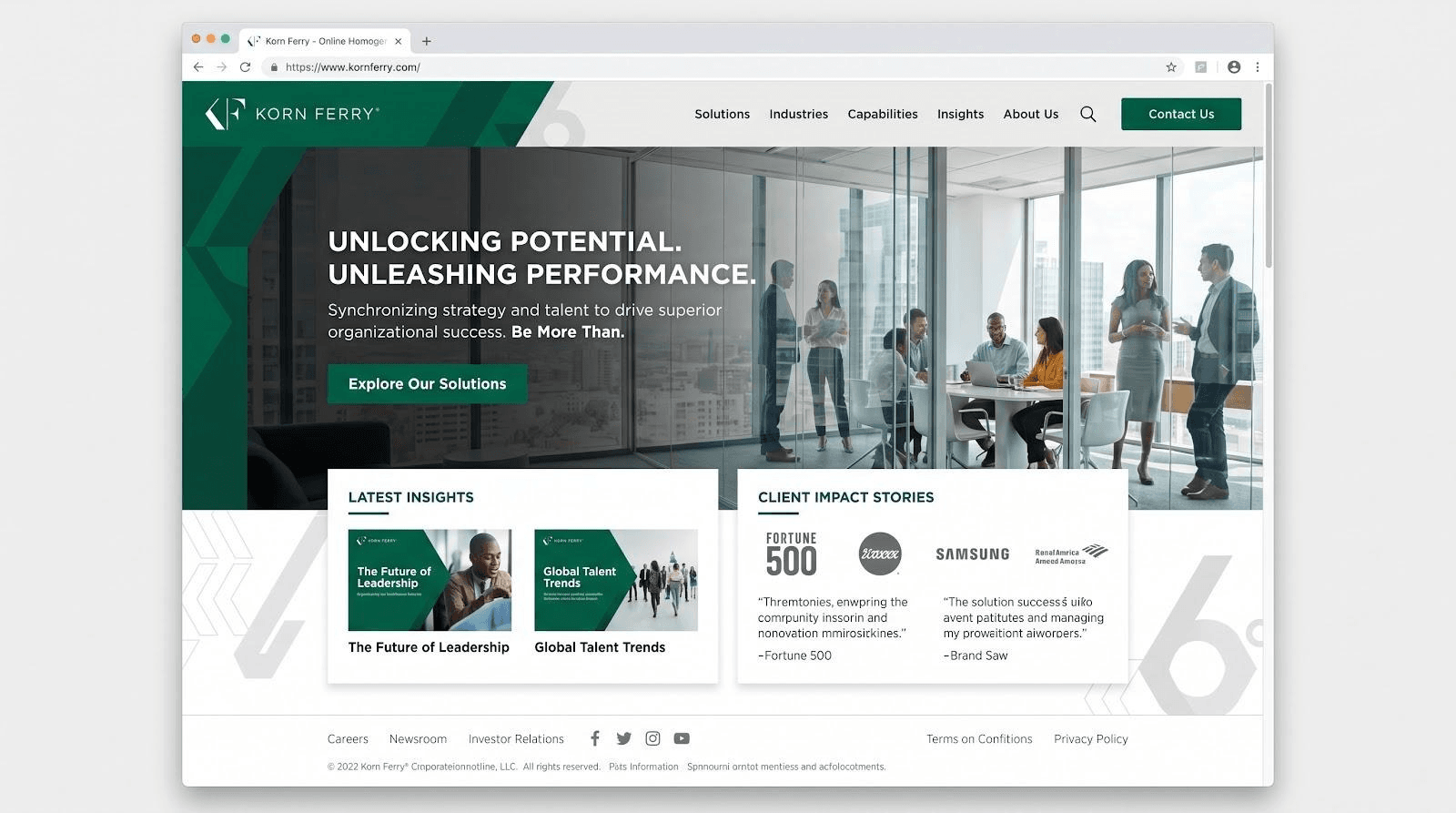
Korn Ferry global executive search and assessment homepage screenshot
Korn Ferry is the only publicly traded search firm on this list and, by revenue, the largest worldwide. Size is not the full story; the firm’s edge is a leadership database built over five decades.
That repository tracks competencies, career paths, and compensation for millions of executives. When your brief arrives, Korn Ferry benchmarks the role against thousands of similar profiles to calibrate skills, behaviours, and pay. You receive a market-tested success profile before the first candidate call.
Process rigour follows. Finalists complete Korn Ferry’s proprietary psychometric and situational-judgment assessments, and the results tie back to performance data from earlier placements, giving boards evidence that a leader’s style fits the culture.
Global reach is extensive. Need a CMO for a Dubai-based conglomerate or a Latin American e-commerce scale-up? Local partners tap the same assessment platform, streamlining cross-border alignment and visa logistics.
Speed remains healthy for a firm of this scale. According to Korn Ferry’s 2025 Talent Acquisition Survey, most CMO searches close in about twelve weeks because worldwide research teams work in parallel. Flexibility stands out, too. While the classic retained fee is about 30 per cent of first-year cash, Korn Ferry can bundle compensation benchmarking, onboarding coaching, and leadership-team diagnostics into one statement of work.
Choose Korn Ferry when the CMO brief is complex, multinational, and politically sensitive. If you want a data-validated shortlist that can withstand any boardroom review, their process delivers.
How to choose the right CMO search partner
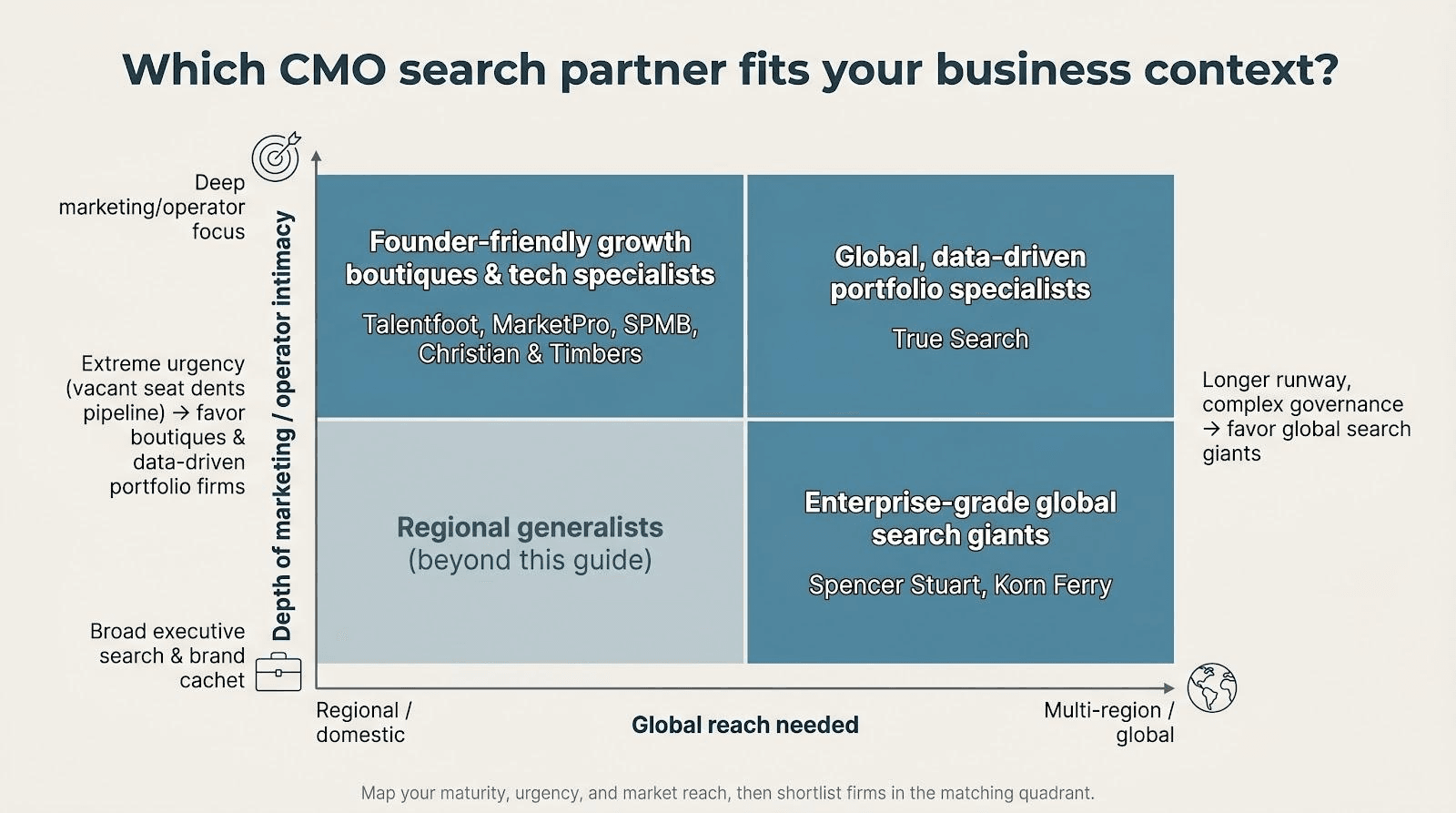
1. Anchor the search to your business context.
Start with an honest look at where your company sits on the growth curve. A Fortune 500 brand defending global share faces a different reality than a Series C startup chasing product-market fit.
If you are enterprise-scale, process depth and worldwide reach matter more than raw speed. Global giants like Spencer Stuart or Korn Ferry already know CMOs who have managed multi-billion-dollar P&Ls, navigated regional compliance, and answered to demanding boards. Their assessments target governance and stakeholder management, skills your next marketing chief needs on day one.
Scale-ups move at a different tempo. Every week of vacancy dents pipeline velocity, so founder-friendly boutiques such as Talentfoot or MarketPro make sense. They arrive fluent in growth-marketing acronyms, not just interview frameworks, and deliver a shortlist before the next sprint review.
Map those realities—maturity, urgency, and market reach—before you contact any firm. Doing so keeps the conversation focused on outcomes rather than slide decks and helps you pick partners built for the road you are on.
2. Weigh global muscle against boutique intimacy.
Big names carry real cachet. A Spencer Stuart introduction email gets opened quickly, and their research teams can surface an Asia-Pacific brand leader that a regional boutique might never meet. Yet global scale can dilute focus if your search needs gritty operator DNA or narrow-industry nuance.
Boutiques flip that equation. Talentfoot’s partners already know the difference between TikTok UGC and programmatic OTT because they managed those channels themselves. That insider lens tightens briefs and speeds vetting, yet a boutique will be candid if your role requires a cross-continental slate beyond its reach.
Ask each firm directly: who leads my search, how many assignments do they juggle, and where do they draw the off-limits line? A clear answer shows whether their bench depth—or their single-minded attention—best serves your goal.
Supplementary reading: Why Recruitment is Broken and How Trust Can Fix It
3. Probe the diversity record, then verify it.
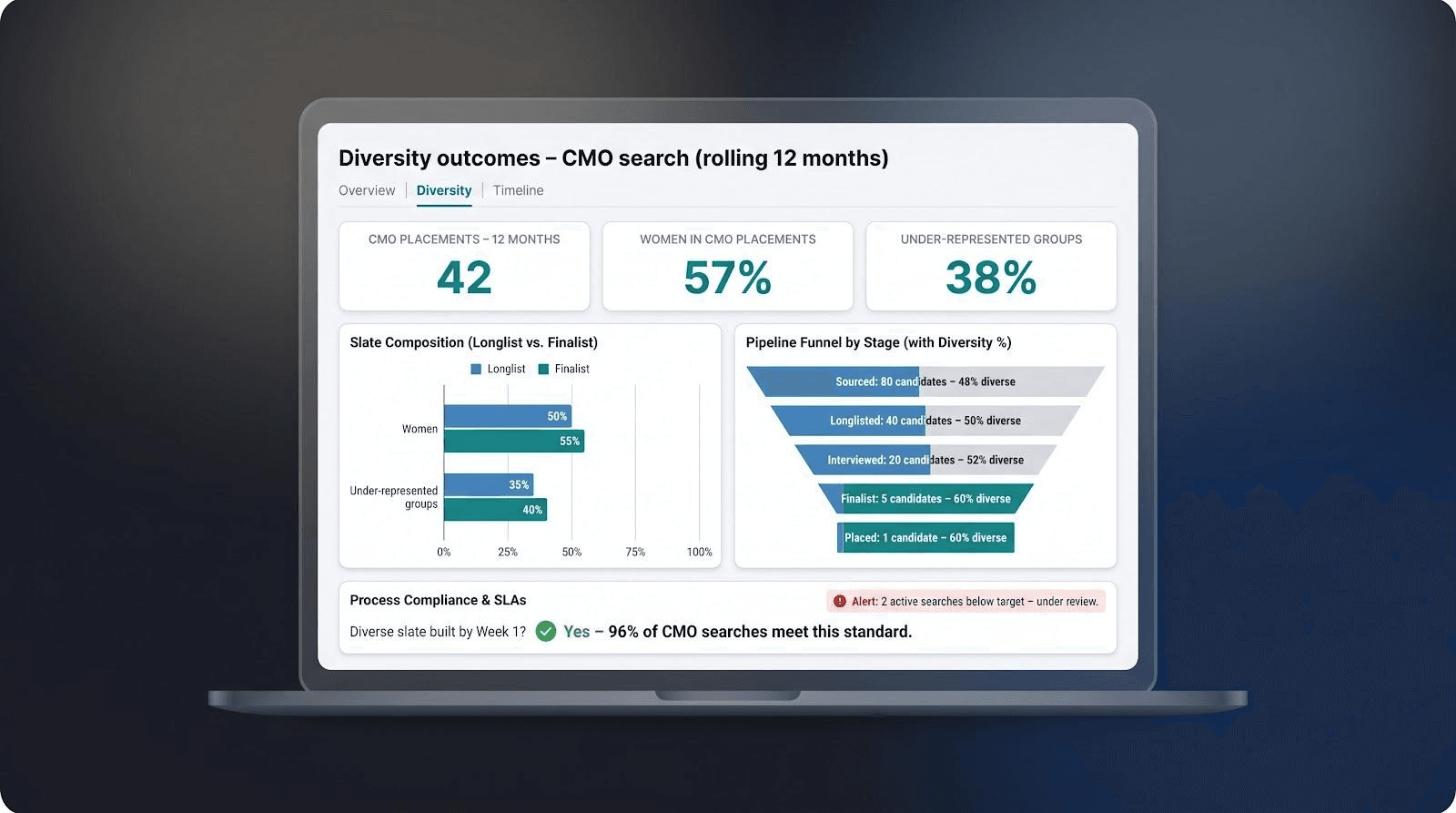
Boards no longer accept vague pledges about inclusive hiring. Request hard numbers: what percentage of last year’s CMO placements were women or leaders from underrepresented groups? How many diverse candidates reached the finalist stage, not just the longlist?
Effective partners respond within seconds and support claims with data or published reports. Spencer Stuart and Korn Ferry share those metrics publicly; boutiques like Talentfoot provide internal dashboards on request. If a firm dodges specifics, expect similar opacity once the search starts.
Examine the process as well. Do they build diverse slates up front or add them after reminders? Firms that embed diversity sourcing in week one—True Search tracks slate mix in real time—outperform teams that “circle back” later. Push for that discipline; it will save cycles and demonstrate your commitment to every candidate you meet.
4. Clarify fees, guarantees, and off-limits early.
Most retained firms charge about thirty per cent of first-year cash, payable in thirds. That is standard. What varies is what you receive in return. Ask whether the fee also covers assessment tools, onboarding coaching, or a compensation benchmark study. Korn Ferry often bundles those extras; boutiques usually separate them to keep the retainer lean.
Guarantees differ, too. Twelve months is best practice for a CMO. MarketPro’s ninety-day window is honest but short, so confirm that it matches your risk tolerance. Put in writing what triggers a free redo and who pays the candidate's travel on the second round.
Finally, review the off-limits list. When a firm places your CMO, it typically agrees not to recruit from you for one to two years. Global giants work with hundreds of companies, which can shrink candidate pools. Obtain that list before you sign; spotting a conflict now is far better than learning mid-search that your top competitor is unavailable.
Closing thoughts: turn the CMO search from risk to growth catalyst
A vacant or mis-hired CMO stalls momentum, but the right search partner turns that risk into a competitive advantage. You now know which firms excel at global brand orchestration, rapid tech growth, data-driven vetting, and interim coverage.
Use this guide as a calibration tool. Revisit your strategy, timeline, and diversity goals, then shortlist two firms whose strengths align with those needs. Schedule exploratory calls, request metrics, and listen for questions that show they understand your market reality.
Choose the partner that earns your confidence, then share financial targets, cultural nuances, and past hiring lessons. The more context you provide, the sharper and faster the search will run.
One decisive hire later, you will replace search briefings with growth dashboards and wonder why you waited to bring the experts in.


Business
Tags: Alignment & Clarity, Brain Bulletin, Building Functional Competencies, Business Management, Competence, HR, Consultant Corner, Companies, Character

Ahmad Shahmir is the Founder & CEO of Backylinks and a strategic content specialist who writes SEO-driven guest posts for leading SaaS and tech sites.