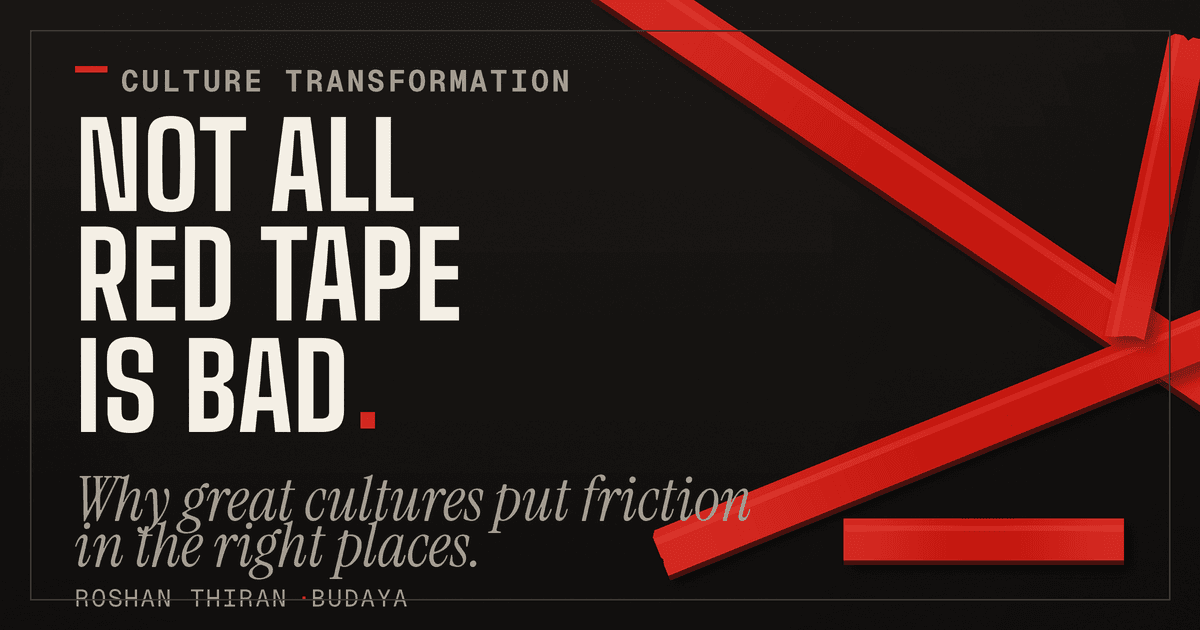
Not All Red Tape Is Bad
There is a video of me wrapped head to toe in bright red tape, straining to lift a single cup of coffee to my mouth. I grunt. I strain. The cup spills everywhere. And then I look at the camera and sigh. People laugh at it, because it is absurd. But the reason I made it is not funny at all. That sigh is the sound millions of capable people make every single working day. Not because they are lazy or disengaged, but because the organisation around them has quietly tied their hands. Good idea, three approvals. Simple request, four meetings. A form nobody reads, signed by a manager who is just covering himself. By the time you are finally allowed to move, the energy is gone. The obvious lesson from that video is "kill the bureaucracy." It is also the wrong lesson. Or at least, only half of it.
The lesson I learned standing on an oil platform
Early in my career, before Leaderonomics, before GE, I worked in operations at ExxonMobil. If there is one place on earth that runs on red tape, it is an oil and gas facility. You cannot touch a valve without a permit. You cannot isolate a pipe without a lockout and a second set of eyes. There are checklists for the checklists.
To an outsider, it looks like bureaucracy gone mad. It is not. It is the opposite. That "red tape" is the reason people go home alive. Skip the permit to work, skip the lockout-tagout, and someone dies. In that world, friction is not the enemy. Friction is the safeguard.
That experience rewired how I think about culture. The problem in most organisations is not that they have too much friction or too little. It is that they have friction in exactly the wrong places. They make it agonisingly slow to do the things that should be fast, and dangerously easy to do the things that should be slow.
You need four signatures to buy a fifty ringgit chair, but a junior team can ship a half tested product to thousands of customers with almost no review. You spend a week justifying a training budget, but a toxic manager gets promoted in an afternoon. The tape is everywhere. It is just wrapped around the wrong limbs. So the real question is not "how do we remove red tape." It is "where do we want speed, and where do we want care, and have we designed for both on purpose."
Friction is a design choice, and most of us never make it
Behavioural scientists have a useful pair of words. A nudge is design that makes the right thing easier. Sludge, a term popularised by Cass Sunstein, is design that makes things needlessly harder: the cancellation process buried in seven clicks, the reimbursement form that takes longer than the expense itself. Most corporate red tape is sludge that no one intended and no one owns.
But friction also has a noble use. Jeff Bezos built much of Amazon's early speed on a single distinction: one way doors and two way doors. A two way door is a reversible decision. Walk through, and if you do not like it, walk back. Those should be fast, delegated, low friction. A one way door is hard or impossible to reverse. Those deserve to be slow, deliberate, high friction. The mistake great companies avoid is treating every decision like a one way door, which is precisely the disease that produces the man wrapped in tape.
Atul Gawande made the same point in medicine and aviation with the humble checklist. A surgical checklist adds friction on purpose, at the exact moment when a tired human is most likely to skip a step that matters. Good friction, placed well, saves lives.
Put it together and you get a simple, almost uncomfortable truth. Bureaucracy is not the problem. Unintentional design is the problem. When you do not deliberately decide where friction belongs, you inherit it by default, and default systems almost always pile friction onto everyday work while leaving the genuinely risky decisions wide open.
The cost of getting this wrong is not abstract. Gary Hamel and Michele Zanini, surveying more than 7,000 people, found the average employee loses 28 percent of their time, more than a full day every week, to bureaucratic chores: reports, approvals, sign offs, meetings about meetings. They estimate that excess bureaucracy drains over three trillion dollars a year from the United States economy alone in lost output. That is the price of red tape that no one chose and no one audits.
Culture transformation, the Budaya way
This is the work we do at Budaya, and it begins with a sentence that tends to make leaders sit up: most organisations do not have a culture problem, they have a design problem. Culture is not a poster or a values statement. It is an adaptive system, sustained through reinforcement loops. Experiences shape beliefs, beliefs drive behaviour, repeated behaviour hardens into rituals and systems, and those systems produce your results. Change the experiences and the systems, and behaviour follows. Send another motivational email, and nothing moves.
Designing friction well, removing it where it strangles and adding it where it protects, is not a one off purge. It runs through three phases.
Phase one is Baseline. You cannot redesign friction you have never honestly measured. So before we touch anything, we find out where the tape actually is and what it is doing. We run Voice of the Employee listening sessions to hear where energy leaks out of the day. We hold a leadership culture debrief to understand where culture is being shaped, and where leaders want it to go. And we run a culture baseline assessment, powered by Happily.ai, that surfaces engagement and sentiment, psychological safety, workload signals, and the team by team hotspots and cold spots. The output is not a glossy report. It is a clear map of which friction is helping performance and which is quietly killing it.
Phase two is Design and Implement. This is where insight becomes action, and where the friction gets rebalanced on purpose. In ritual design workshops, leaders and teams co-create the future culture instead of having it dictated to them, taking the specific hotspots from baselining and rebuilding the daily habits around them. We operationalise each value through four deliberate steps: defining the behavioural anchors that say what is acceptable and what is not, building the daily, weekly and monthly rituals that make those behaviours routine, embedding them into the hard systems where culture actually lives (decision frameworks, hiring criteria, performance reviews, meeting structures, recognition), and protecting them under pressure, for the moments when targets tempt people to cut corners.
That last point is where intentional friction earns its keep. Removing red tape from everyday work is the easy, popular half. The harder half is adding friction precisely where urgency tempts shortcuts: the safety step, the ethical line, the irreversible decision. We also level up managers to be culture multipliers rather than bottlenecks, and we pilot the redesigned rituals through influential Lighthouse Teams, so success creates the social proof that makes change spread on its own rather than by mandate.
Phase three is Sustain. Most culture efforts fade into a campaign. This one becomes an operating system. A recognition and reinforcement loop rewards the right behaviours in real time, so people feel the new norms in everyday work. Culture scorecards and KPIs fold specific behaviours into leadership performance reviews, so the standard has teeth. And Happily.ai acts as a culture acceleration layer, tracking habit adoption, leadership consistency, and the early sentiment shifts that show up before engagement formally drops, so leaders can intervene while it is still cheap to fix.
The thread running through all three phases is the same one from the oil platform. You are not chasing a frictionless organisation. You are building a well designed one, fast where speed compounds trust and creativity, deliberately slow where care protects people, money, reputation and lives.
What you can do on Monday
You do not need a transformation programme to start thinking this way. You need a question. Walk through your week and sort your processes into two piles. Where does friction protect something that genuinely matters, and where is it just sludge that survives because no one ever asked why it exists.
Then go further. Look at your fastest decisions and your slowest ones, and ask whether they are matched to the right doors. Are your reversible, two way door decisions being treated like irreversible ones, smothered in approvals. Are your genuinely irreversible, one way door decisions slipping through with too little thought. Most leaders discover, uncomfortably, that they have it backwards.
That is the heart of culture transformation. Not slogans on a wall. Not another values workshop. The patient, deliberate work of deciding where your organisation should move fast and where it should move with care, and then building the rituals and systems that make both the path of least resistance.
Get that right, and your people stop sighing into spilled coffee. They get to do the work they came to do, with the tape only ever where it actually belongs.

Business
Tags: Culture
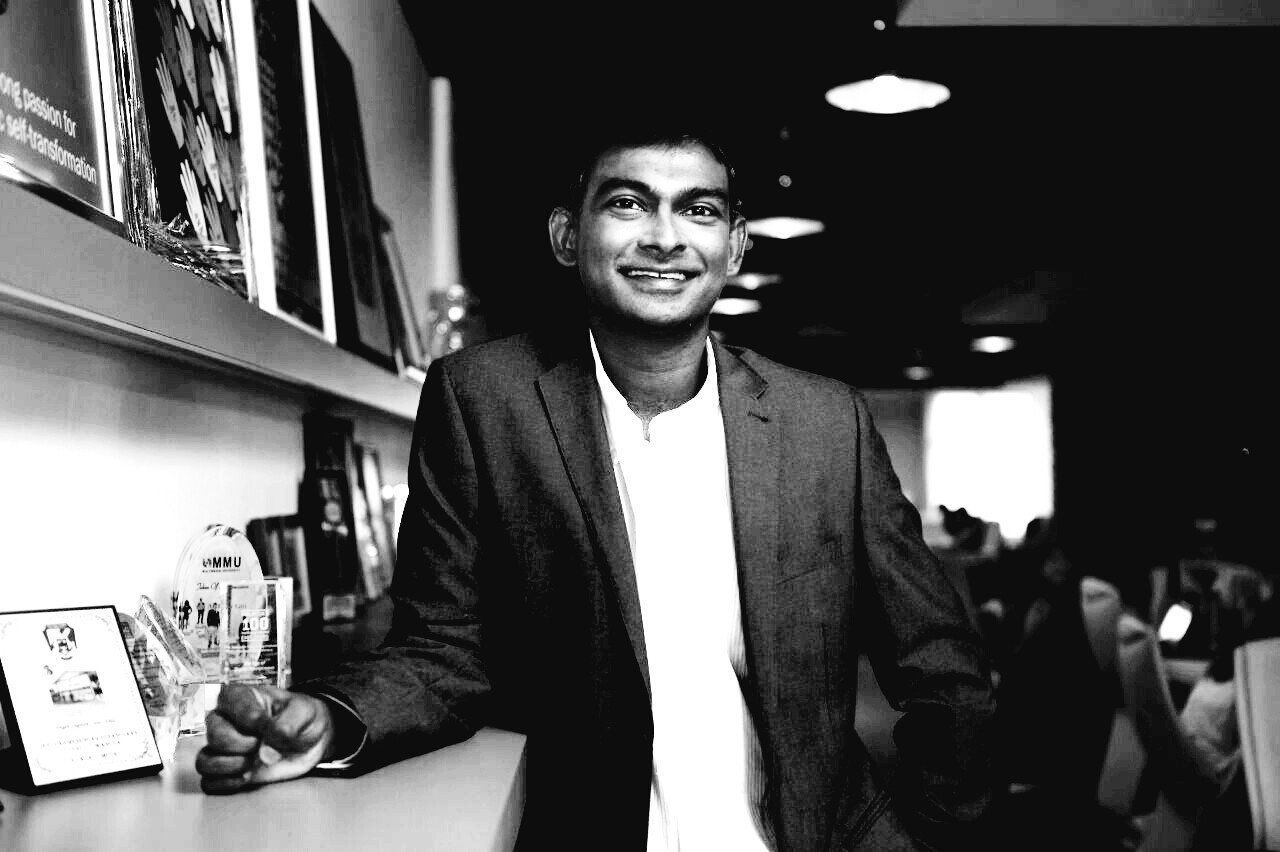
Roshan is the Founder and “Kuli” of the Leaderonomics Group of companies. He believes that everyone can be a leader and "make a dent in the universe," in their own special ways. He is featured on TV, radio and numerous publications sharing the Science of Building Leaders and on leadership development. Follow him at www.roshanthiran.com