12 Months Later Is Not Feedback. It's Archaeology.
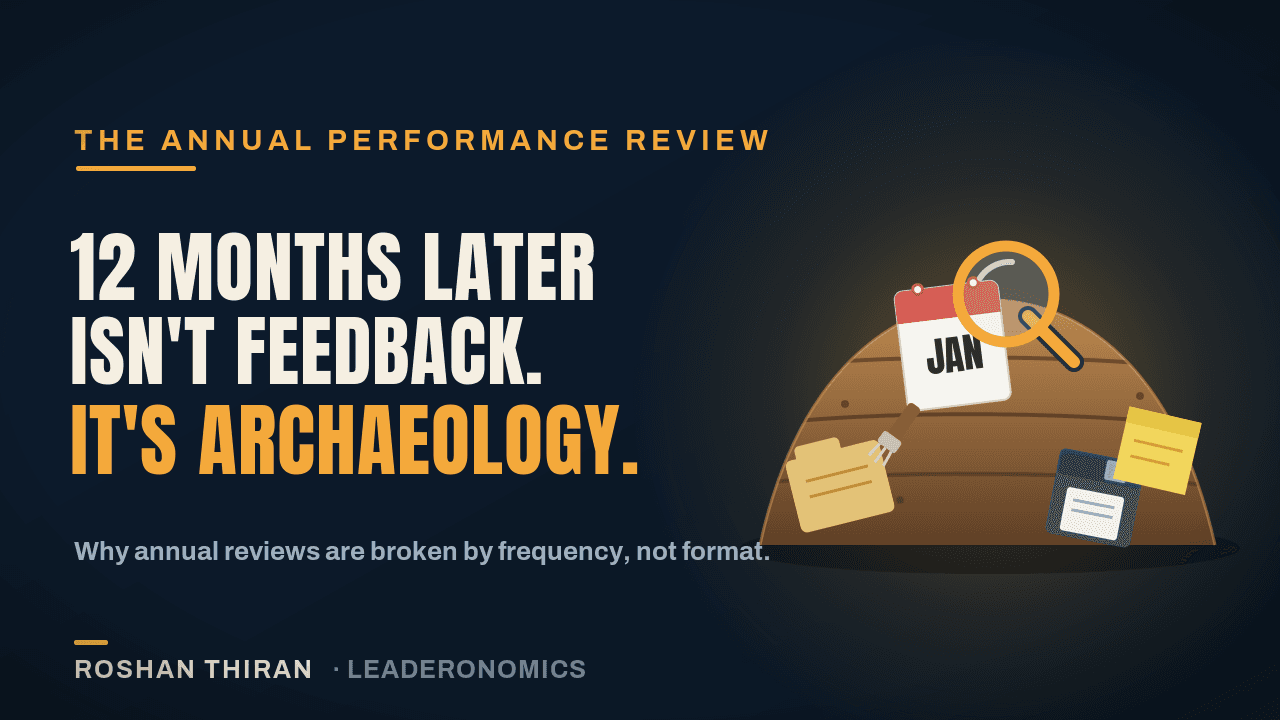
If you watched the video (you can watch the video here), you saw me re-enact one of my earliest performance reviews, back in my GE days, centuries ago. I am sitting across from my manager, who is holding a form thick enough to stun a fish. She asks one simple question.
"So, tell me what happened in January."
And I freeze.
It is a re-enactment, but it is not fiction. It really happened to a younger, sweatier version of me, unable to account for the first half of a year I had actually lived. (I updated the props in the video to WhatsApp and the like to keep up with the times. The original involved Lotus 1-2-3 spreadsheets and very real file folders. If you remember Lotus 1-2-3, we should probably be friends.)
I played it for laughs because it is funny. Two grown adults flipping through old calendars and ancient documents, excavating a year of work from memory and digital rubble. Archaeology, basically.
But here is the part that stopped being funny for me.
I have now sat on both sides of that table. I have been the nervous employee digging through my notes. I have also been the manager holding the giant form, quietly realising I could not honestly remember what this person did in the second quarter. And in all the years since, across companies and countries and a lot of well-intentioned HR systems, this awkward little ritual has barely changed.
We are still doing it. Today. In organisations that consider themselves modern.
So I want to take the joke seriously for a moment, because underneath it is one of the most expensive, least examined habits in corporate life.
The annual review is not broken because of the form. It is broken because of the frequency.
We keep trying to fix performance reviews by redesigning the template. New rating scales. New competencies. New software with nicer dashboards. We are polishing the form when the real fault line is the calendar.
Think about what we are actually asking. We sit a manager down once a year and ask them to fairly assess twelve months of another human being's effort, growth, mistakes and contribution, in a single sitting. And then we are surprised when it feels arbitrary.
It feels arbitrary because, neurologically, it is.
Our memory does not store a year in even, well-lit shelves. It keeps the recent and the dramatic, and lets the rest quietly fade. The win from last month feels vivid. The conflict from last week feels enormous. The steady, excellent work from February has simply evaporated. Psychologists call this recency bias, and it is one of the most documented errors in performance appraisal precisely because it is so hard for any of us to switch off.
And it gets worse than memory. A landmark study by Scullen, Mount and Goff, published in the Journal of Applied Psychology, analysed thousands of managers and found that 62% of the variation in performance ratings reflected the idiosyncrasies of the rater, not the actual performance of the person being rated. Real performance explained only about 21%.
Read that slowly. Most of your score is not about you. It is about who happened to be holding the pen.
No wonder Gallup found that only 14% of employees strongly agree that their performance reviews inspire them to improve. We built an entire annual ceremony around a moment our brains were never designed to handle, and then we act surprised when people walk out of it deflated rather than developed.
Managers are not the villains here. They are human.
It is easy to turn this into a story about lazy or biased managers. I do not buy that. Notice that in my own re-enactment, my manager was digging through her notes and documents just as frantically as I was. She was not careless. She was a competent person being asked to do something the human brain cannot reliably do. I know, because I later became that manager too, and I was not lazy either. I was overloaded, under-prompted, and working against my own memory.
Picture the average manager in review season. They have eight, ten, maybe fifteen reviews to write. They have their own deliverables. They are handed a form in November and asked to reconstruct a year they experienced in fragments while doing six other things. Of course recency bias wins. Of course the last big project dominates. The system is asking a human being to perform a feat of memory and objectivity that no human being can reliably perform.
So the honest reframe is this: the problem was never the people on either side of the table. It was the design of the conversation. And design is something we can change.
The fix is not a better form. It is a different rhythm.
The most effective shift I have seen, and the one we built into how we work at Budaya, is almost embarrassingly simple. Stop compressing a year into one heavy ceremony. Break it into twelve light ones.
A short monthly review. Ten to fifteen minutes. What went well, what to adjust, recognise the work, and where possible, reward it that same month while the effort and the outcome are still connected in everyone's mind. Twelve honest conversations, captured while the memory is still warm.
By the time December arrives, there is nothing left to excavate. The annual review writes itself, because it was lived month by month, not reconstructed in a panic. You are not adding twelve times the bureaucracy. You are replacing one painful archaeological dig with twelve easy check-ins, and the total time is usually less, not more.
Feedback, it turns out, is a lot like fresh bread. It is best the day it is made. Leave it twelve months and you are serving something nobody wants to eat.
What a manager can actually do (starting this month)
You do not need to wait for HR to overhaul the system. You can change the rhythm inside your own team tomorrow.
First, schedule a recurring fifteen-minute monthly conversation with each direct report and protect it like a client meeting. The discipline of frequency matters more than the elegance of the format.
Second, separate recognition from correction in time. Catch good work as it happens and name it specifically, rather than banking it for the annual summary. People cannot grow from feedback they receive eleven months too late, and they cannot repeat strengths they were never told they had.
Third, keep a running, one-line note on each person through the year. Not surveillance, just memory support. It is the difference between a fair review and a fictional one.
What an employee can do (without waiting to be reviewed)
If you are early in your career, here is the thing I wish someone had told the sweating young version of me in that chair: you are allowed to ask for feedback. You do not have to wait for the ceremony.
Try the monthly one-liner. Once a month, message your manager a single question: "What is one thing I should keep doing, and one thing I should change?" Thirty seconds for them, enormous value for you, and zero surprises in December.
Catch the moment while it is hot. Just finished a project or a presentation? Ask right then: "How did that land? Anything you would tweak next time?" Feedback gathered while it is warm is worth ten times the same comment dredged up months later.
And keep your own receipts. One honest line a week in your notes about what you worked on and what you learned. So when someone finally does ask you what happened in January, you are not the one staring blankly across the table.
Asking for feedback is not being needy. It is how you grow faster than everyone still waiting passively for review season. It is also how you remove the surprises that, left alone, quietly harden into resentment.
The real point
A performance review should be the calm summary of a conversation you have been having all year. Not the first time you finally have it.
Thirty years on, I still find that scene funny. But I no longer find it acceptable. The best review is the one nobody has to dig for.
So whether you are the manager holding the form or the employee being asked about January, you can start the better habit this month. Memory fades. Momentum doesn't.
Sources
- Scullen, S., Mount, M., & Goff, M. (2000). Understanding the latent structure of job performance ratings. Journal of Applied Psychology. (The "idiosyncratic rater effect": ~62% of rating variance attributable to the rater.)
- Gallup, More Harm Than Good: The Truth About Performance Reviews (only 14% of employees strongly agree reviews inspire them to improve).
- Recency bias and the forgetting curve (Ebbinghaus): widely established cognitive patterns underpinning appraisal error; cited qualitatively, not with a specific figure.


Business
Tags: Culture

Roshan is the Founder and “Kuli” of the Leaderonomics Group of companies. He believes that everyone can be a leader and "make a dent in the universe," in their own special ways. He is featured on TV, radio and numerous publications sharing the Science of Building Leaders and on leadership development. Follow him at www.roshanthiran.com