The Power of Many Mentors: How Moyes, Wenger, and Guardiola Forged Mikel Arteta's Arsenal Project
On the evening of May 19, 2026, the landscape of European football was fundamentally reorganised. Arsenal Football Club secured the 2025/26 English Premier League championship, effectively ending a 22-year drought that had stretched back to the legendary "Invincibles" campaign of the 2003/04 season. The mathematical confirmation of this triumph arrived via the Vitality Stadium, where Manchester City—the reigning hegemon of English football—was held to a 1-1 draw by AFC Bournemouth. This result left Pep Guardiola’s side stranded four points adrift with only one match remaining, officially crowning Arsenal as the champions of England for the 14th time in the club's illustrious 140-year history.
The victory is the culmination of a grueling, meticulously planned multi-year project spearheaded by Mikel Arteta, who became the first former Premier League player to win the trophy as a manager. Following three consecutive seasons of agonizing runner-up finishes—including a 2023/24 campaign where they fell short by a mere two points—Arsenal finally dismantled the psychological and tactical barriers that had previously confined them to the status of "nearly men". However, to attribute this success merely to linear squad progression or natural variance is to fundamentally misunderstand the architecture of this Arsenal side.
The prevailing, yet overly simplistic, narrative surrounding Mikel Arteta has long categorized him exclusively as a disciple of Pep Guardiola. Observers frequently point to his three-year tenure as an assistant at Manchester City, assuming the 2025/26 Arsenal team is merely a replication of the Guardiola blueprint. Exhaustive analysis of Arsenal’s on-pitch behavior, structural evolution, and psychological resilience reveals a far more complex managerial pedigree. Arteta’s tactical framework is not a monolith; it is a highly sophisticated, hybrid model forged in the crucible of three fundamentally disparate footballing philosophies.
The foundation of this championship-winning side rests upon the disciplined pragmatism and defensive solidity of David Moyes, the attacking fluidity and cultural stewardship of Arsène Wenger, and the micro-tactical pressing and spatial manipulation of Pep Guardiola. Although I am not an Arsenal fan, I want to understand and provide an exhaustive deconstruction of Mikel Arteta’s tactical synthesis. In the process of research, I uncovered how a Basque midfielder absorbed the defining characteristics of three legendary managers to construct a squad capable of unseating his former mentor and executing one of the most structurally complete Premier League campaigns of the modern era.
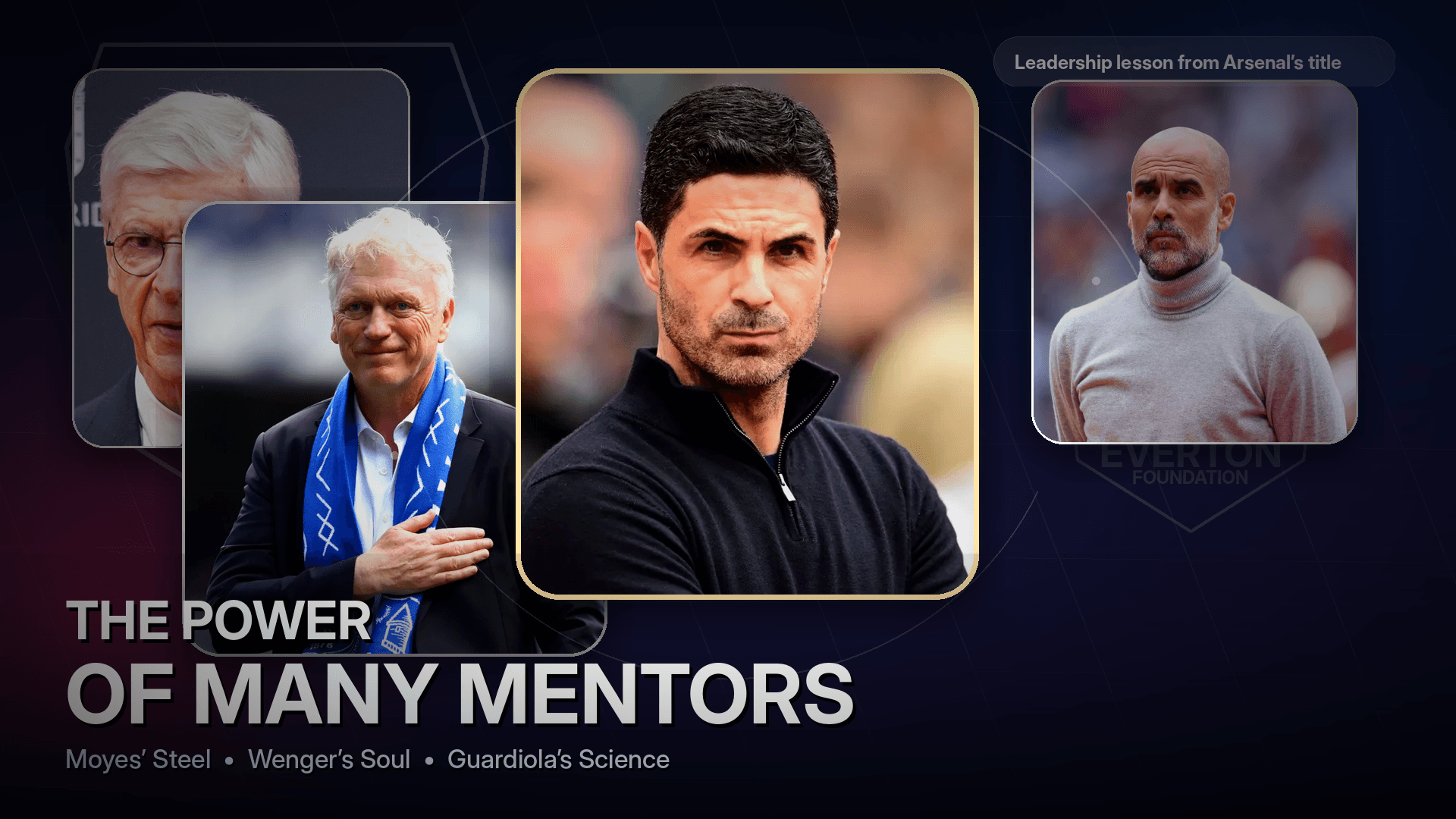
Great leaders are not photocopies. They are synthesis machines. Arteta’s genius was not that he copied Guardiola. It was that he refused to become a copy of anyone. He took Moyes’ steel, Wenger’s soul and Guardiola’s science, then forged something distinctly his own. That may be the greatest leadership lesson from Arsenal’s title win: the best leaders do not merely inherit wisdom. They metabolise it.
The Bedrock of Steel: The David Moyes Apprenticeship
The most underappreciated, yet arguably the most foundational, influence on Mikel Arteta’s managerial identity is David Moyes. Long before Arteta was exposed to the elite tactical frameworks of Wenger at the Emirates or Guardiola at the Etihad, he spent six formative years (2005–2011) operating in the engine room of Everton Football Club. Understanding the mechanics of Moyes' Everton is paramount to deciphering the defensive resilience of Arteta's 2025/26 Arsenal.
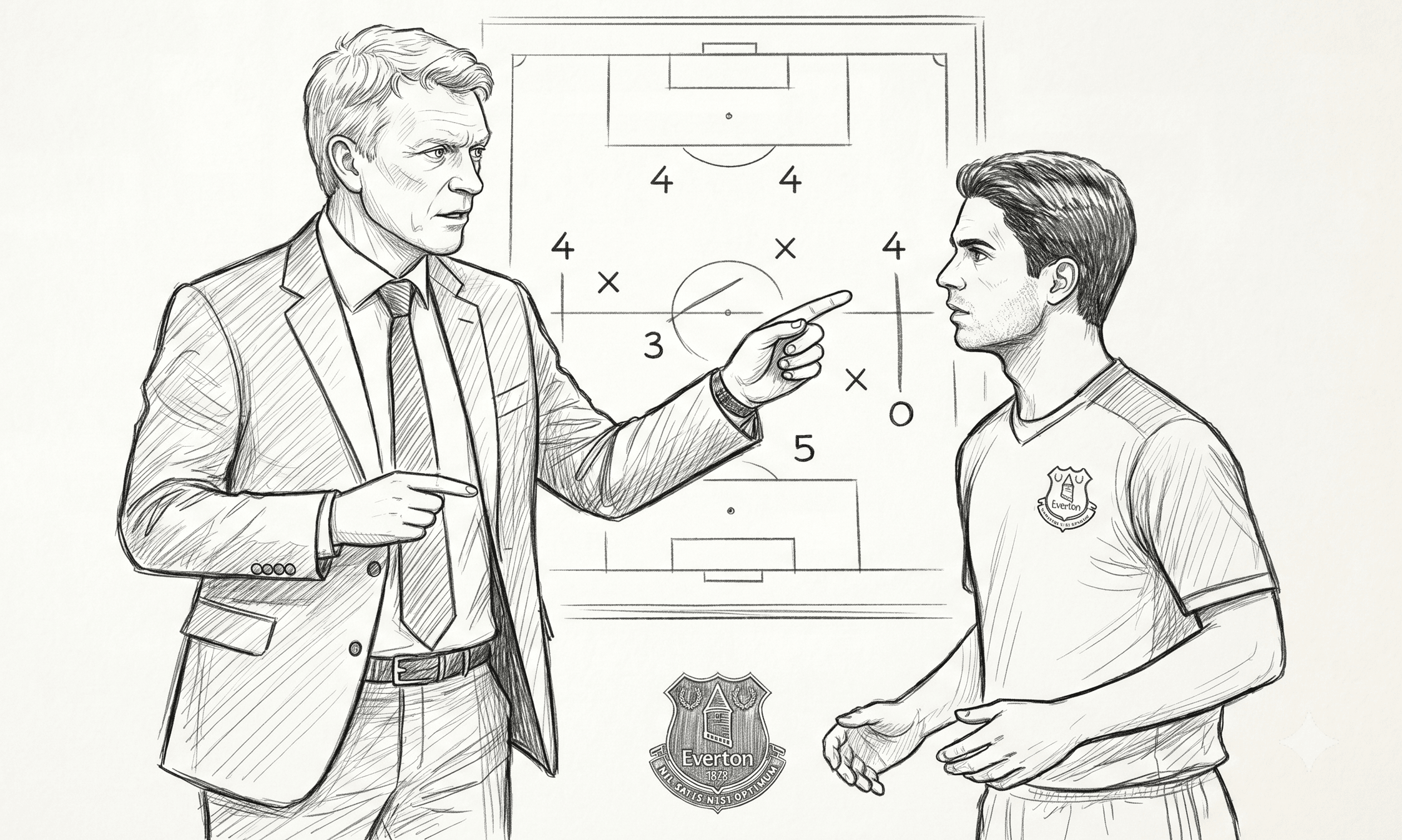
Arteta learnt his defensive resilience under the wings of David Moyes
When David Moyes assumed control of Everton, he inherited a struggling side perennially flirting with relegation. Through sheer force of will, tactical discipline, and meticulous organization, Moyes transformed the Merseyside club into a formidable force that consistently challenged the financial elite of the Premier League for top-six finishes.
| Everton Season | Final League Position | Points Tally | Goals Conceded | Managerial Context |
| 2003-04 | 17th | 39 | 57 | Pre-Arteta struggles; narrowly avoiding relegation. |
| 2004-05 | 4th | 61 | 46 | Arteta arrives on loan (Jan 2005); defensive solidification. |
| 2006-07 | 6th | 58 | 36 | Arteta as central figure; elite defensive metrics. |
| 2007-08 | 5th | 65 | 33 | Sustained European qualification; rigid 4-5-1 shape. |
| 2008-09 | 5th | 63 | 37 | FA Cup finalists; peak Moyesian pragmatism. |
The Cultivation of Pragmatism and the "Basque Boy" Grit
When Arteta first arrived at Goodison Park from Real Sociedad—following a physically demanding spell at Rangers under Alex McLeish—Moyes harbored intense doubts about whether the refined, technical playmaker could withstand the unrelenting physical rigors of the Premier League. Moyes initially deployed Arteta cautiously, often placing him on the right side of midfield to protect him from the chaotic central battles.
However, Moyes quickly realized that Arteta’s technical elegance masked a profound inner steel. Moyes noted that Arteta’s Basque roots provided an innate "fight and hunger" that perfectly complemented the traditional, rugged British game. Under Moyes' demanding stewardship, Arteta evolved from a delicate prospect into the robust, combative heartbeat of the team. Moyes demanded suffering, organization, and a collective work ethic that prioritized the integrity of the team's shape over individual expression. Arteta absorbed this lesson entirely. He developed a deep, emotional reverence for Moyes, famously stating, "I would go through a brick wall for him when he was my manager... I learned from him on the field and off the field about building a team and getting the right characters in the team to build what you want". Furthermore, Moyes challenged his tactical understanding, playing him in unfamiliar positions and pushing him out of his comfort zone, which Arteta later cited as crucial to his developmental balance.
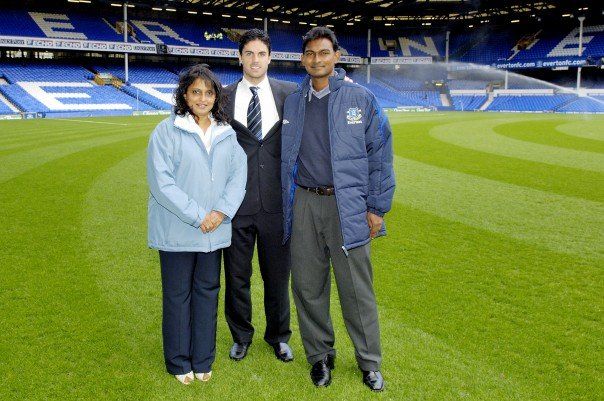
The author, Roshan, together with Mikel Arteta at Goodison Park as a player before a game during his Everton days under the tutelege of David Moyes
Translating the Moyes Mid-Block to North London
The Moyesian influence manifested profoundly in the tactical architecture of the 2025/26 Arsenal squad. While the modern narrative demands that elite teams dominate possession perpetually, Arteta’s Arsenal showcased a distinct willingness to embrace the "dark arts," surrender the ball, and prioritize structural impenetrability over aesthetic purity.
At Everton, Moyes utilized a highly disciplined 4-4-2 or 4-5-1 mid-block, where defensive solidity was non-negotiable. Arteta transported this exact structural discipline to Arsenal. When facing elite possession teams like Manchester City, Arsenal demonstrated an absolute comfort in managing space without the ball. They routinely dropped into a compact 4-4-2 shape, fiercely protecting the central channels and forcing the opposition into low-value wide areas. This is the essence of transition control—reducing the opponent's time, space, and options until their attacks dissolve before reaching the penalty area.
The starkest departure from the Guardiola doctrine—and the clearest homage to Moyes—is Arteta’s willingness to sacrifice aesthetics to secure a result. During a pivotal 2-2 draw against Manchester City earlier in the evolutionary cycle of this squad, Arsenal, reduced to ten men, reverted to a striker-less 5-4-0 formation for an entire half. In that highly combative fixture, players like Jurriën Timber and Kai Havertz played immense minutes without completing a single pass to a teammate, dedicating themselves entirely to clearances, defensive headers, and structural integrity. Arsenal finished that match with a mere 22% possession, deliberately frustrating City and getting under their skin—a display of the rugged "British DNA" Arteta absorbed during his playing career with Everton, where playing with no striker under David Moyes was quite the norm to get a result.
Defensive Dominance
The recruitment strategy under Arteta heavily favored physically imposing, duel-winning profiles, directly mirroring Moyes’ preference for strength and endurance. The acquisition of Declan Rice—ironically a former David Moyes protégé at West Ham United—served as the ultimate validation of this philosophy, anchoring the midfield with unparalleled ground coverage. In Arsenal's most high-stakes encounters, Arteta’s side fielded lineups where nearly every player remaining on the pitch stood over six feet tall, prioritizing aerial dominance and combativeness.
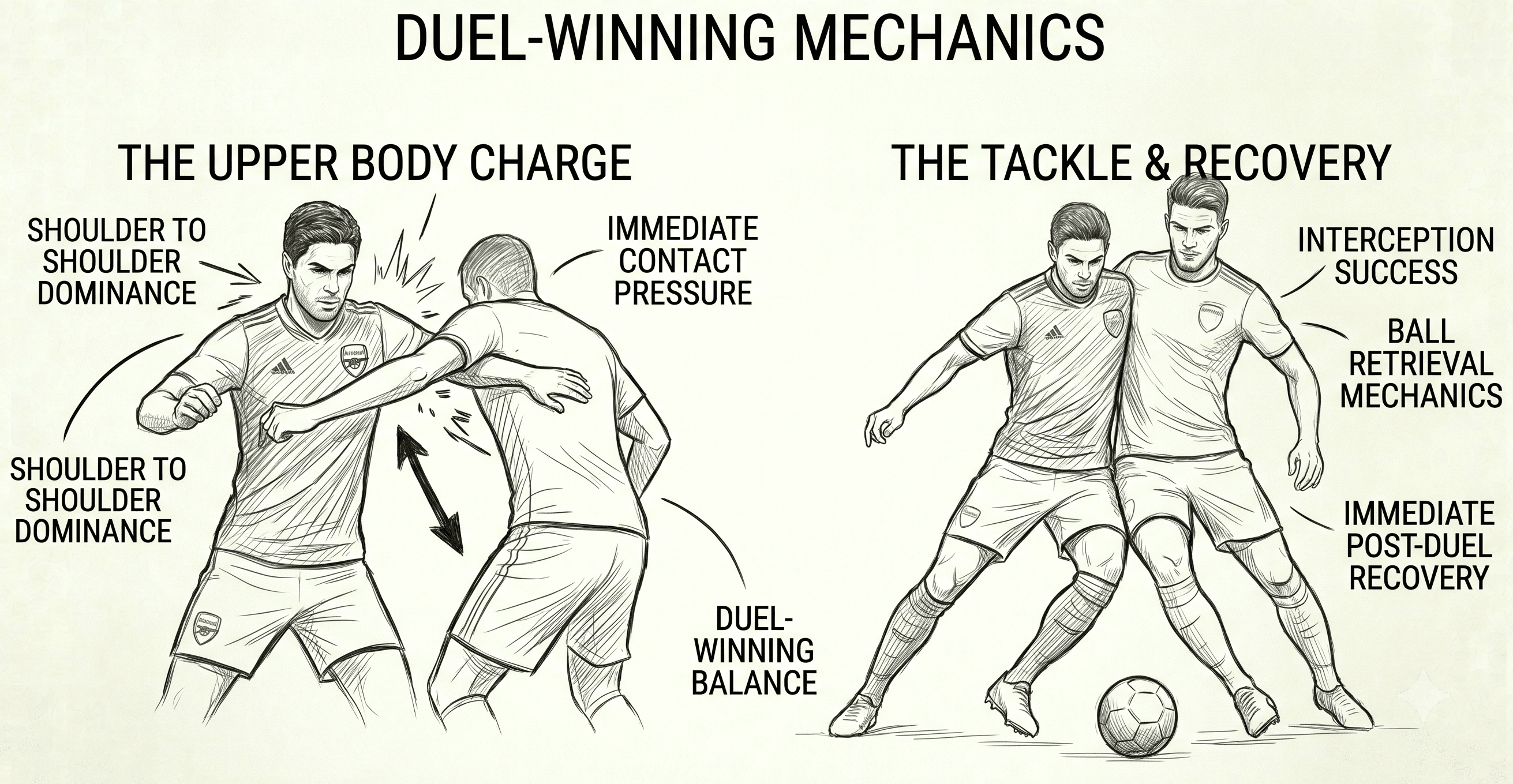
Arteta mirrored a lot of Moyes' preference for duel-winning profiles in his team recruitment
The statistical output of this pragmatism is evident in Arsenal's defensive metrics for the 2025/26 season, which laid the foundation for the championship.
| Defensive Metric (2025/26 Season) | Arsenal Performance | League Context & Significance |
| Clean Sheets | 19 | 1st in the Premier League. David Raya secured his third successive Golden Glove award. |
| Total Duels Won | Dominant (Timber 51, Gabriel 46 early season) | Highest individual dual success rates, indicating high physical combativeness and mid-block stability. |
| Errors Leading to Goals | 1 (Since start of previous season) | Fewest in the league. Demonstrates extreme concentration, far outpacing rivals like Chelsea (16) and Man City (11). |
| Tactical Fouling | High Volume (e.g., 65 vs Man City's 32 in H2H) | Embrace of the "Dark Arts" to disrupt opponent rhythm, reminiscent of traditional British pragmatism. |
| Goals Conceded | Fewest in the division | Surpassed the defensive resilience of the 2003/04 Invincibles. |
This data confirms that the defensive bedrock of Arsenal’s title-winning side is not rooted in the tiki-taka academies of Catalonia, but in the gritty, unforgiving trenches of Goodison Park. David Moyes himself recognized this synthesis, publicly defending Arteta’s tactics when the media criticized Arsenal for being overly reliant on physicality and set-pieces. "If there's this thing out there where everybody has to play the beautiful game and everything has to be perfect, well if we all do that then it would be boring," Moyes stated, praising Arsenal's strength as a virtue rather than a flaw. He noted that Arteta had successfully transitioned Arsenal into a robust machine capable of fighting on all fronts.
The Architect of Culture and Fluidity: Arsène Wenger’s Enduring Imprint
If David Moyes provided the steel and the structural foundation, Arsène Wenger provided the intellectual capacity and the attacking soul. In the summer of 2011, Arteta transitioned to Arsenal, arriving in the wake of a traumatic 8-2 defeat to Manchester United. He was immediately thrust into a leadership role to stabilize a club in crisis, eventually earning the captain's armband.
Under Wenger, Arteta experienced a footballing philosophy completely antithetical to Moyes’ Everton. To understand Wenger's Arsenal is to understand a profound evolutionary shift in English football. Prior to Wenger, the George Graham era defined Arsenal—a ruthless, relentless, and rock-solid 4-4-2 system built on the legendary back four of Lee Dixon, Steve Bould, Tony Adams, and Nigel Winterburn. Graham's Arsenal was a tank. Wenger arrived in 1996 and transformed the club into a "Ferrari," implementing a fluid, shape-shifting attacking system that prioritized movement, intelligence, and unmatched flair.
The Recognition of Latent Managerial Genius
Wenger recognized Arteta’s profound tactical intelligence immediately. While Arteta lacked the explosive physical traits of some of his peers, his deep-lying playmaking abilities and spatial awareness became the focal point of Wenger's midfield. Wenger observed that Arteta possessed an obsession with detail that mirrored his own. The Frenchman famously noted that Arteta was "super conscientious," preparing for training two hours in advance every single day.
Wenger's foresight regarding Arteta's managerial potential was prophetic. In 2015, while Arteta was still a 33-year-old active player, Wenger publicly campaigned for his captain's future in management: "Mikel has a huge influence even when he is not playing. Just through his behaviour, his focus on getting everything right in the team, he has a huge influence... I really hope Mikel considers going into coaching. When you manage, you want to see your players continue and see them give their experience and knowledge back... It would be great if someone like Mikel went into management, so somewhere the spirit of our game can survive through the players who have played for us".
Arteta absorbed Wenger’s principles of attacking positional freedom. Wenger’s systems relied on players interpreting space dynamically, trusting highly technical individuals to combine rapidly in the final third without strict, rigid patterns. Arteta retained this attacking DNA. In the 2025/26 season, Arsenal showcased attacking sequences that were unmistakably Wenger-esque. The right-sided triangle—comprising Ben White, Martin Ødegaard, and Bukayo Saka—executed complex, fluid rotations that routinely dismantled opposition low blocks. This allowed Arsenal to score a staggering 69 goals in their first 37 matches, sharing goal involvements across 14 different players, showcasing a collective attacking responsibility.
The Implementation of Ruthless Guardrails
However, the true mastery of Arteta’s application of Wenger’s philosophy lies in what he consciously chose not to emulate. During Arteta’s playing days at the Emirates, Wenger’s Arsenal developed a debilitating reputation for being "soft touches". As the Invincibles era faded, Wenger systematically replaced physically imposing leaders with smaller, highly technical playmakers. This resulted in chronic structural fragility, particularly during defensive transitions, and a lack of on-field discipline when matches devolved into physical contests.
Arteta witnessed firsthand how a lack of defensive structure and a permissive culture could undermine absolute attacking brilliance. When he returned to the Emirates as manager in December 2019—sitting in the opposition dugout for Manchester City just days prior and observing a hollowed-out Arsenal squad—he identified that the "soul of the club had been lost" and the environment lacked necessary discipline.
Consequently, Arteta instituted severe cultural and tactical guardrails. He was ruthless in squad construction, purging the roster of highly paid, low-work-rate stars who did not conform to the collective ethos, famously parting ways with figures like Pierre-Emerick Aubameyang and Mesut Özil. Arteta established a non-negotiable team ethic, insisting that the collective was greater than the individual.
In possession, Arteta allowed the Wenger-esque attacking flair to flourish, but strictly within a disciplined framework. The team was anchored by a robust "rest-defense"—a concept largely absent in late-era Wenger sides. While the attackers roamed freely, the defense and holding midfielders maintained a highly structured shape to immediately suffocate opposition counter-attacks. Furthermore, Arteta took inspiration from Wenger’s unwavering loyalty to the club's values, stating, "The way he defended the club, the way he presented himself, the way he was loyal to the players and his staff is something that I really took from him. He is an example for me". By marrying Wenger’s attacking idealism with Moyes’ defensive pragmatism, Arteta cured the chronic fragility that had haunted Arsenal for nearly two decades.
The Crucible of Innovation: Pep Guardiola and the Science of Control
The final, and most heavily scrutinized, phase of Arteta’s managerial education occurred at the Etihad Stadium. Upon retiring as a player in 2016, Arteta was immediately recruited by Pep Guardiola to serve as his assistant manager at Manchester City. Guardiola sought Arteta’s intimate, decade-long knowledge of the English game, and the two shared a profound tactical alignment originating from their mutual Barcelona and La Masia heritage.
The Mechanics of Positional Play and the High Press
During his three-year tenure as Guardiola's understudy (2016–2019), Arteta gained an unprecedented insider’s perspective on operating a hyper-elite, dominant footballing machine. He noted how his perspective shifted dramatically from a player executing orders to a coach understanding the grand architecture of spatial dominance: “You can observe how the tactics you’ve planned actually work, from the inside. And then you see things you wouldn’t have spotted otherwise... I can see immediately if a certain position doesn't give me enough time to close down a space.”
From Guardiola, Arteta adopted the core tenets of Juego de Posición (Positional Play). He learned to view positioning not just as a tool, but as the fundamental language of the game. The objective was to manipulate opponents through structure, holding width to stretch defensive blocks while positioning players between the lines to create passing access.
The most visible manifestation of Guardiola's influence in the 2025/26 Arsenal side is the aggressive, suffocating high press and the manipulation of numerical superiorities. Arteta implemented the use of inverted full-backs—most notably utilizing Jurriën Timber, Oleksandr Zinchenko, and Ben White—to step into the midfield during the build-up phase. This specific tactic overloads the center of the pitch, allowing Arsenal to bypass opposition presses and establish absolute control over the rhythm of the match.
Arsenal’s pressing metrics under Arteta reflect Guardiola’s obsession with winning the ball high up the pitch. Utilizing the Passes Per Defensive Action (PPDA) metric—where a lower number indicates a more aggressive press—Arsenal established themselves as one of the most intense, proactive pressing units in Europe during the 2024–2026 tactical cycle.
| Premier League Team | Managerial Setup | Average PPDA | Pressing Intensity Profile & Tactical Intent |
| Liverpool | Arne Slot | 9.89 | League-low; hyper-aggressive, physically demanding high-press. |
| Arsenal | Mikel Arteta | 9.9 - 10.05 | Highly structured, trigger-based aggressive press; designed to dictate direction. |
| Brighton & Hove Albion | Fabian Hürzeler / De Zerbi | 10.0 - 10.2 | Proactive disruption aimed at rapid transitions. |
| Newcastle United | Eddie Howe | 10.29 | High physical engagement; league-leading defensive interceptions. |
| Aston Villa | Unai Emery | 10.39 | Mid-block central compression; forces play out wide. |
| Chelsea | Enzo Maresca / Rosenior | 15.17 (Against) | Opponents press them less aggressively due to slow, safe build-up structures. |
Arsenal’s PPDA of roughly 10.05 demonstrates a proactive approach, but crucially, it is highly structured. Arteta’s side does not press with reckless, uncoordinated abandon. They utilize specific triggers, marshaled by the intelligence of Martin Ødegaard and Declan Rice, to dictate the direction of the opponent's play, trapping them against the touchlines and overwhelming the ball carrier.
The Divergence from the Master: Directness and Tactical Flexibility
However, strictly labeling Arteta a "Pep clone" ignores the significant tactical divergences that ultimately allowed Arsenal to surpass Manchester City in the 2025/26 title race. Guardiola's philosophy is fundamentally rooted in total, absolute control through continuous possession. If City loses the ball, their immediate counter-press is designed to win it back instantly so they can resume their passing sequences.
Arteta, heavily influenced by his British footballing experiences under Moyes, recognized that total possession is not the only mechanism for control. Arsenal evolved into a side that dominates through transition control and territorial denial rather than mere ball retention. Arsenal compresses space, forcing opponents into rushed decisions and low-value territory long before they reach the penalty area.
Furthermore, in the 2025/26 season, Arsenal frequently demonstrated a willingness to bypass the high press altogether—a highly un-Guardiola-like tactic. When opponents committed bodies forward to press David Raya, Arsenal utilized the dropping movements of players like Eberechi Eze or Mikel Merino to drag center-backs out of position, allowing Raya to launch direct, vertical passes into the space behind the defensive line, often targeting the aerial prowess of Kai Havertz.
Guardiola himself highlighted differences in their attacking methodologies. While analysing Gabriel Jesus, Guardiola noted that his own system demands goals from all wingers and midfielders, warning against over-reliance on a single striker. While Arteta shares this philosophy of distributed goalscoring (evidenced by 14 different players contributing to goals), Arteta has been willing to sacrifice attacking fluidity for defensive stability when required, a compromise Guardiola rarely entertains. The tension between the two managers occasionally surfaced, with Guardiola engaging in psychological warfare, ironically suggesting that if Arteta won the league, it would only be due to financial spending. Yet, Guardiola ultimately conceded the magnitude of his former assistant's achievement, admitting, “Mikel has created a team that is almost unbeatable.”
The Margin of Victory: Nicolas Jover and Set-Piece Supremacy
Perhaps the most definitive synthesis of Moyes' pragmatism and Guardiola's obsessive analytical detail is Arsenal's mastery of set-pieces. David Moyes consistently utilised set-pieces as a primary offensive weapon at Everton, recognizing them as an equalizer against more technically gifted sides. Guardiola, conversely, historically minimizes the importance of traditional set-pieces, preferring open-play combinations to unlock defenses.
Arteta identified set-pieces as a massive market inefficiency in the modern Premier League. To exploit this, he recruited set-piece specialist Nicolas Jover in the summer of 2021. Jover, who had previously worked with Arteta at Manchester City (having joined City in 2019 on Arteta's recommendation) and Brentford, was granted unprecedented authority to choreograph Arsenal's dead-ball situations.
The Mechanics of Controlled Chaos
Under Jover's meticulous guidance, Arsenal turned corners and wide free-kicks into high-probability scoring events. The tactical mechanics of Jover's set-pieces rely on engineered, controlled chaos. Routines involve highly specific roles designed to manipulate the opposition's defensive structure:
- Blockers: Players like Ben White are deployed specifically to impede the movement of the opposition's primary zonal markers, creating separation and opening aerial corridors.
- Runners: Players attack blind spots between defenders, sprinting from the edge of the box to arrive at precisely timed intervals, confusing zonal markers who prefer predictability.
- Targeted Players: Aerially dominant figures like Gabriel Magalhães, William Saliba, or Kai Havertz occupy central zones to execute the finish.
- Reactors: Players positioned specifically to anticipate deflections or second balls.
Furthermore, Arsenal maintains a strict structural perimeter around the edge of the box, committing players to recycle possession or smother counter-attacks immediately if the initial delivery fails, ensuring that a set-piece remains an extended phase of offensive pressure.
Record-Breaking Execution
The statistical impact of this strategy during the 2025/26 campaign was historic, establishing Arsenal as the undisputed set-piece kings of English football.
| Set-Piece Metric (2025/26 Season) | Arsenal Performance | Tactical Implication & Context |
| Goals from Corners | 18 | Broke the all-time single-season Premier League record. |
| Total Set-Piece Goals | 24 | Dead-ball situations accounting for 36% of their total goals (Reuters) |
| Set-Piece Goal Differential | +4 over nearest rival | Demonstrated a massive, sustained tactical edge over the entire division. |
| 1-0 Victories | 8 occasions | Allowed Arsenal to grind out results efficiently when open-play structures failed, perfectly echoing Moyesian pragmatism. |
This set-piece mastery was perfectly personified in the defining moment of the title race—the must-win match against Burnley. In a tense, anxiety-ridden fixture at the Emirates where open-play fluency was stifled, Bukayo Saka delivered a pinpoint inswinging corner. Kai Havertz rose highest, exploiting the space created by Jover's blocking routines, to power home a towering header and secure a critical 1-0 victory. This singular moment, stripping away all aesthetic pretense in favor of brutal, mechanistic efficiency, was the fulcrum upon which the 2025/26 title was won.
The 2025/26 Season Narrative: Psychological Triumph and Squad Culmination
The 2025/26 Premier League title was the realisation of Arteta's grand vision—a five-phase master plan originally pitched to the Arsenal hierarchy during his interview in December 2019. After surviving early eighth-place finishes (the club's worst in 25 years), navigating the COVID-19 impacted seasons, and enduring consecutive late-season collapses against Manchester City, the squad finally achieved full tactical and psychological maturation.
The Synthesis of Player Profiles
The squad assembly for the 2025/26 campaign perfectly reflected Arteta’s tripartite managerial philosophy, blending the distinct traits of his mentors into a cohesive unit.
- The Moyes Profiles (Physical Combativeness): Declan Rice and Kai Havertz provided the physical combativeness, aerial superiority, and relentless defensive work rate required to execute the mid-block and dominate set-pieces.6 Havertz’s transformation into a physical target man allowed Arsenal to bypass the press, while Rice’s unparalleled ground coverage protected the backline.
- The Wenger Profiles (Technical Fluidity): Martin Ødegaard and Bukayo Saka encapsulated the technical brilliance, spatial awareness, and attacking fluidity that defined Arsenal’s heritage. Ødegaard’s ability to operate between the lines and Saka’s relentless one-on-one dominance (contributing heavily to the team's goal tally alongside Viktor Gyokeres and Leandro Trossard) provided the "beautiful chaos" Wenger championed.
- The Guardiola Profiles (Positional Dominance): The defensive unit possessed the technical proficiency required for elite ball progression and positional rotation. Jurriën Timber’s ability to invert into midfield, alongside the composure of center-backs William Saliba and Gabriel, allowed Arsenal to dictate the tempo of matches from the deepest areas of the pitch while rendering the defense nearly impenetrable. Behind them, goalkeeper David Raya acted as an extra outfield player in possession while producing vital saves—such as a crucial stop against West Ham's Mateus Fernandes—probably securing the Golden Glove.
Overcoming the Mental Hurdle
Tactics aside, the 2025/26 championship was ultimately a triumph of psychological resilience. The narrative of being the "nearly men" threatened to derail the project entirely. During the title run-in, Arsenal endured a brief slump, suffering domestic defeats that threatened to allow Manchester City back into the race. The pressure at the Emirates was suffocating. Watching Arsenal’s run-in reminded me of something we experienced recently with my own team, Leaderonomics FC. When a team hits a slump near the finish line, the question is no longer whether they have talent. The question is whether the habits, standards and culture built over months will hold under pressure.
At Arsenal, the cultural guardrails Arteta had installed held firm. The team did not panic or fracture. (In fact, we experienced these same emotions guiding our Leaderonomics FC team to the MFL title after our slump). Arsenal (and our Leaderonomics FC team) leaned heavily into our structure, mindset and efficiency that had been inculcated for years. While Manchester City faltered, drawing against Everton (David Moyes playing yet another role in helping Arteta) and eventually Bournemouth, Arsenal recorded a sequence of four successive victories without conceding a single goal to reclaim the top spot. The squad emerged strongest from what effectively became a high-stakes playoff against City. When the final whistle blew at the Vitality Stadium confirming City's dropped points, the scenes of jubilation at Arsenal's Hertfordshire training ground—where players like Declan Rice, Bukayo Saka, and William Saliba gathered to watch the decisive match—signaled the end of a grueling psychological odyssey. Arsenal now has an insurmountable 82 points through 37 matches (25 wins, 7 draws, 5 losses), leaving City trailing on 78 points with a match to go.
Conclusion: The Power of Mentors & Masters
Mikel Arteta’s achievement in guiding Arsenal to the 2025/26 Premier League title stands as a monumental feat of managerial engineering and psychological rehabilitation. By breaking the iron grip of Pep Guardiola's Manchester City, Arteta cemented his place in Arsenal's history, succeeding where countless others across Europe have failed: he built a sustainable, scalable team capable of outlasting a Guardiola machine over a brutal 38-game season.
Arsenal's victory was not just the result of merely mimicking Manchester City's Juego de Posición, but enabled through the development of mentors who provided a unique, multifaceted footballing education to Arteta. By extracting the physical resilience, pragmatic defensive structures, and set-piece focus from David Moyes; integrating the technical fluidity, cultural stewardship, and attacking combinations of Arsène Wenger; and overlaying the positional discipline, spatial manipulation, and high-pressing intensity of Pep Guardiola, Mikel Arteta was educated to create a tactical hybrid rare in English football.
This iteration of Arsenal can dominate possession, but they do not demand it. They can paint beautiful, intricate attacking patterns, but they are equally comfortable winning through sheer attrition, structural rigidity, and physical force. They have mastered the art of transition control and set-piece execution, reducing the inherent randomness of the sport to a highly calculated, ruthless science.
The 2025/26 Premier League title is the ultimate vindication of the Arteta project. It stands as a testament to a manager who deeply respected the divergent philosophies of his mentors, selectively harvested their greatest strengths, and discarded their fatal flaws to forge an entirely new paradigm of footballing dominance. As Arsenal prepares for the UEFA Champions League final in Budapest against Paris Saint-Germain, possessing the opportunity to secure an unprecedented domestic and European double, the footballing world must recognize Mikel Arteta not merely as a gifted apprentice, but as a definitive master who has synthesized the past to conquer the present. This is the power of mentors and learning from masters. Masterclasses and spending deep, quality time with different top leaders, who specialise in spaces, and then stitching them into your own methodology and leadership, is what creates new masters and innovation.
Arteta’s Arsenal reminds us that mastery is rarely born from imitation. It is born when we sit at the feet of different masters, absorb their best lessons, reject their limitations, and then build something that carries our own fingerprints. That is how apprentices become architects. That is how students become masters. And occasionally, that is how a club waits 22 years, then finally becomes champion again.



Leadership
Tags: Be A Leader
References:
- Champions! Arsenal end 22-year wait for Premier League title, accessed on May 20, 2026, https://www.premierleague.com/en/news/4662306/arsenal-win-2025-26-premier-league-title-ending-22-year-wait-to-be-crowned-champions-again
- Arsenal crowned 2025/26 Premier League champions, accessed on May 20, 2026, https://www.arsenal.com/news/arsenal-crowned-202526-premier-league-champions
- Mikel Arteta steps out of Pep Guardiola’s shadow to deliver Arsenal title, accessed on May 20, 2026, https://www.straitstimes.com/sport/football/arteta-steps-out-of-guardiolas-shadow-to-deliver-arsenal-title
- How Arteta went from Pep protege to Premier League winner ..., accessed on May 20, 2026, https://www.thescore.com/topsn/news/3543079/how-arteta-went-from-pep-protege-to-premier-league-winner
- Arteta steps out of Guardiola’s shadow to deliver Arsenal title, accessed on May 20, 2026, https://www.freemalaysiatoday.com/category/sports/2026/05/20/arteta-steps-out-of-guardiolas-shadow-to-deliver-arsenal-title
- Mikel Arteta's true inspiration isn't Guardiola or Wenger – it's David ..., accessed on May 20, 2026, https://www.independent.co.uk/sport/football/mikel-arteta-arsenal-guardiola-wenger-moyes-b2617436.html
- Mikel Arteta's Evolution: How He Built a New Arsenal, accessed on May 20, 2026, https://youaremyarsenal.com/mikel-arteta-evolution-new-arsenal/
- Arsenal crowned Premier League champions after Manchester City draw, accessed on May 20, 2026, https://www.theguardian.com/football/2026/may/19/arsenal-premier-league-champions-manchester-city-bournemouth
- Mikel Arteta: coach with 'British DNA' who learned from McLeish and ..., accessed on May 20, 2026, https://www.theguardian.com/football/2024/dec/25/mikel-arteta-arsenal-rangers-everton
- Mikel Arteta - Wikipedia, accessed on May 20, 2026, https://en.wikipedia.org/wiki/Mikel_Arteta
- David Moyes OBE - Everton Managers - ToffeeWeb, accessed on May 20, 2026, https://www.toffeeweb.com/club/managers/moyes.php
- David Moyes - Wikipedia, accessed on May 20, 2026, https://en.wikipedia.org/wiki/David_Moyes
- Mikel Arteta: Pep protege to Premier League winner - BeSoccer EN, accessed on May 20, 2026, https://www.besoccer.com/new/mikel-arteta-pep-protege-to-premier-league-winner-1410173
- Arteta on Moyes: "More than respect, it's admiration. I would go through a brick wall for him when he was my manager. He's a really good coach, exceptional and managing individuals and a man who honours his word. He's someone I learned a lot from." : r/soccer - Reddit, accessed on May 20, 2026, https://www.reddit.com/r/soccer/comments/12m0fe4/arteta_on_moyes_more_than_respect_its_admiration/
- Mikel Arteta has turned his back on Pep Guardiola and Arsene ..., accessed on May 20, 2026, https://www.goal.com/en-us/lists/mikel-arteta-turned-back-pep-guardiola-arsene-wenger-embrace-david-moyes-football-arsenal/blt77531c5ebddcb522
- Arsenal 2025–26 Tactical Analysis: Transition Control and Defensive Structure Under Arteta, accessed on May 20, 2026, https://youaremyarsenal.com/arsenal-2025-26-tactical-analysis-transition-control-defensive-structure/
- Arsenal's Premier League title winners 2025-26: player-by-player ..., accessed on May 20, 2026, https://www.theguardian.com/football/2026/may/19/arsenals-premier-league-title-winners-2025-26-player-by-player-ratings
- Stats breakdown: The key numbers in 25/26 so far | Statistics | News - Arsenal.com, accessed on May 20, 2026, https://www.arsenal.com/news/stats-breakdown-key-numbers-2526-so-far
- Can Arsenal's defence win them the title and break Chelsea's record? - Premier League, accessed on May 20, 2026, https://www.premierleague.com/en/news/4437518/can-arsenals-defence-break-chelseas-record-and-win-them-the-title
- Everton manager David Moyes defends Mikel Arteta's Arsenal after playing style criticism | FlashscoreUSA.com, accessed on May 20, 2026, https://www.flashscoreusa.com/news/soccer-premier-league-everton-manager-david-moyes-defends-mikel-arteta-s-arsenal-after-playing-style-criticism/Es70JE8U/
- Moyes defends Arsenal's set piece tactics: It's giving you something to talk about!, accessed on May 20, 2026, https://www.tribalfootball.com/article/soccer-premier-league-moyes-defends-arsenal-s-set-piece-tactics-it-s-giving-you-something-to-talk-about-6922be58-d764-493c-a273-a6694e25f050
- Mikel Arteta defended by David Moyes over Arsenal playing style criticism as Everton boss says not every team can play 'the beautiful game' | Goal.com US, accessed on May 20, 2026, https://www.goal.com/en-us/lists/moyes-defends-arteta-arsenal-style/blt6c314df949ffb248
- Special Contributor — The Library - ArsenalVision Podcast, accessed on May 20, 2026, https://www.arsenalvisionpodcast.com/the-library/category/Special+Contributor
- How have Arsenal's football tactics changed over the years?, accessed on May 20, 2026, https://untold-arsenal.com/archives/114509
- Wenger on 33 year old Arteta in 2015: : r/Gunners - Reddit, accessed on May 20, 2026, https://www.reddit.com/r/Gunners/comments/rslcft/wenger_on_33_year_old_arteta_in_2015/
- Arsene Wenger says Mikel Arteta should take up coaching in future | Football News, accessed on May 20, 2026, https://www.skysports.com/football/news/11670/10045372/arsene-wenger-says-mikel-arteta-should-take-up-coaching
- Arsene Wenger Believes Mikel Arteta Would Make Good Manager - beIN SPORTS, accessed on May 20, 2026, https://www.beinsports.com/en-us/soccer/premier-league/articles/arsene-wenger-believes-mikel-arteta-would-mak
- Mikel Arteta: “If I'm here, it's thanks to Pep Guardiola. I called him this morning. I will always be grateful to him.” : r/soccer - Reddit, accessed on May 20, 2026, https://www.reddit.com/r/soccer/comments/1k168qx/mikel_arteta_if_im_here_its_thanks_to_pep/
- How Arteta changed Arsenal's culture and turned them into champions, accessed on May 20, 2026, https://www.premierleague.com/en/news/4662274/how-mikel-arteta-changed-arsenal-culture-and-turned-them-into-premier-league-champions
- Notes from Wenger's Autobiography - 7amkickoff, accessed on May 20, 2026, https://7amkickoff.com/index.php/2020/10/06/notes-from-wengers-autobiography/
- Arteta on the Wenger values he now uses himself | Interview | News - Arsenal.com, accessed on May 20, 2026, https://www.arsenal.com/news/arteta-wenger-values-he-now-uses-himself
- How Mikel Arteta learned the Pep Guardiola way at Manchester City | Arsenal | The Guardian, accessed on May 20, 2026, https://www.theguardian.com/football/2019/dec/23/mikel-arteta-pep-guardiola-arsenal-manager
- Premier League Data Analysis 2025/2026: Defensive Profiles, accessed on May 20, 2026, https://totalfootballanalysis.com/data-analysis/premier-league-2025-2026-defensive-profiles-data-analysis
- Arsenal Vs Brighton [2–1] Premier League 2025/2026 Analysis, accessed on May 20, 2026, https://totalfootballanalysis.com/match-analysis/arsenal-brighton-premier-league-2025-2026-analysis-tactics
- Premier League 2025/2026: The UCL Race Data Analysis, accessed on May 20, 2026, https://totalfootballanalysis.com/data-analysis/premier-league-2025-2026-champions-league-race-data-analysis-statistics
- Mikel Arteta's Arsenal Tactical Analysis 25-26 - Football Bunseki, accessed on May 20, 2026, https://footballbunsekicom.com/team-analysis/mikel-artetas-arsenal-tactical-analysis-25-26/
- Mikel Arteta tactic that Pep Guardiola highlighted could be why Gabriel Jesus is struggling, accessed on May 20, 2026, https://www.football.london/arsenal-fc/news/mikel-arteta-tactic-pep-guardiola-29167970
- Mikel Arteta on learning from Pep Guardiola : r/Gunners - Reddit, accessed on May 20, 2026, https://www.reddit.com/r/Gunners/comments/1qlillr/mikel_arteta_on_learning_from_pep_guardiola/
- Mikel Arteta could have been Pep Guardiola's successor. Instead, he's built his own empire at Arsenal : r/soccer - Reddit, accessed on May 20, 2026, https://www.reddit.com/r/soccer/comments/1thrdiu/mikel_arteta_could_have_been_pep_guardiolas/
- Nicolas Jover - Wikipedia, accessed on May 20, 2026, https://en.wikipedia.org/wiki/Nicolas_Jover
- ARSENAL'S DEADLY CORNER ROUTINES Nicolas Jover's Set Piece Masterclass - YouTube, accessed on May 20, 2026, https://www.youtube.com/shorts/O7zhMjEQ5iM
- Nicolas Jover Set-Piece Tactics At Arsenal 2025/2026 - Total Football Analysis, accessed on May 20, 2026, https://totalfootballanalysis.com/set-piece-analysis/nicolas-jover-tactics-arsenal-2025-2026-set-piece-analysis
- Arsenal are Premier League champions! 22-year wait for top-flight title over as Man City draw confirms Gunners’ coronation, accessed on May 20, 2026, https://www.goal.com/en-us/lists/arsenal-premier-league-champions-title-man-city-gunners-coronation/bltdd850a233fd4af98
- Bridesmaids no more: Arsenal’s faith in Mikel Arteta rewarded with the ultimate prize, accessed on May 20, 2026, https://www.theguardian.com/football/2026/may/19/arsenal-win-premier-league-title-mikel-arteta-2025-26
- Kai Havertz Header Edges Arsenal Past Burnley in Tense Title Chase, accessed on May 20, 2026, https://www.asatunews.co.id/en/kai-havertz-header-edges-arsenal-past-burnley
- Arsenal find solace in set pieces again on another gruelling night of football as pain, accessed on May 20, 2026, https://www.theguardian.com/football/2026/may/18/arsenal-find-solace-in-set-pieces-again-on-another-gruelling-night-of-football-as-pain
- “Incredible impact”: Tactical analysis of West Ham 0 Arsenal 1, accessed on May 20, 2026, https://learning.coachesvoice.com/cv/west-ham-arsenal-tactics-may-2026/
- Arsenal End 22-Year Drought to Win Premier League Title, accessed on May 20, 2026, https://www.chosun.com/english/sports-en/2026/05/20/6VVC3HMA6JAMRGAZBBRZH37OHM/
- Arsenal win Premier League before Champions League final: How many English teams have achieved ‘the double’?, accessed on May 20, 2026, https://bolavip.com/en/premier-league/arsenal-win-premier-league-before-champions-league-final-how-many-english-teams-have-achieved-the-double

Roshan is the Founder and “Kuli” of the Leaderonomics Group of companies. He believes that everyone can be a leader and "make a dent in the universe," in their own special ways. He is featured on TV, radio and numerous publications sharing the Science of Building Leaders and on leadership development. Follow him at www.roshanthiran.com