A Sloppy Future
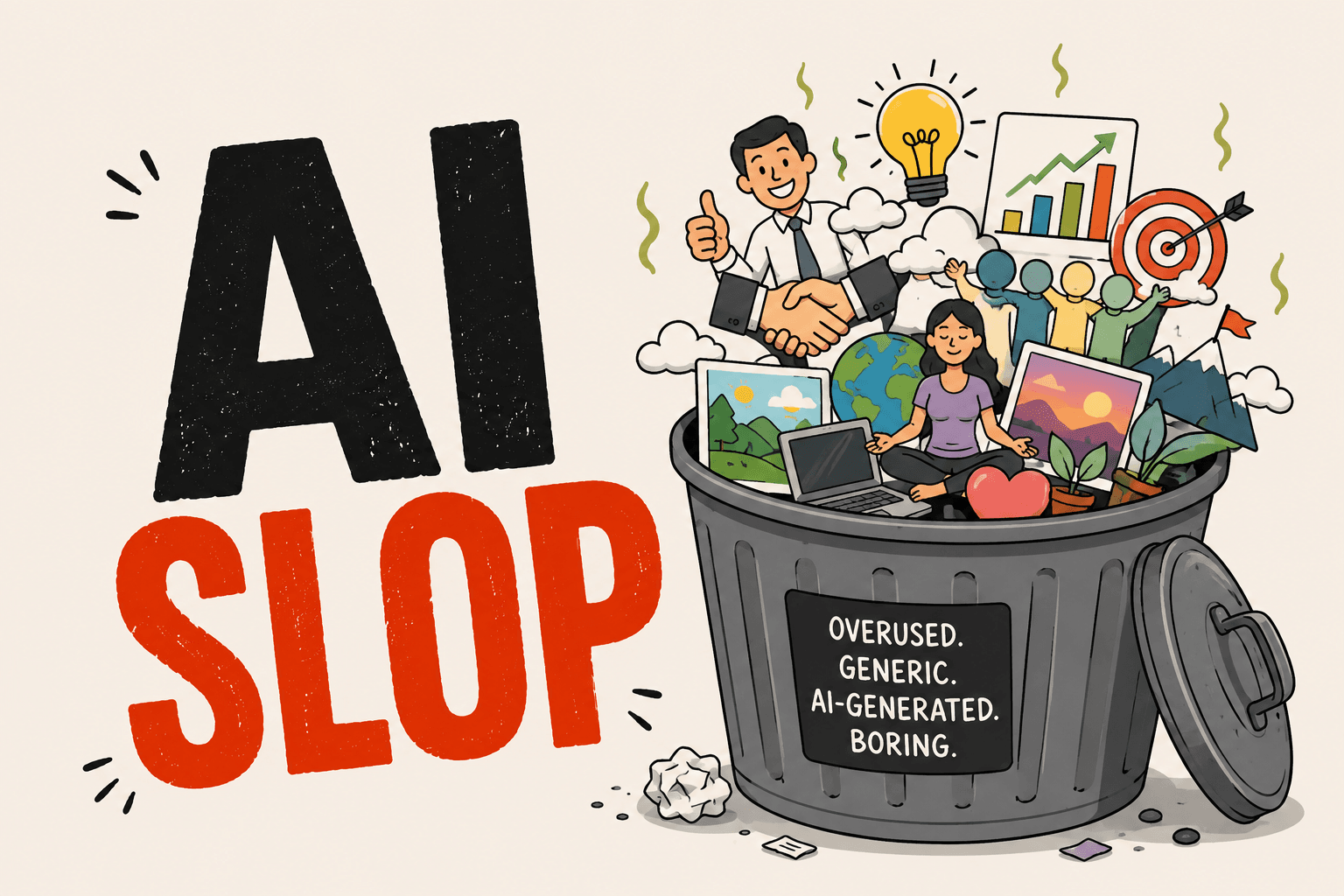
Yesterday I was talking with an executive friend who recently semi-retired after a long career. He had decided to start a small consulting practice and proudly showed his 14-year-old the new logo he'd created using GenAI. His kid glanced at it for about two seconds. "Dad," he said, "that's AI slop."
My friend was truly surprised. He thought it looked perfectly good, but his kid immediately recognized something he couldn't quite see anymore, as if, even after a long career in high-quality professional service, his standards for what makes “good” had gotten fuzzier. And they had gotten fuzzy FAST.
That conversation has stayed with me because I think it points to a much bigger question, not whether AI output is good or bad, but whether AI is changing our definition of “good” entirely. AI is certainly a life-changing tool, but if left unchecked, it is also a threat to the quality set point in all corporate work, and that can have real consequences.
Struggling to make change stick? Learn how to lead it better →
The Sexiness of Speed
For years, organizations have rewarded speed. Now AI has made speed almost limitless. Need a detailed budget breakdown? Done. Need a first draft? Done. Need fifty ideas? Done.
Speed and volume are intoxicating. They light up exactly the parts of the brain that love progress, novelty, and immediate gratification.
Quality, on the other hand, is terribly unglamorous. Quality is slow, it requires multiple rounds of edits and follow-up questions. It’s something we quietly earn in the early hours of the morning and late nights over espresso. Quality throws away perfectly acceptable work in search of exceptional work. Speed gives us dopamine while quality demands patience. Guess which one wins most days in the corporate world?
But the real danger isn't that AI can produce mediocre work; it’s that we are not-so-slowly forgetting what exceptional work looked like in the first place. Ecologists even have a name for this phenomenon: Shifting Baseline Syndrome.
Marine biologist Daniel Pauly coined the term while studying fisheries. Each generation inherited oceans that were already less abundant than the generation before them. But because nobody remembered what the ocean used to look like, each depleted version became the new definition of "normal."
No one felt like they were lowering the standard because the standard simply kept moving (and not in the right direction). Corporate work may be facing the same risk. A new employee joins a company where every first draft comes from AI. They never experience what thoughtful writing looked like before, so their version of "excellent" is already a little flatter. Then they train the next generation. Eventually the entire organization has drifted away from craftsmanship and no one remaining remembers the original baseline well enough to notice.
Use It Or Lose It
Most workers are overloaded and tired, and this makes it very tempting to keep hitting the easy button.
But there's another body of research that reinforces this concern and it's called Skill Decay. Researchers have studied it for decades in aviation, medicine, and the military, fields where forgetting how to perform critical skills carries enormous consequences.
One of the most widely cited studies, by Arthur, Bennett, Stanush, and McNelly, found something important: Skill decline doesn't happen gradually; it accelerates. The longer a skill goes unused, the faster it deteriorates.
This matters because many of the skills AI now performs for us are exactly the ones that improve through repetition, like writing, editing, critical thinking, analysis, and judgment. If we stop exercising those muscles because AI can produce something "good enough," we shouldn't be surprised when our own ability to recognize excellence begins to weaken.
Protecting Your Quality Set Point
So what’s the solution to our waning quality set points? The real leadership challenge here isn't deciding whether to use AI, it's deciding where quality needs to remain stubbornly human, even at the cost of speed. AI generates the first draft, but humans always still own and add to the final product.
It will require real discipline not to get caught up in the conveyor belt of work and output faster simply because you can. Leaders still have to protect their brands and their future from this overall degradation where accepted output becomes sloppier and sloppier.
And not just sloppy, but bland. This word should send healthy fear into the hearts of business owners.
Leaders Create the Baseline
I have a prediction. Within a few years, "Human Made" will become a meaningful mark of quality. Much the way consumers look for "Made in America," "Organic," or "Fair Trade," creative and consulting work may eventually carry its own signal: A human actually crafted this.
Most work will be some combination of human thinking and machine acceleration. But because AI will become more and more ubiquitous, genuine craftsmanship in every form will become more valuable. Scarcity always creates value, and quality just might become the next hottest commodity.
As leaders, you don't just shape today's output; you shape tomorrow's new baseline. And once an organization forgets what excellence looked like, it's remarkably difficult to remember it again.
This was also published on Juliet Funt's LinkedIn.



Leadership
Tags: Leadership & Development (L & D), Artificial Intelligence, Be A Leader