8 Cybersecurity Predictions for 2026
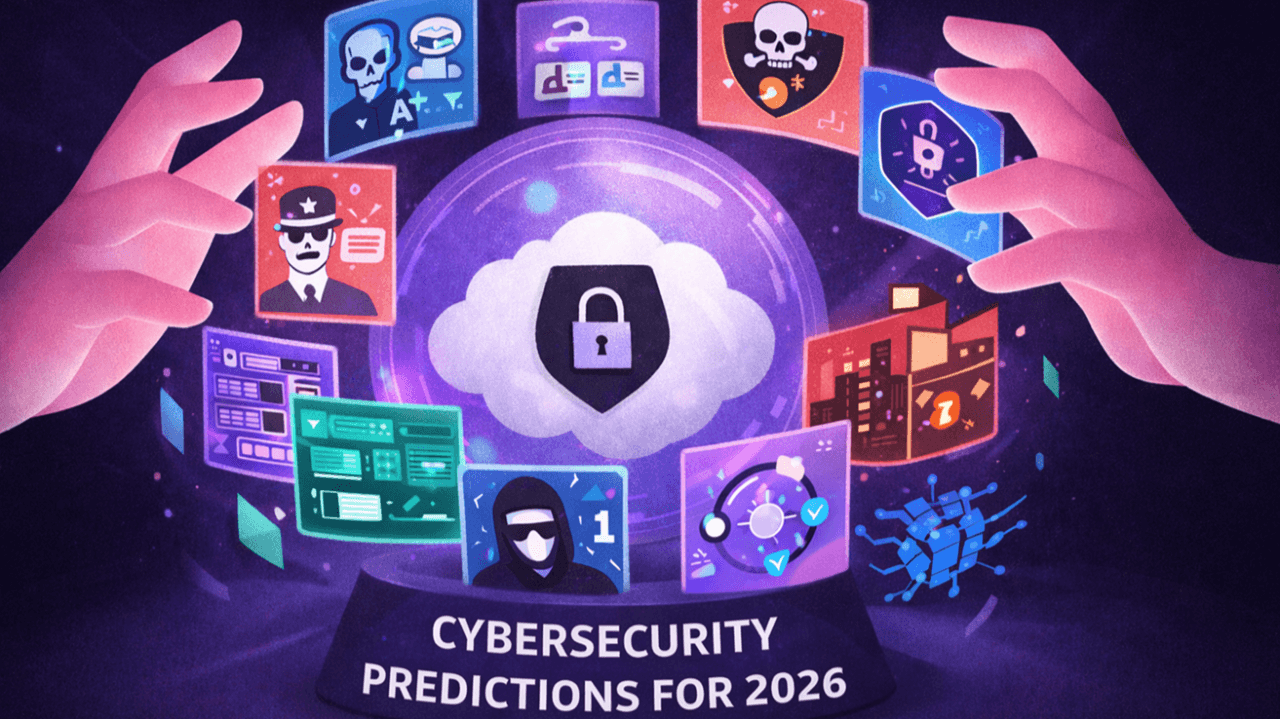
Cybersecurity in 2025 has reached a critical inflexion point. For the past year, I’ve sat down with CEOs, CISOs, and SOC leaders across every major industry, as well as experts from a top cyber security institute, to discuss the shifting front lines of digital defence. From the rise of invisible data flows to the persistent embedding of nation-state actors, the threat landscape is maturing faster than most governance can keep up with.
To lead through this shift, we must move beyond the "detect and respond" mindset. True resilience in 2026 will be measured by how effectively we reduce exposure and enforce least privilege by design. If you are accountable for risk and strategy, the following predictions are the roadmap for what comes next.
Related: Why Smarter Cybersecurity Matters More Than Ever
1. At first, AI will decisively shift the balance toward attackers
Threat actors are moving from experimental use/Proof of concept of AI to operational use. AI is now being applied across reconnaissance, social engineering, malware development, and automation of the entire attack lifecycle. Attacks will become cheaper to run, harder to attribute, scalable, and extremely profitable for the hackers.
Prompt injection, in particular, will become a major enterprise risk as organisations rapidly adopt AI systems, enabling attackers to manipulate models for data exfiltration and sabotage. At the same time, AI-enabled social engineering, especially voice phishing using realistic voice cloning, will increase in volume and effectiveness by exploiting human trust rather than technical weaknesses. Given the high success rate and low deterrence, these attacks will continue to grow, forcing defenders to implement stronger governance, validation, and multi-layered controls to counter AI-driven deception.
We have infact seen this in action this year when a Salesforce instance used by Google was breached by the hacking collective ShinyHunters (also known as UNC6040/UNC6240). The attackers gained access through sophisticated social engineering, specifically voice phishing (vishing), rather than a technical vulnerability in the Salesforce platform itself.
2. SOCs will increasingly rely on AI to keep pace with attack velocity
By 2026, security operations centres will no longer be built around analysts manually triaging alerts. Analysts will move away from drowning in alerts to directing AI agents in what can be described as an “agentic SOC.” Alerts will arrive with AI-generated case summaries, decoded attack activity, and mappings to frameworks like MITRE ATT&CK, enabling analysts to validate decisions and approve containment actions in minutes rather than hours.
Organisations deploying these agentic systems must ensure their insider threat solutions are also AI-augmented, so they can detect anomalous behaviour by privileged users and close automation blind spots before they are exploited.
The same shift will apply to threat hunting and intelligence, where AI performs large-scale data correlation and report generation, allowing human analysts to focus on judgment, strategy, and final decision-making rather than manual analysis.
3. Ransomware will focus on maximum business disruption, not just encryption
Ransomware combined with data theft and extortion will remain the most financially disruptive threat. The objective is no longer limited to endpoints. Attackers are increasingly targeting critical enterprise systems and third parties to trigger cascading operational and supply-chain failures. We saw this with the recent breach of Asahi Group Holding.
4. Infrastructure layers are becoming the new high-value targets
As endpoint defenses mature, attackers are shifting their focus to areas with less visibility and weaker controls, virtualization platforms, control planes, open port vulnerabilities, and shared infrastructure layers. A single compromise at this level can disable hundreds of systems in hours, not days.
This year we saw 4 critical vulnerabilities found in VMware's ESXi, Workstation, and Fusion, allowing attackers to escape from VMs and gain control of the host.
5. ICS and OT environments remain highly exposed
Industrial and operational environments continue to suffer from weak remote access hygiene, like insecure RDP, VPN, outdated software, and insufficient segmentation. Business-layer compromises increasingly spill into OT, turning cyber incidents into real-world operational shutdowns.
6. Governance will struggle to keep up
The growth of AI agents will turn today’s “Shadow AI” issue into a critical “Shadow Agent” risk, as employees deploy powerful agents without formal approval. This creates invisible data flows that increase the risk of data leakage, compliance violations, and IP theft.
Banning AI agents will not work and will only reduce visibility, as employees might run these AI agents off the network. Instead, organisations must establish AI security and governance by design, deploying controls that monitor and manage agent activity while enabling innovation within auditable, secure environments.
7. State-sponsored attacks
State-sponsored cyber activity in 2026 will remain persistent, highly strategic, and closely aligned with geopolitical objectives rather than short-term disruption. Nation-state actors are expected to prioritize stealthy, long-term access for espionage, intelligence gathering, and strategic positioning, often targeting infrastructure layers, edge devices, and trusted third-party providers to maximize scale and impact.
These operations increasingly blur the lines between espionage, cybercrime, and information warfare, with AI amplifying influence campaigns and enabling faster adaptation. For organisations, this means assuming capable adversaries may already be present in the environment and shifting defenses toward layered security, supply-chain risk management, and resilience against long-dwell, well-resourced attackers.
8. Crypto and Web3
As the global economy increasingly adopts cryptocurrencies and tokenized assets (roughly 10% of the world's population held cryptocurrency as of early 2025), cybercriminals will exploit the immutability and decentralization of blockchains for financial gain. High-value attacks against DeFi platforms, crypto exchanges, and supply chains will continue to grow, particularly in regions with expanding crypto adoption (US, Southeast Asia, Middle East).
Threat actors are expected to move core parts of their operations on-chain, using blockchain infrastructure for command-and-control, data exfiltration, and asset monetization, making takedowns significantly harder. This shift will require defenders to develop blockchain investigation capabilities, including transaction tracing and smart contract analysis, while recognizing that the same on-chain immutability that benefits attackers also creates permanent, auditable evidence that can be used to disrupt entire criminal ecosystems.
The implication for leadership is clear, in 2026, security strategy cannot rely on detecting attacks after access is gained. The time between intrusion and impact is collapsing. Resilience will depend on reducing exposure by removing open port vulnerabilities, enforcing least privilege by design, and limiting lateral movement, i.e., what attackers can reach even when they succeed.
The organisations that adapt early will not just respond faster. They will give attackers far fewer opportunities to begin with.
Be Invisible, Be Invincible
Is Your Network SSHepherd® Protected?
cyberarmour.asia


Business
Tags: Cybersecurity

As a CTO with a background in customer success, Prashant Gonga leverages 10+ years of expertise in product development and management, technical onboarding, and account management to drive SAAS and E-commerce success.