Is The Giant Sleeping? How a "Small" Idea is Shook the Foundations of Google
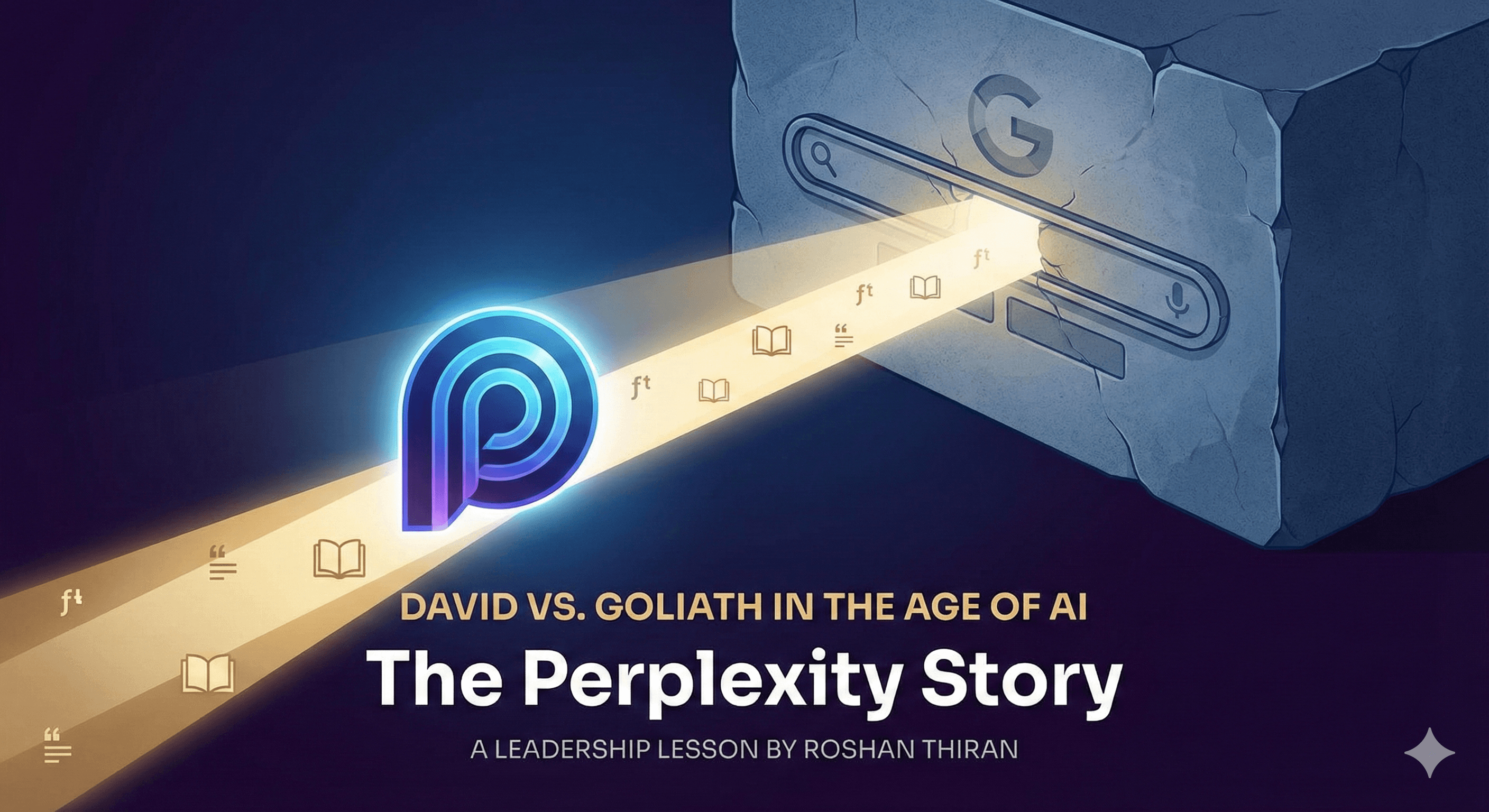
I recently watched a fascinating case study on Perplexity AI (video above), and I couldn’t help but be reminded of the classic David and Goliath story. We often think of "disruption" as a buzzword, something reserved for the history books or Silicon Valley folklore. But right now, we are witnessing it unfold in real-time. (Although in this video it concluses that Perplexity has lost, I think there is much to be learnt from their challenge of Google)
For two decades, Google has been the undisputed king of search. It’s a verb. It’s a habit. It’s the gatekeeper of the internet. But what happens when the gatekeeper becomes too cluttered with ads, SEO spam, and blue links that lead nowhere?
Enter Aravind Srinivas and his team at Perplexity.
This video wasn't just a tech review; it was a masterclass in vision, pivot, and the courage to challenge the status quo. As I reflected on their journey, I distilled three powerful leadership lessons that every entrepreneur, CEO, and manager needs to hear today.
The Case Study: A Quick Breakdown
For those of you who haven’t seen it, here is the essence of the Perplexity story (and what you need to know):
The Origin (0:00 - 2:30): The story begins not with a search engine, but with a frustration. Aravind Srinivas (CEO) and his co-founders—former researchers from OpenAI and Google—realized that Large Language Models (LLMs) were powerful but "hallucinated" (made things up). They wanted accuracy.
The Pivot (2:30 - 5:00): They didn't start with search. They started with "Bird SQL," a tool to search Twitter databases. It was cool, but niche. They realized the real pain point wasn't searching tweets; it was searching the world's knowledge without digging through ten blue links.
The Solution (5:00 - 8:45): Perplexity isn't a "search engine"; it's an "Answer Engine." It reads the internet for you and gives you a direct, cited answer. No ads (mostly). No scrolling. Just the truth.
The Growth (8:45 - End): In just over a year, they went from zero to a "unicorn" status (valued over $1 billion), backed by heavyweights like Jeff Bezos and NVIDIA. They aren't trying to be Google; they are trying to be better than Google at the one thing that matters: finding truth.
3 Leadership Lessons from the Rise of Perplexity
Watching this, I was struck by how applicable their journey is to any of us leading organizations today. Here are my key takeaways:
1. Solve the "Job to Be Done," Not the Tech
We often get obsessed with our product features. Google is obsessed with "organizing information." But Aravind asked a different question: "What is the user actually trying to do?" The user doesn't want to search. The user wants to know. Lesson: Stop falling in love with your process. Fall in love with your customer’s problem. If your "solution" (like 10 blue links) is becoming a hassle, someone else will come along and make it simple.
2. The Power of "Academic Integrity" in Business
In a world of fake news and AI hallucinations, Perplexity doubled down on one thing: Citations. Every answer has a footnote. They brought the rigour of an academic PhD paper to the chaos of the internet. Lesson: Trust is your most valuable currency. In an age of AI, the leaders who prioritize transparency and "showing their work" will win. Don't just give answers; give your people the source of the truth.
3. Courage to Poke the Bear
Everyone said, "Don't build a search engine. Google has won." If Aravind had listened to the "experts," Perplexity wouldn't exist. He understood that even Giants have weaknesses. Google's weakness is its business model—it needs you to click on ads. Perplexity disrupts this by giving you the answer directly, bypassing the ad model entirely. Lesson: Where is the "Giant" in your industry lazy? Where are they too comfortable? That is your opening. You don't need more resources than them; you just need to be willing to do what they cannot afford to do.
My Final Thoughts
Perplexity is still young. They face massive legal battles (copyright is a huge issue) and competition. But they have already taught us that innovation happens when you refuse to accept "good enough."
As you go into your week, ask yourself: What is the "Google" in my life or business—the old habit I'm accepting just because it's always been there?
Maybe it's time to build your own answer engine.
Be a leader today.
- Roshan


Functional
Tags: Case Studies

Roshan is the Founder and “Kuli” of the Leaderonomics Group of companies. He believes that everyone can be a leader and "make a dent in the universe," in their own special ways. He is featured on TV, radio and numerous publications sharing the Science of Building Leaders and on leadership development. Follow him at www.roshanthiran.com