The Courage to Tackle Fear as a Leader

Shobrun Bagastio from Lummi AI
Fear is inevitable in leadership. The weight of responsibility for an organisation’s performance and the livelihood of its people, especially in times when the next crisis is never too far away, can feel overwhelming. The question is how leaders should respond to fear.
Together with Heidi K. Gardner of Harvard Law School, I hosted a discussion on the topic at the recent World Economic Forum Annual Meeting in Davos. During a lively exchange with executives from diverse sectors, I made the case that tackling fear requires building two essential foundations: a cohesive organisation and a moral compass.
Building cohesion through diversity
When times get tough, our instincts often betray us. The common response to uncertainty is often to surround ourselves with faces and perspectives that mirror our own. It’s tempting to seek consensus and eliminate friction by working only with people who think like ourselves.
But this instinct can lead to our downfall.
Related: Fear vs. Anxiety: Emotions at the Edge of Growth
The world is diverse, complex and multifaceted. If we don't tap into the diversity within our organisations, blind spots may emerge. We may miss trade-offs we should be considering or fail to understand segments of our market, our stakeholders or our own teams.
No doubt embracing diversity can be uncomfortable, since it means facing perspectives that challenge our assumptions and slow down our decision-making. But it’s also the organisational equivalent of stress-testing our ideas before we implement them.
A cohesive organisation is one where diversity is embraced. It is also where people with different perspectives are united by something deeper: a shared sense of purpose.
This brings me to the other glue of organisational cohesion. When people see the meaning of their work, the firm’s performance also improves. Take for example a recent study of a consumer goods multinational where some 3,000 employees were invited to workshops about identifying personal meaning in their work. Over two years, the firm’s internal rate of return improved as low performers either left or improved their performance.
When people feel their work has purpose, they're more resilient in the face of uncertainty. They can weather the storms – and stay motivated – because they understand what they do matters.
Trust matters

Source: Rochak Shukla from Freepik
Of course, cohesion requires trust. You cannot have a united organisation, especially one that embraces productive disagreement, without deep trust among and between employees and leadership.
Research shows that trust is built on two pillars: performance and integrity. Delivering results is important, yes, but you must also demonstrate consistent ethical behaviour, because it’s the latter that will sustain trust through crises, when results inevitably suffer.
A moral compass: principles over performance
Economics can teach us much about building organisations, but it has less to offer when we ask deeper questions about leadership: What guides us when the path forward is shrouded in fog? What keeps stakeholders by our side when we stumble or are laid low by events beyond our control?
Tackling fear requires building two essential foundations: a cohesive organisation and a moral compass.
This is where I turn to philosophy. Immanuel Kant wrote, "Act only according to that maxim whereby you can at the same time will that it should become a universal law." To the German philosopher, it’s imperative to identify the principles guiding our actions and apply them consistently.
Your stakeholders – employees, investors, customers and communities – need to understand not just what you do, but why you do it. They need to know the principles that guide your decisions. And critically, they need to see you abide by those principles even when circumstances change, when it's inconvenient and when a different path might seem more expedient.
This transparency of principles creates predictability. When people understand your framework for decision-making, they can trust you through good times and bad. When unforeseen events lead to disappointing outcomes, they can see that you remained true to your stated values. This consistency is what transforms a competent manager into a memorable leader.
Yes, performance maximisation must remain one of your guiding principles. But I believe truly memorable leadership requires going beyond this. It requires articulating a set of values that encompasses how we treat people, how we engage with our communities, how we steward resources, and what we're willing to sacrifice.
What will you be remembered for?
Every leader should ask themselves: What do you want your legacy to be? What do you want to be remembered for? If one is remembered only for hitting quarterly targets or maximising shareholder value, I’d argue they have fallen short of their potential to be a great leader.
Fear in leadership often stems from focusing on outcomes we cannot fully control. Markets will fluctuate, crises will erupt, or our best efforts may fall flat. But we can stay true to our principles. We can control whether we build organisations that embrace diversity and foster purpose. We can control whether we act with integrity. Because as leaders, these matter more than fear itself.
For leaders carrying more than their job titles…
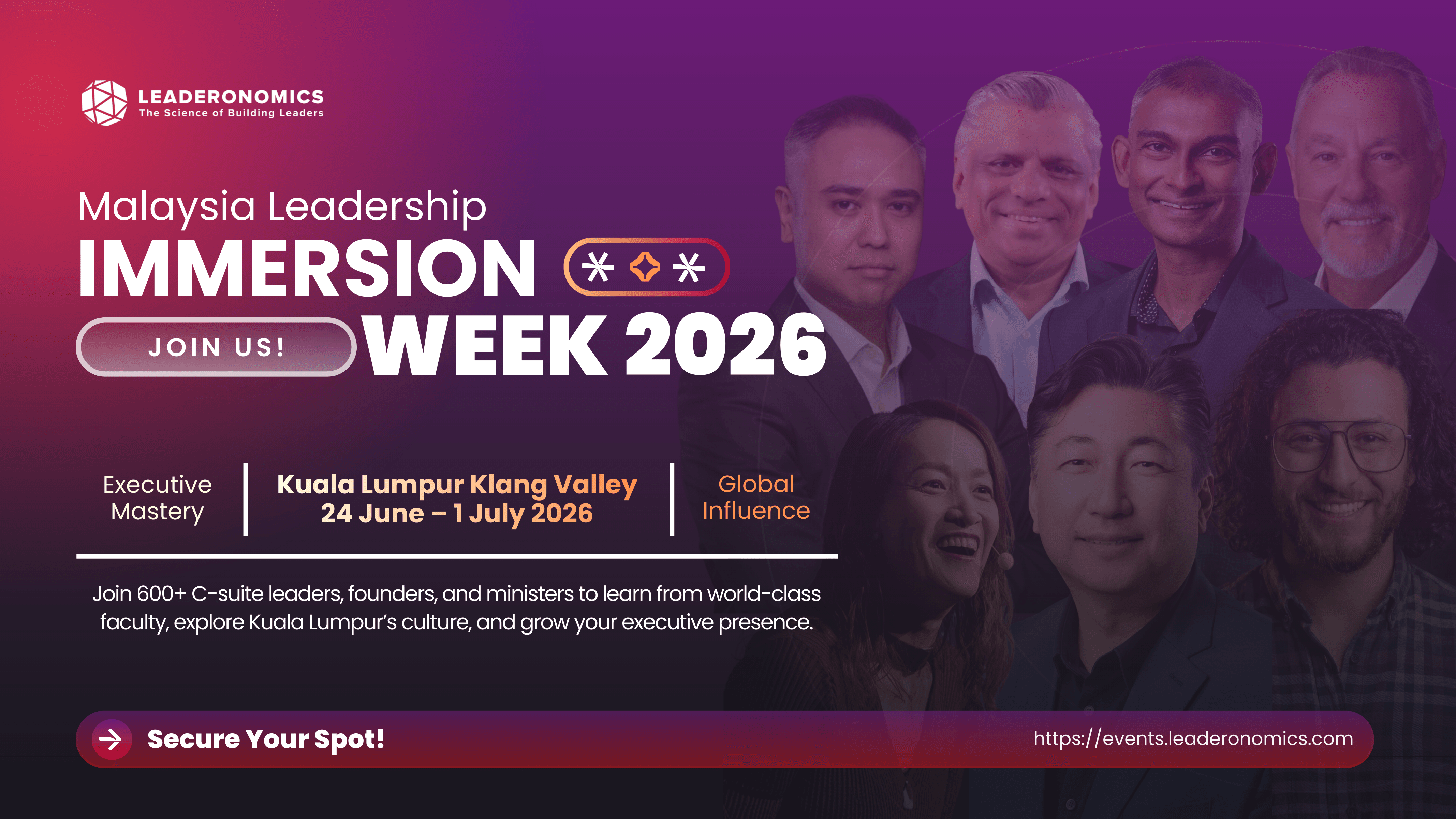
Be part of Malaysia Immersion Week 2026!
Join us for an 8-day journey (June 24–July 1, 2026) designed for leaders who want time and space to connect with like-minded business leaders. You’ll gain VIP access to the Malaysia Leadership Summit, engage in masterclasses with global leaders, and experience cultural immersion that offers fresh perspective on yourself and your team.
Apply now!



Collaborator Description:
This article is published courtesy of INSEAD Knowledge, the portal to the latest business insights and views of The Business School for the World. Copyright INSEAD 2026.
Edited by: Seok Hwai Lee
Leadership

Alexandra Roulet is an Assistant Professor of Economics at INSEAD and a CEPR Research Affiliate.