Team Leadership Development: A CEO's Guide to Building Leaders Who Actually Deliver

Companies spend an average of $3,750 per leader annually on development programs. Only 25% can demonstrate any clear ROI from that investment (Harvard Business Review, 2023). And when DDI surveyed thousands of organizations for their Global Leadership Forecast, the number that rated their own leadership development as "very effective" was 12%.
That means 88% of organizations know their leadership development programs are underperforming. They keep funding them anyway.
This guide is for the CEO or senior leader who wants to stop subsidizing mediocre results. What follows is a framework for team leadership development built on research from McKinsey, the Center for Creative Leadership, DDI, and behavioral data from over 500,000 workplace interactions. Every recommendation is specific, measurable, and tied to business outcomes.
Table of Contents
- Why Most Leadership Development Programs Fail
- The 5 Capabilities That Actually Matter
- How to Structure a Development Program
- Measuring Whether It's Working
- The ROI Calculation
- Implementation Timeline
- Common Pitfalls
Why Most Team Leadership Development Programs Fail
The problem is specific and diagnosable. Programs fail for three structural reasons, not because leadership is “hard to teach.”
Reason 1: They develop the wrong capabilities. Most programs focus on strategic thinking, visioning, and executive presence. Those matter for senior leaders. For the team leaders who manage 80% of your workforce, the capabilities that move performance metrics are different: coaching conversations, conflict resolution, goal clarity, and feedback quality. Programs built for the C-suite get applied to the entire management layer.
Reason 2: They rely on the wrong delivery method. The Center for Creative Leadership's research is clear: 70% of leadership development happens through on-the-job experiences, 20% through developmental relationships, and 10% through formal training. Yet organizations spend the majority of their budget on that 10% (workshops, courses, offsites) and hope the other 90% happens organically. It doesn't.
Reason 3: They never measure outcomes. DDI found that organizations typically track attendance (did they show up?) and satisfaction (did they enjoy it?). Tracking whether the program changed leadership behavior or improved team outcomes is rare. Without measurement, ineffective programs persist for years because no one can prove they're failing.
McKinsey's 2023 research quantifies the cost of getting this wrong: organizations with effective leadership development are 2.4x more likely to hit their performance targets. The inverse is equally true. Ineffective development drags performance. It also signals to your strongest managers that growth isn't a priority, which accelerates the attrition of the people you can least afford to lose.
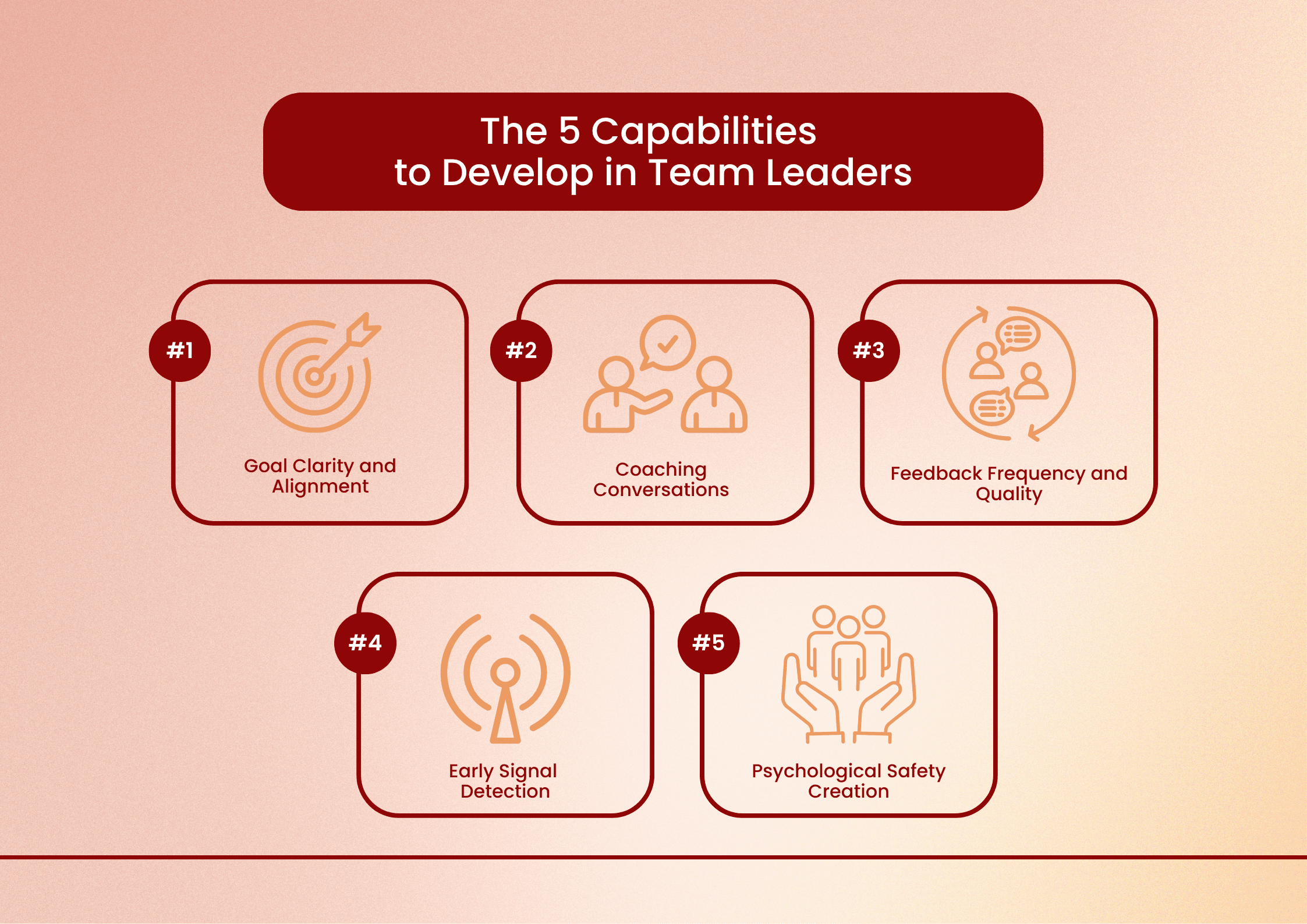
The 5 Capabilities to Develop in Team Leaders
When researchers isolate which leadership behaviors predict team outcomes, the same five capabilities surface repeatedly. These aren't "nice to haves." Each one connects to a measurable business result.
Capability 1: Goal Clarity and Alignment
What it is: The ability to translate organizational strategy into clear, specific goals for each team member, and to connect daily work back to those goals.
Why it matters: When team members can articulate how their work connects to the company's priorities, execution speed increases and rework decreases. When they can't, you get the "alignment tax": people working hard on things that don't matter.
What good looks like: A manager who can answer, in real time, what each of their direct reports is focused on this week and why it's the highest-leverage use of their time. Research from Happily.ai shows that teams with high alignment scores resolve conflicts 31% faster, because disagreements about priorities get surfaced early rather than festering.
How to develop it: Practice translating company OKRs into team-level goals in a workshop setting, then apply it in weekly team meetings. The feedback loop is immediate: if team members can't restate the goal, the translation failed.
Capability 2: Coaching Conversations
What it is: The ability to help team members solve problems through guided questions rather than directive answers. Not "here's what I'd do" but “what options have you considered, and what's holding you back?”
Why it matters: Directive management creates bottlenecks. When every decision routes through the manager, speed drops and the manager burns out. Coaching develops decision-making capacity across the team.
What good looks like: A manager who spends more time asking questions than providing answers in 1:1s. The ratio should skew 60-70% listening, 30-40% speaking. Teams led by coaching-oriented managers show higher autonomy scores and lower escalation rates.
How to develop it: Pair each developing leader with a coaching partner (peer or external coach) for monthly practice sessions. Record and review 1:1 conversations (with permission) to identify moments where the manager defaulted to telling instead of asking.
Capability 3: Feedback Frequency and Quality
What it is: The ability to deliver timely, specific, behavior-focused feedback (both reinforcing and corrective) as a regular practice, not a quarterly event.
Why it matters: Managers account for 70% of the variance in team engagement, and feedback is the primary mechanism through which that influence operates. Delayed feedback loses its power. A manager who waits three months to address a pattern has let that pattern become a habit.
What good looks like: Feedback delivered within 48 hours of the observed behavior. Specific enough that the recipient knows exactly what to repeat or change. Balanced: reinforcing feedback should outnumber corrective feedback roughly 3:1 to maintain psychological safety.
How to develop it: Structured practice with real scenarios. Roleplay is effective when it uses actual situations from the manager's team (anonymized if needed). The SBI model (Situation-Behavior-Impact) from the Center for Creative Leadership gives developing leaders a repeatable framework.
Capability 4: Early Signal Detection
What it is: The ability to identify disengagement, burnout, or conflict before they escalate into resignations or performance crises.
Why it matters: Exit interviews are autopsies. By the time someone tells you why they're leaving, you've already lost them, their institutional knowledge, and 6-9 months of salary in replacement costs. Leaders who catch signals early can intervene when the cost of intervention is low.
What good looks like: A manager who notices changes in participation, energy, or communication patterns and initiates a conversation within a week. Teams with top-quartile managers on early signal detection show 40% lower turnover (Happily.ai data).
How to develop it: Teach specific behavioral markers (decreased participation in meetings, shorter responses in written communication, reduced initiative). Pair this training with data tools that surface team health metrics in real time, so managers have both intuition and evidence.
Capability 5: Psychological Safety Creation
What it is: The ability to create an environment where team members surface problems, admit mistakes, and challenge ideas without fear of punishment.
Why it matters: Google's Project Aristotle found psychological safety to be the strongest predictor of team performance. Teams that hide problems don't fix them. They accumulate failure silently until the cost is catastrophic.
What good looks like: Team members proactively flagging risks in meetings. People disagreeing with the manager openly. Mistakes discussed as learning opportunities, not blame events.
How to develop it: Model vulnerability from the top. When the CEO or senior leader admits a mistake publicly, it signals that honesty is safe. For developing managers: practice opening team meetings with "What's one thing that didn't go well this week?" and responding to the answer with curiosity, not correction.
Why These Five (and Not Others)
Strategic thinking, executive presence, stakeholder management: these are important for senior leaders. But for the team leaders who run your day-to-day operations, the five capabilities above are where the variance lives. A manager with strong coaching skills but average strategic thinking will outperform a brilliant strategist who can't hold a 1:1.
Brandon Hall Group's research confirms this at scale: companies with strong leadership development focused on these operational capabilities are 6x more likely to be in the top quartile for employee engagement.
The 5 Capabilities to Develop in Team Leaders
How to Structure a Team Leadership Development Program
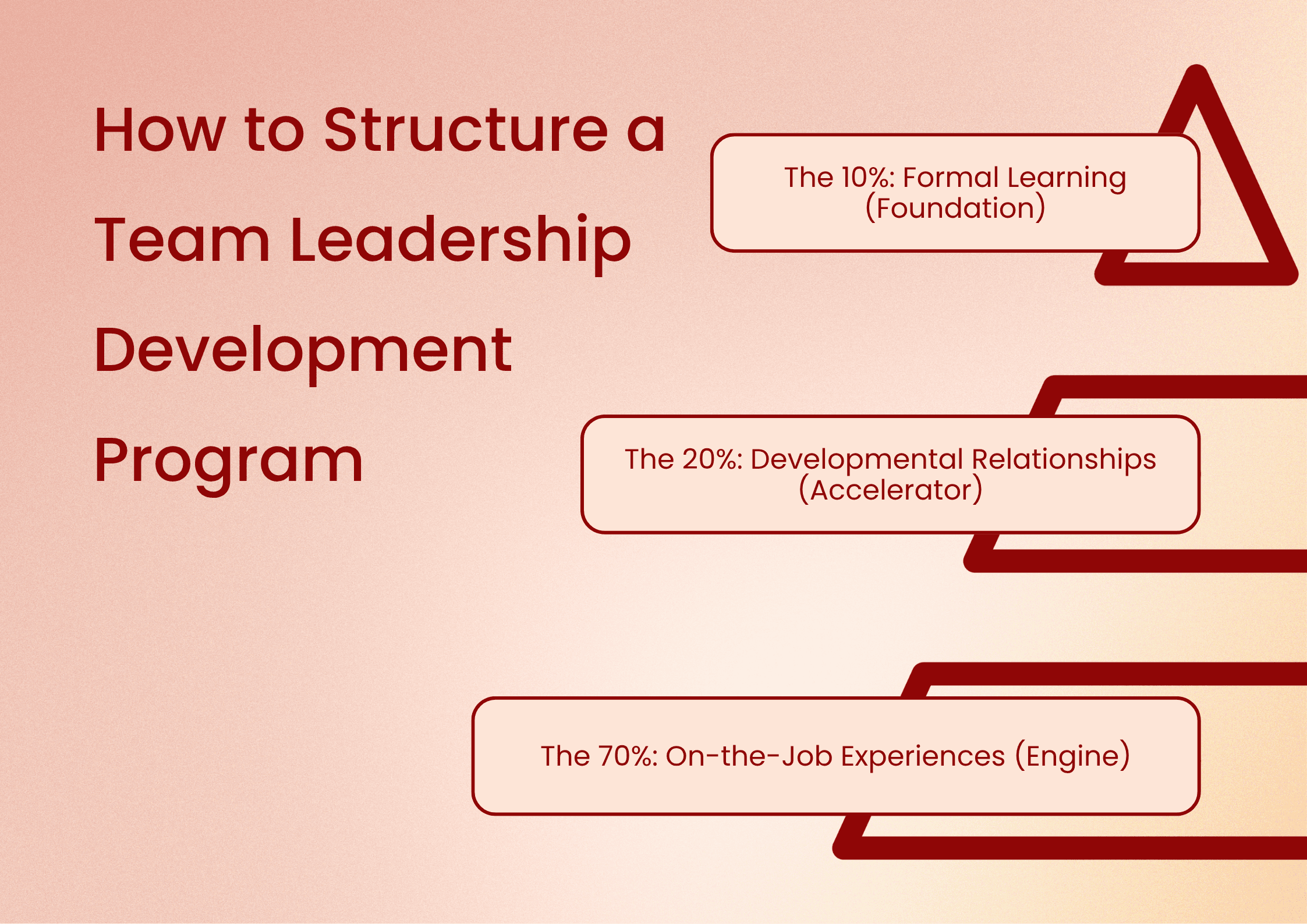
The 70-20-10 framework (Center for Creative Leadership) gives the architecture. Here's what it looks like in practice.
The 10%: Formal Learning (Foundation)
This is the smallest component by time investment but serves as the foundation. Use it to introduce frameworks, shared language, and evidence.
| Format | Duration | Frequency | Purpose |
| Cohort workshop | 4 hours | Monthly | Introduce capability frameworks, practice in safe environment |
| Micro-learning modules | 15-20 min | Weekly | Reinforce concepts, introduce new research |
| Case study sessions | 90 minutes | Biweekly | Analyze real organizational scenarios |
Key design principles:
- Cohort-based, not individual. Leaders develop faster when they learn alongside peers who share the same challenges. Cohorts of 8-12 create accountability without diffusing attention.
- Spaced over months, not concentrated in days. A 3-day leadership retreat feels productive. Research on learning retention shows that 80% of content from intensive workshops is forgotten within 30 days without reinforcement (Thalheimer, Spacing Effect in Learning, 2006).
- Focused on the five capabilities, not a buffet. Resist the temptation to add modules on "innovation thinking" or "digital transformation." Depth beats breadth.
The 20%: Developmental Relationships (Accelerator)
Relationships are where formal learning gets stress-tested against reality.
| Relationship Type | Structure | Focus |
| Peer coaching pairs | Biweekly 45-min sessions | Practice feedback delivery, problem-solve real scenarios |
| Skip-level mentoring | Monthly 30-min sessions | Broader organizational perspective, career development |
| External coach | Monthly 60-min sessions (for high-potentials) | Deep behavioral change, blind spot identification |
What makes this work: Structure. Unstructured mentoring (pairing a senior leader with a developing manager and hoping they meet) produces results roughly equivalent to doing nothing. Each relationship needs a cadence, an agenda framework, and clear outcomes to track.
Manager behaviors cascade through organizations in predictable ways. A manager's direct leader is the single strongest influence on their management style. This means the developmental relationships you design are, in effect, designing the management culture of the next layer down.
The 70%: On-the-Job Experiences (Engine)
This is where development actually happens. The challenge: most on-the-job learning occurs by accident. Intentional design makes it dramatically more effective.
| Experience | What It Develops | How to Assign |
| Leading a cross-functional project | Goal alignment, stakeholder management | Assign projects that require negotiating priorities across teams |
| Onboarding a new team member | Coaching, feedback, clarity | Every developing manager should onboard at least one person per quarter |
| Managing through a conflict | Early signal detection, psychological safety | When conflicts arise, resist solving them from above. Coach the manager through it. |
| Running a quarterly planning process | Goal clarity, strategic translation | Have developing managers own the process for their team, not just participate |
| Presenting to senior leadership | Communication, executive presence | Monthly updates from developing managers to the leadership team |
The critical design choice: deliberate stretch with supported recovery. Assign challenges that push developing leaders slightly beyond their current capability, then pair them with coaching support (the 20%) to process what they learned. Without the stretch, growth stalls. Without the support, you get failure and disillusionment.
Measuring Your Leadership Development Program
Measurement separates the 12% of effective programs from the 88% that persist on faith. Here's a framework that tracks both leading indicators (is the program working?) and lagging indicators (did it produce results?).
Leading Indicators (Track Monthly)
These tell you whether the program is on track before you see business outcomes.
| Indicator | How to Measure | Target |
| Feedback frequency | Number of feedback interactions per manager per week | 3+ per direct report per month |
| 1:1 completion rate | Percentage of scheduled 1:1s that actually happened | >90% |
| Coaching question ratio | Percentage of 1:1 time spent asking vs. telling | >50% asking |
| Goal clarity score | Team members can articulate their goals and connection to company priorities | >80% of team |
| Response time to employee concerns | Average days between concern raised and manager response | <3 days< td> |
Lagging Indicators (Track Quarterly)
These confirm that behavioral changes are producing business results.
| Indicator | How to Measure | Target |
| Team engagement score | Pulse survey or continuous measurement | Top quartile improvement within 6 months |
| Voluntary turnover | Annualized turnover rate for teams of developing leaders | 20%+ reduction vs. baseline |
| Promotion readiness | Percentage of developing leaders deemed ready for next role | >60% within 18 months |
| Manager effectiveness score | Multi-dimensional assessment of manager behaviors | Progressive improvement each quarter |
| Time to fill internal roles | Speed of filling roles with internal candidates | 30% faster than external hiring |
The Measurement Cadence
| Timeframe | What to Measure | Who Reviews | Action |
| Monthly | Leading indicators | Program lead + participants | Adjust coaching focus, identify struggling participants |
| Quarterly | Leading + lagging indicators | Senior leadership team | Assess program trajectory, decide on continuation/expansion |
| Annually | Full ROI analysis | CEO + board | Strategic investment decision for next fiscal year |
Avoiding the measurement trap: do not survey participants about whether they "enjoyed" the program. Satisfaction scores correlate weakly with behavior change. A program that makes leaders uncomfortable (because it pushes them) often produces better outcomes than one that gets high ratings.
Calculating Leadership Development ROI
Here's the math that makes the business case. Every number below is sourced from published research or derived from it.
Cost Side
| Cost Component | Typical Range | Notes |
| Program design and facilitation | $500-1,500/leader | Internal: lower cost, less objectivity. External: higher cost, fresh perspective |
| Manager time (opportunity cost) | $1,000-2,000/leader | Based on 40-60 hours over 12 months at manager-level compensation |
| Technology and tools | $200-500/leader | Measurement platforms, learning management, coaching tools |
| External coaching (high-potentials) | $2,000-5,000/leader | For top 20% of cohort only |
| Total per leader | $2,000-6,000 | Varies by program intensity |
Return Side
| Return Component | Calculation | Typical Value |
| Reduced turnover | (Avoided departures) x (Replacement cost at 6-9 months salary) | $50,000-150,000 per avoided departure |
| Increased productivity | (Engagement increase) x (Productivity multiplier of 17-21%) | Varies by team size |
| Reduced absenteeism | (Engagement increase) x (Absenteeism reduction of 41%) | $2,000-5,000/employee/year |
| Faster internal promotion | (Avoided external search fees) x (Number of internal promotions) | $15,000-30,000 per filled role |
A Worked Example
Consider a 100-person company with 12 team leaders:
- Program cost: 12 leaders x $4,000 = $48,000
- Turnover reduction: If program prevents 3 departures at $75,000 replacement cost = $225,000
- Productivity gain: 12 teams averaging 7 people, 10% engagement improvement translating to 4% productivity gain on average salary of $70,000 = $235,200
- Year 1 ROI: approximately 8.5x
This is conservative. It excludes harder-to-quantify benefits like institutional knowledge retention, reduced conflict costs, and the cascade effect where better managers develop better future managers.
McKinsey's finding that effective development makes organizations 2.4x more likely to hit performance targets puts the ROI in strategic terms: this investment isn't about "people stuff." It connects directly to whether the company achieves its goals.
How to Structure a Team Leadership Development Program
Implementation Timeline: Quarterly Milestones
A practical roadmap for launching a team leadership development program from scratch. This assumes a mid-size organization (50-500 employees) with 10-30 team leaders.
Quarter 1: Foundation
Month 1: Assessment
- Baseline manager effectiveness scores across all five capabilities
- Identify top-quartile managers (your future peer coaches and mentors)
- Audit existing development programs for overlap and gaps
- Secure executive sponsorship (CEO, not just CHRO)
Month 2: Design
- Select first cohort of 8-12 developing leaders
- Design 12-month program structure mapped to 70-20-10
- Pair each participant with a peer coaching partner
- Create measurement dashboard with leading indicators
Month 3: Launch
- Kick off first cohort workshop (4 hours, focused on goal clarity and alignment)
- Begin biweekly peer coaching sessions
- Assign first on-the-job stretch project to each participant
- Start monthly leading indicator tracking
Quarter 2: Acceleration
- Second and third workshops (coaching conversations, feedback delivery)
- Introduce skip-level mentoring relationships
- First quarterly review of leading and lagging indicators
- Adjust program based on data (which capabilities need more focus?)
- Begin external coaching for top 3-4 high-potentials
Quarter 3: Deepening
- Fourth and fifth workshops (early signal detection, psychological safety)
- Participants lead a team retrospective using new capabilities
- Second quarterly review with senior leadership presentation
- Identify candidates for Cohort 2
- Document case studies from Cohort 1 for internal communication
Quarter 4: Scaling
- Cohort 1 graduation and assessment against baseline
- Full ROI calculation and business case for Year 2
- Launch Cohort 2 with design improvements from Cohort 1 learnings
- Promote strongest participants into peer coaching roles for Cohort 2
- Annual report to board on leadership pipeline health
7 Pitfalls That Derail Leadership Development Programs
Each of these is common, predictable, and avoidable.
Pitfall 1: Treating Development as an Event
A two-day offsite is not a development program. It's a kickoff. When organizations invest heavily in an intensive experience and then provide no follow-through, they've spent money on inspiration that fades within weeks. The 70-20-10 model exists because behavior change requires sustained practice, not a single dose.
Pitfall 2: Developing Everyone at Once
The instinct to be "fair" by enrolling all managers simultaneously dilutes impact. Start with a cohort of 8-12. Develop them well. Use their success stories to build demand for the next cohort. Scarcity creates value.
Pitfall 3: Skipping the Baseline
Without a pre-program measurement, you cannot demonstrate improvement. Every program should start with quantified baseline scores on the five capabilities. If you can't measure it before, you can't prove it improved after.
Pitfall 4: No Executive Sponsorship
When the CEO delegates leadership development entirely to HR, it sends a signal: this is an HR initiative, not a business priority. The programs that produce results have a senior leader (ideally the CEO) who opens sessions, checks in on progress, and asks about outcomes in leadership meetings.
Pitfall 5: Teaching Theory Without Practice
Knowing what "good feedback" looks like is different from delivering it under pressure. Every workshop hour should include at least 40% practice time using real scenarios. The gap between knowing and doing is where most programs lose their impact.
Pitfall 6: Ignoring the Manager's Manager
Development doesn't stick when a participant's own manager models different behaviors. If you're developing someone in coaching conversations, but their boss operates through commands, the gravitational pull of daily reality beats workshop learning every time. Include the participant's manager in the program design (even informally) to align expectations.
Pitfall 7: Measuring Satisfaction Instead of Behavior
"How did you enjoy the program?" is the wrong question. "How has your feedback frequency changed in the past 90 days?" is the right one. Satisfaction surveys measure the experience of the program. Behavioral metrics measure the effectiveness of it. Only one predicts ROI.
Building the Leadership Layer Your Organization Needs
The 88% failure rate in leadership development isn't a reflection of how hard it is to develop leaders. It reflects how poorly most programs are designed: wrong capabilities, wrong delivery method, no measurement.
The organizations in the top 12% share a common approach. They focus on the specific capabilities that predict team outcomes. They weight on-the-job experience over classroom learning (70-20-10). They measure behavioral change, not satisfaction. And they treat leadership development as a strategic investment with a defined ROI, not a line item under “employee benefits.”
For a CEO deciding where to invest, the math is straightforward. A well-designed team leadership development program costs $2,000-6,000 per leader and returns multiples of that through reduced turnover, increased productivity, and stronger internal promotion pipelines. McKinsey's 2.4x performance target finding makes the strategic case. The 6x engagement multiplier from Brandon Hall Group makes the people case.
The starting point: pick your first cohort of 8-12 team leaders, baseline their capabilities, and build the program around what the research says matters. Not what's trendy. Not what fills a catalog. What produces measurable results.
Ready to baseline your managers and build a development program with measurable outcomes? Happily.ai's performance intelligence platform provides continuous data on manager effectiveness, team alignment, and early warning signals, giving you the measurement foundation that 88% of programs lack. Book a demo to see how teams with top-quartile managers achieve 40% lower turnover and 31% faster conflict resolution.


Leadership
Tags: HR, Leadership & Development (L & D), Building Functional Competencies

Tareef is a product-focused innovator passionate about data, design, and using tech for good. He believes technology should make us better: happier, and healthier.