Grey Leadership
There is a paradox at the heart of most leadership appointments. Organisations select leaders precisely because they have a strong voice. A track record. A proven way of seeing and solving. A philosophy that has produced results. The qualities that make a leader appointable are the same qualities that can, once they arrive, make them difficult to lead through.
This is not a character flaw. It is the central tension of every leadership transition. The leader brings a voice shaped by prior success. The institution already carries a voice shaped by decades of accumulated identity, culture, memory, and collective expectation. When those two voices are in genuine dialogue, something productive becomes possible. When the leader’s voice becomes so dominant that the institution’s voice can no longer be heard, a specific and recognisable condition begins to form.
Leadership researchers have begun calling this condition grey leadership. It is worth understanding what that means, because the term names something most leaders have experienced without ever having a word for it.
Equip yourself for complexity with our Paradoxical Leadership framework →
What Grey Leadership Actually Is
Grey leadership is not dark leadership. It is not the deliberate abuse of power, the calculated manipulation of others, or the conscious erosion of trust. Those conditions exist and deserve their own examination. Grey leadership is subtler, more common, and in many ways more difficult to address precisely because it does not feel wrong from the inside.
Grey leadership describes the condition in which a leader’s behaviours, intentions, and decisions produce mixed outcomes that cannot be simply classified as constructive or destructive. The same management style that produces results in one context creates resistance in another. The same philosophy that built success elsewhere generates incoherence in the new institution. The same conviction that enabled decisive action in a previous role becomes, in different circumstances, an inability to hear what the current situation is actually requiring.
Mixed ethical intent. Inconsistent moral signalling. Situationally contingent consequences. These are the markers of grey leadership as researchers have begun to define it. And when this condition persists across successive appointments in the same organisation, it suggests something deeper than individual leadership failure. It suggests that the institution itself has entered a sustained grey state, one in which the developmental conditions for genuine transformation are not yet present.
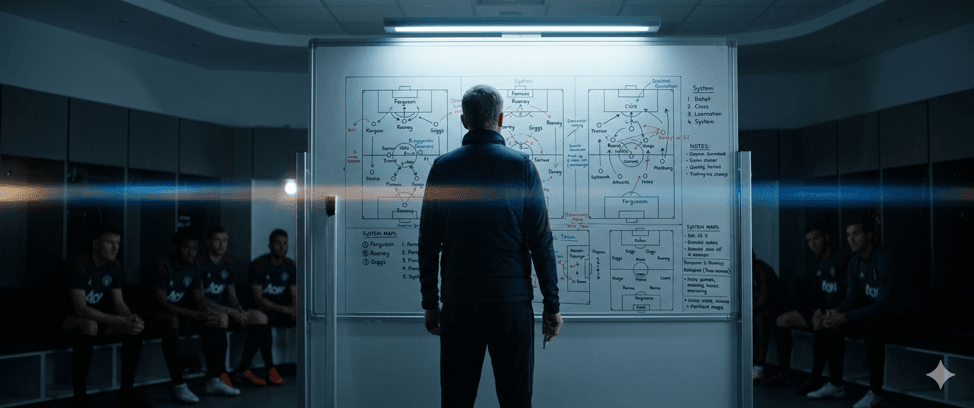
Manchester United’s thirteen years following Sir Alex Ferguson’s retirement illustrate this with unusual clarity. Seven managers. Seven distinct philosophies. Seven genuine attempts to restore what had been lost. And yet the grey persisted, not because each manager was without capability, but because the conditions that would have enabled movement through the grey territory toward coherent performance were repeatedly dismantled before they could fully form.
Grey leadership is not a verdict on a leader’s character. It is a description of conditions. And conditions can change.
Two Voices, One Institution
In Article 5 of this series, we explored the idea that institutions carry voices. Not the voice of the mission statement or the annual report, but the voice that lives in the people, the rituals, the collective memory, the shared understanding of what the institution is fundamentally for. That voice does not disappear when leadership changes. It continues, expressed through morale, through engagement, through the quality of performance, through the enthusiasm or resistance that greets each new initiative.
Grey leadership frequently begins at the point where the leader’s voice and the institution’s voice diverge, and where that divergence goes unaddressed. Not because the leader is indifferent. But because the leader’s prior certainty, the model that worked before, the philosophy refined through years of success, becomes the lens through which every institutional signal is interpreted. Resistance is read as a problem to be overcome rather than as information to be received. Disengagement is attributed to individual performance rather than to systemic misalignment. The institution keeps communicating. The leader keeps leading. But the two are no longer quite in contact with each other.
Brian Niccol’s appointment as Chief Executive of Starbucks in September 2024 offers a recent and instructive illustration. Arriving from Chipotle with a strong reputation for operational turnaround, Niccol brought a coherent diagnosis and a credible prescription. Streamline the menu. Reduce complexity. Improve speed. These interventions were tactically defensible from a performance perspective.
But Starbucks carries a specific institutional voice. Howard Schultz built it over decades around the philosophy of the third place, the space between home and work, where belonging, warmth, and the unhurried pleasure of a familiar ritual were the actual product. That voice is carried not in the coffee but in the atmosphere, in the barista who knows a customer’s name, in the handwritten cup, in the sense that the café belongs to the neighbourhood it inhabits. Speed and belonging pull in different directions. Efficiency and the third place experience are not easily reconciled. The institution’s voice was communicating this tension. Whether it was being fully heard before the redesign began is the question the results continue to pose.
This is not a judgement of Niccol’s leadership. It is an observation about the structural challenge that every leader faces when they arrive carrying a successful model into an institution that already carries its own deep identity. The grey leadership condition does not require bad intentions. It requires only that the leader’s voice becomes louder than the institution’s voice for long enough that the signals stop reaching the decisions that are being made.

How Leaders Begin to Hear Again
The question that matters most is not how grey leadership forms. That process is by now familiar. The question is how leaders move through it toward something more coherent. This is where the science, if we can call it that, becomes genuinely useful.
What research and practice suggest is that the movement through grey territory toward discernment does not begin with a new strategy or a new system. It begins with a different quality of attention. And that quality of attention has a recognisable structure, one that can be developed rather than simply hoped for.
The neurologist Antonio Damasio has argued that feelings are the inaugural event of consciousness: that the body registers something meaningful before the conscious mind has language for it. Leaders who have moved through significant institutional misalignment often describe a moment of felt unease that preceded any formal recognition of the problem. Something was not right before the performance data confirmed it. Something felt misaligned before the resistance became visible. That felt sense, dismissed in many leadership cultures as mere intuition or sentiment, is in Damasio’s framing a form of biological intelligence. The institution communicating through the body of the leader before it reaches their analysis.
Michael Polanyi, the philosopher of science, captured this with the phrase we know more than we can tell. Expert practitioners, whether surgeons, musicians, or experienced leaders, develop the capacity to recognise patterns before they can articulate why. A leader who has spent decades building and leading institutions carries within them a tacit understanding of what healthy institutional dynamics feel and sound like. When those dynamics are absent, that tacit knowing registers the absence, often before any formal indicator confirms it. The institutional voice reaches the experienced leader not through a report but through a quality of recognition that precedes explanation.
Karl Weick, writing on how organisations make sense of themselves, argues that what we notice and what we make of what we notice depends substantially on identity: on who we understand ourselves to be and what we therefore expect to see. A leader whose identity is bound tightly to a particular model will notice the signals that confirm that model and interpret away the signals that challenge it. The pathway toward genuine listening therefore involves something uncomfortable: a sufficient loosening of identity attachment that the institutional voice can reach the leader’s attention without being immediately filtered through prior certainty.
The pathway from grey leadership toward discernment begins not with a new strategy but with a different quality of attention. One that is sufficiently free from prior certainty to hear what the institution is actually saying.
The Gap: Where Most Transformations Stall
Between the moment a leader begins to hear the institutional voice and the moment genuine transformation becomes possible, there is a space that deserves to be named directly. We might call it the Gap.
The Gap is not a stage in a process or a step in a framework. It is a holding space. Within it, the leader encounters the full weight of what genuine listening requires: the ambiguity of not yet knowing the answer, the grief of releasing a model that has defined their professional identity, the fear that letting go of prior certainty will leave them without foundation, the attachment to past success that makes the present reality harder to see clearly.
Most grey leadership persists not because leaders cannot recognise the institutional signals. It persists because they cannot bear to stay in the Gap long enough for those signals to fully reach them. The pressure to resolve, to decide, to demonstrate authority and direction, compresses the space in which genuine understanding might form. A new system is installed. A new philosophy is announced. The cycle continues.
George Kohlrieser’s work on secure base leadership is directly relevant here. He argues that the capacity to process difficulty, grief, and loss without becoming their prisoner depends on the quality of the psychological foundation a leader carries. A leader who is inwardly secure enough to remain in uncertainty, to hold the question without prematurely resolving it, to feel the weight of what the institution is communicating without being overwhelmed by it, is a leader who can stay in the Gap long enough for transformation to become possible. That inner security is not passivity. It is, in Kohlrieser’s terms, the precondition for genuine courage.
Michael Carrick’s arrival at Manchester United in January 2026 demonstrated what it looks like when a leader holds the Gap successfully. He did not arrive with a declaration. He arrived with a question. He asked every player individually what they considered their best position and why. He listened to the answers. He integrated what he heard with his own assessment. He built from what was already present in the institution rather than from what he had decided in advance it should become. Eleven wins from sixteen games followed. Not because a brilliant new philosophy arrived, but because a leader arrived sufficiently free from attachment to his own prior certainty that the institution’s voice could finally reach the decisions being made.
The Emergence Mirror Framework: A Pathway Through
The Emergence Mirror Framework, developed through sustained research into human and organisational development, describes this pathway not as a linear process but as a set of conditions that converge when a leader becomes sufficiently free to hear what their institution is actually saying.
The framework proposes that discernment, the capacity to recognise what matters most in a specific context and act accordingly, emerges when several developmental conditions converge. Psychological freedom from the fear, loss, and identity captivity that grey leadership both produces and requires. Expanded developmental capacity, the ability to hold the complexity of the situation without collapsing into simplistic responses. A quality of seeing that goes beyond downloading from prior experience toward genuine perception of what is actually present. The recovery of sensemaking and organisational identity. The reactivation of tacit knowing that extended disruption tends to suppress. And an orientation toward what fundamentally matters, the values and purpose that give the institution its deepest coherence.
When these conditions converge, discernment becomes possible. And discernment becomes visible through the quality of decisions made under uncertainty. The Emergence Mirror Framework describes these decisions through three movements: Proceed, when the signals confirm that the current direction is genuinely aligned with what the institution needs. Pivot, when the signals indicate that a significant adjustment is required while the core direction remains sound. Concede, when the signals indicate that the current approach is fundamentally misaligned and that genuine transformation requires letting go of something the leader may have been holding tightly.
The Carrick story is a Proceed story that became possible only because the institution had been held in uncertainty long enough for genuine coherence to begin forming beneath the surface. The Starbucks story is still being written. The signals suggest that a Pivot may be required, one that holds the efficiency imperative and the belonging identity simultaneously rather than allowing one to override the other. Whether that Pivot becomes possible depends, as it always does, on whether the leader can stay in the Gap long enough to hear what the institution is actually asking for.
What This Means for Leaders in Malaysia and Beyond
Grey leadership is not a condition that belongs only to football clubs or global coffee brands. It is a condition that forms wherever a leader arrives carrying a strong voice into an institution that already carries one. It forms in family businesses navigating generational transition. In public institutions managing cultural change. In growing organisations appointing their first professional leadership layer over a founding team. In any context where the leader’s model and the institution’s identity have not yet found a way to be in genuine dialogue.
The leadership development question this raises is not how to make leaders less confident or less decisive. Confidence and decisiveness remain necessary. The question is how to develop in leaders the additional capacity to hold their own voice and the institution’s voice simultaneously, to bring conviction and curiosity into the same moment, to lead from strength while remaining genuinely open to what the institution is communicating.
That capacity is not a personality trait. It is a developmental achievement. It can be cultivated through reflective practice, through genuine engagement with difficulty rather than avoidance of it, through the kind of leadership development that goes beneath behaviour and competency toward the deeper question of who the leader is becoming and what they are capable of hearing.
The progression that the Manchester United series has traced across six articles, from fear to freedom, from ego to letting go, from fragmentation to coherence, from pattern recognition to listening, from institutional voice to discernment, is not a progression that belongs to football. It is a map of what human development in leadership contexts actually requires. Grey leadership is the territory most leaders inhabit for most of their careers. The pathway through it is real, and it is available, but it begins not with a better strategy or a more refined philosophy.
It begins with the willingness to hear what is already being said.
Grey leadership is not the exception. It is the condition most leaders live in most of the time. The question is not whether you are in it. The question is whether you are moving through it.
This is the sixth and final article in the Manchester United Leadership Series. The series explored fear, ego, identity, pattern recognition, institutional voice, and grey leadership through the lens of one club’s thirteen-year journey and eventual recovery.



Leadership
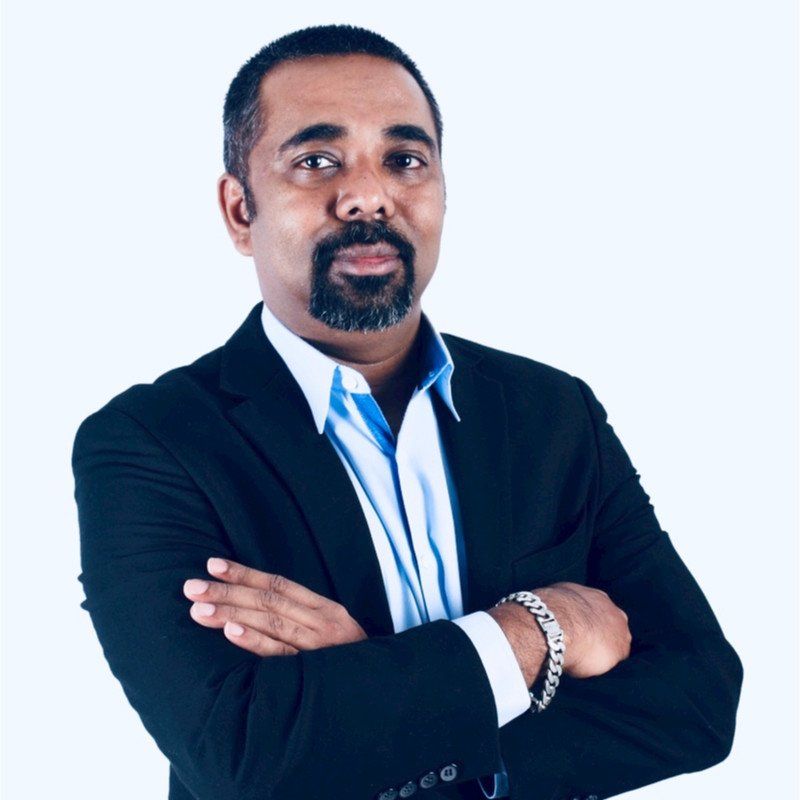
Arul Aruleswaran is a transformation architect, researcher, and author whose work explores leadership, human development, organisational transformation, and emerging technologies. Drawing on more than two decades of experience across supply chains, government services, and business transformation, he combines practitioner insight with interdisciplinary research to examine how individuals and organisations navigate complexity, uncertainty, and change. His current work focuses on discernment, stewardship, and Human-AI interaction through Emergence Mirror Labs (EML), where he is developing frameworks for leadership, organisational development, and responsible AI. Arul writes regularly on leadership, transformation, decision-making, and the human dimensions of technological change.