Building the Future
There is an old story I have always loved.
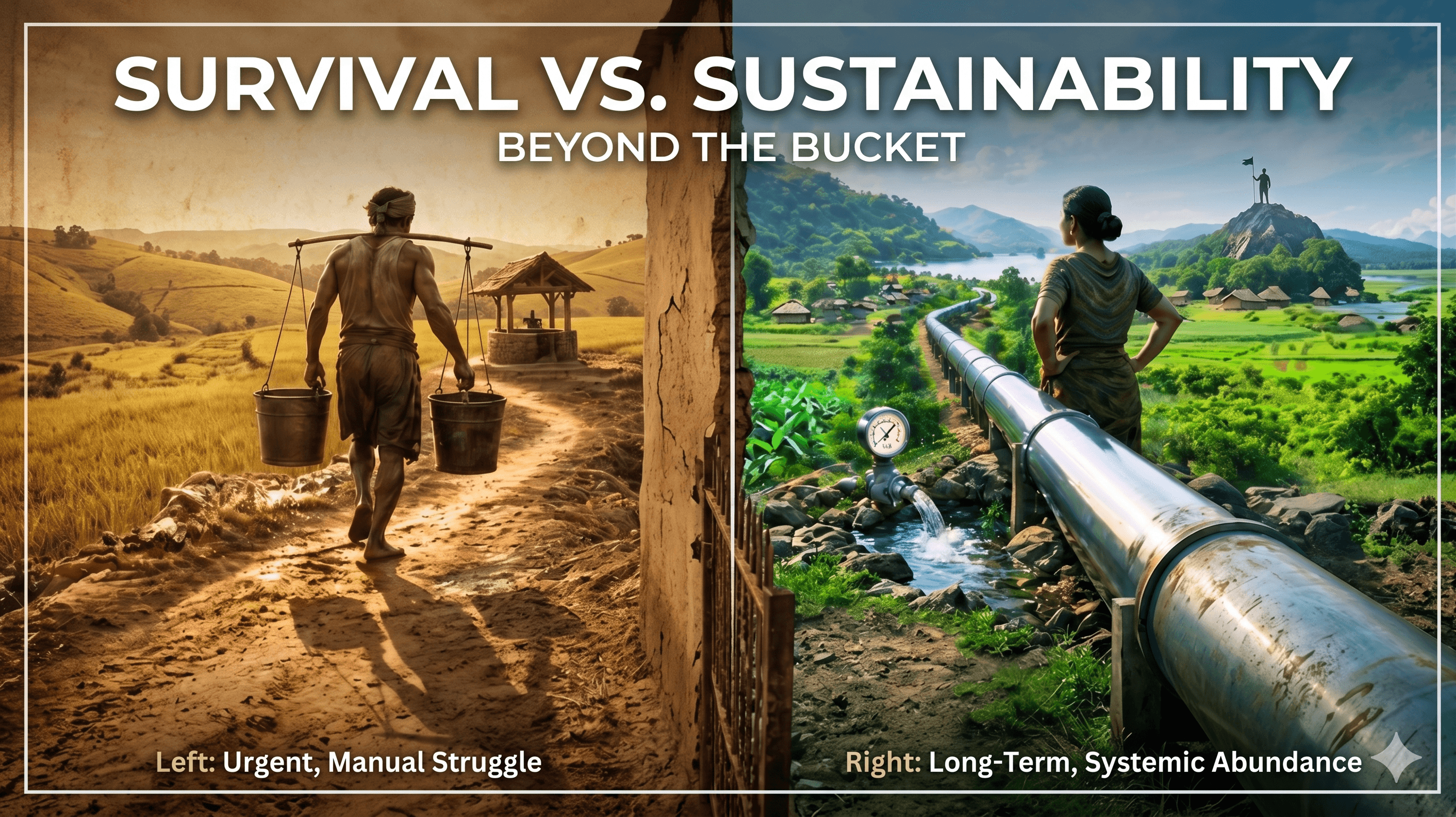
A small island village depended on a well in the centre of the village. One day, the well ran dry. The leaders called an emergency meeting and accepted two offers to solve the problem. Both would be paid 25 cents per gallon of water delivered. The first person said, “I can start immediately.”
So he did.
He took two buckets, walked back and forth to a nearby lake, filled them, carried them back, poured them in, and repeated the process again and again and again. He made money from day one. He was admired for his hustle. He was busy 12 to 14 hours a day. Every evening, the village could say, “At least something is being done.”
The second person, a woman, also said yes to the job. But she made a very different choice. She said, “It will take me six months.”
Instead of carrying buckets, she hired a contractor, built a pump, laid a pipeline from the lake to the well, and installed a meter to measure the flow. For six months, it probably looked like she was slower. Less productive. Less heroic. Maybe even foolish.
You may like: Change Leadership with Dr. Karuna Ramanathan
Then one day the pump was turned on.
And from that moment onward, the water kept flowing. The first person got paid for effort and had to hussle each time to get paid. The second got paid for building a system, and sat back and let the system create continous payments.
That story has been sitting with me because it captures a mistake many leaders and organisations make. We often celebrate the person carrying buckets.
The fast responder. The fixer. The firefighter. The person who is always in motion. The person who looks busy, urgent, indispensable.
And sometimes, in a crisis, that is exactly what is needed.
But great organisations are not built by bucket-carrying alone. They are built by people who eventually stop asking, “How do we solve this again today?” and start asking, “How do we make sure this problem does not require heroics every day?”
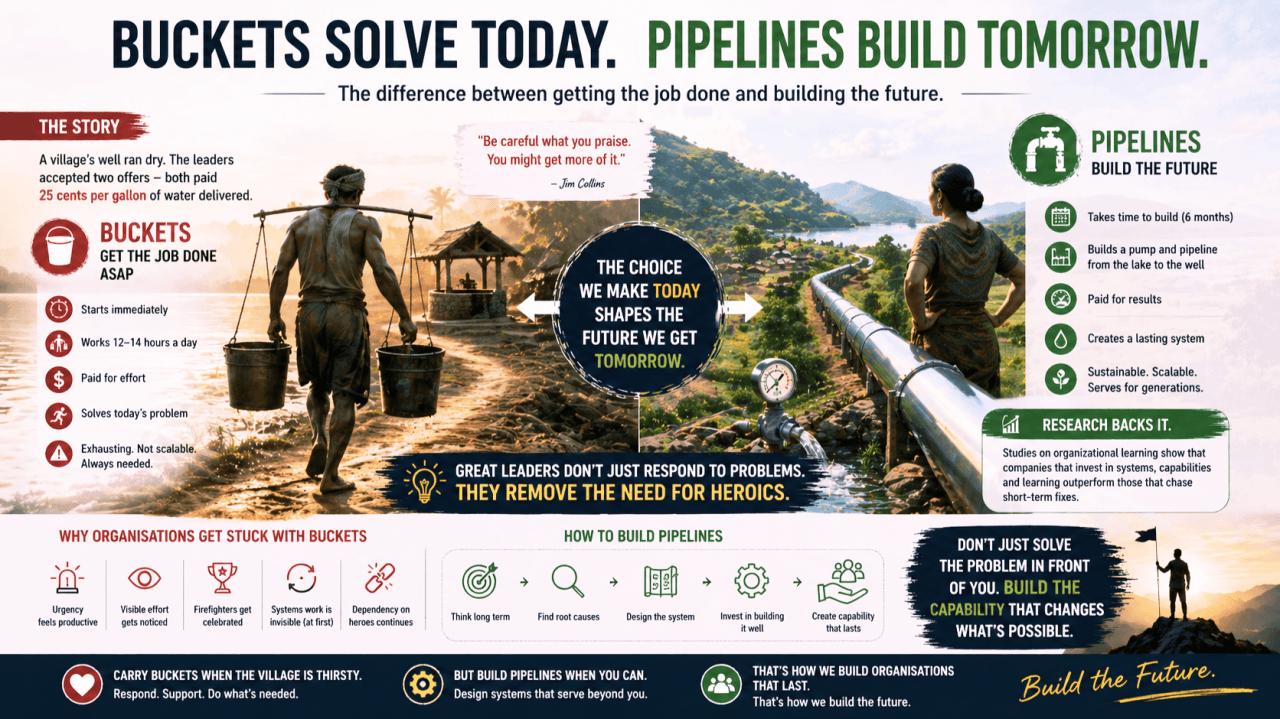
That is the difference between getting the job done and building the future.
One keeps you alive. The other makes you scalable.
One produces visible activity. The other produces enduring capacity.
One gets applause quickly. The other often gets questioned while it is being built.
And that is why systems thinking is so hard. Because buckets deliver immediate proof. Pipelines demand patience.
Buckets make you feel useful now. Pipelines make you look slow before they make you look wise. In many organisations, we are unintentionally rewarding buckets all the time.
We reward responsiveness more than redesign. We reward urgency more than architecture. We reward fixing more than preventing. We reward visible effort more than invisible systems.
Then we wonder why the company stays dependent on heroes.
If every problem in your organisation still needs a person to run harder, stay later, chase manually, escalate repeatedly, and rescue constantly, you may not have built a company. You may have built a sophisticated bucket brigade.
And the danger is this: Bucket cultures often feel productive.
You may like: Paradoxical Leadership with Roshan Thiran
But they do not scale well. They exhaust people. They hide weak systems. They create dependency on a few “strong” individuals. And the moment those people leave, the cracks show.
Pipelines are different. Pipelines look boring compared to heroics. But they are what make excellence repeatable. Pipelines are processes. Pipelines are systems. Pipelines are leadership benches. Pipelines are capability building. Pipelines are dashboards, rhythms, habits, decision rules, and culture by design. Pipelines are what allow organisations to stop surviving from one emergency to the next.
This is one of the values we hold deeply at Leaderonomics: Build the Future.
Not just solve the problem in front of you. Build the capability that changes what is possible tomorrow.
So yes, carry buckets when the village is thirsty. But do not mistake urgent effort for strategic leadership. Because the leaders who change organisations are not only the ones who respond fast. They are the ones who build pumps, lay pipelines, and create systems that keep serving long after the applause for the firefighters has faded.
Today, maybe the question for all of us is this:
Where in our work are we still carrying buckets, when it is time to build a pipeline?
For leaders carrying more than their job titles…
Be part of Malaysia Immersion Week 2026!
Join us for an 8-day journey (June 24–July 1, 2026) designed for leaders who want time and space to connect with like-minded business leaders. You’ll gain VIP access to the Malaysia Leadership Summit, engage in masterclasses with global leaders, and experience cultural immersion that offers fresh perspective on yourself and your team.
Apply now!




Leadership
Roshan is the Founder and “Kuli” of the Leaderonomics Group of companies. He believes that everyone can be a leader and "make a dent in the universe," in their own special ways. He is featured on TV, radio and numerous publications sharing the Science of Building Leaders and on leadership development. Follow him at www.roshanthiran.com