The Bank That Gave Junior Employees Permission to Challenge the Boss
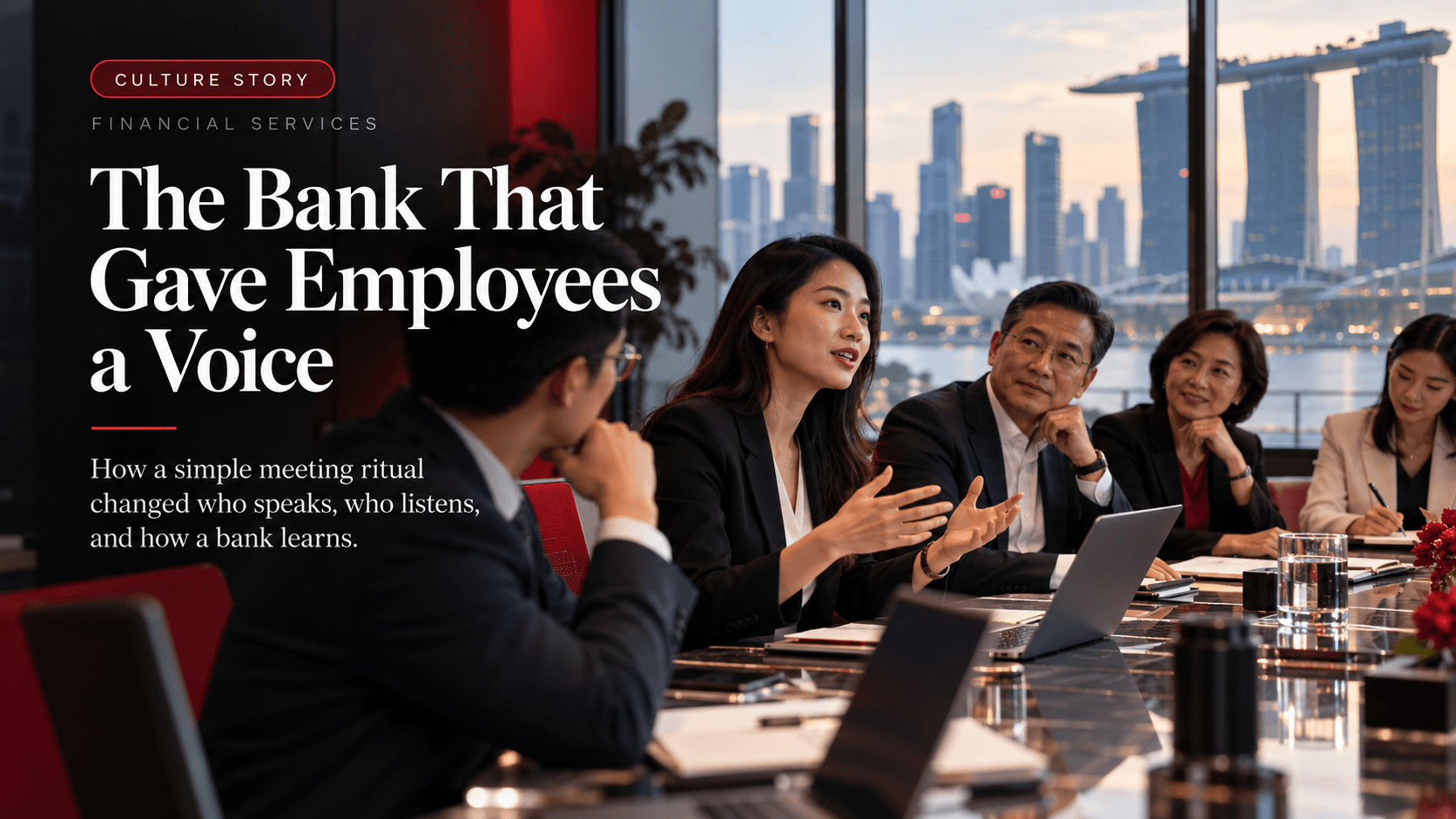
How a simple meeting ritual helped DBS transform a culture of hierarchy and silence into one where employees could challenge ideas, hold leaders accountable and make their voices heard.
Imagine sitting in a meeting with your CEO. There are twelve people around the table. The boss is speaking passionately about a new business strategy. Everyone is nodding. Everyone seems to agree.
Except you.
You can see a serious flaw in the proposal. You've spent weeks working with customers, and you know something the senior leadership team doesn't. But do you speak up? Perhaps you tell yourself that the boss must know better. Perhaps you don't want to look foolish. Or perhaps you remember what happened the last time somebody challenged a senior executive.
So you remain silent. The meeting ends. Everyone congratulates one another on a productive discussion. And the organisation walks confidently towards a potentially expensive mistake.
Sound familiar?
This is a hypothetical scenario, but it captures a very real problem that Singapore's DBS Bank confronted during its extraordinary transformation. And what DBS did about it was surprisingly simple. It didn't begin by sending everyone on another leadership course. It changed what happened inside the meeting room.
From "Damn Bloody Slow" to a 27,000-person startup
In 2009, when Piyush Gupta became CEO of DBS, the bank was facing enormous challenges. DBS had grown into one of Southeast Asia's leading financial institutions. But its size and established processes had also created bureaucracy, inefficiency and habits that were increasingly difficult to change.
The bank had even acquired an unfortunate nickname among some Singaporeans: "Damn Bloody Slow." Not exactly the branding you want for a financial institution!
Gupta and his transformation team recognised that technology alone wouldn't solve the problem. To compete in a world of fintech startups and digital platforms, DBS needed to become faster, more innovative and more willing to experiment.
The ambition was audacious: create a 27,000-person startup.
Now, that's an interesting paradox. How do you get tens of thousands of people working in a highly regulated bank to think and behave like entrepreneurs? You can't simply announce, "From Monday onwards, everybody please be innovative!"
Innovation isn't something that happens because the CEO sends an inspirational email. It happens when employees repeatedly experience the freedom, responsibility and encouragement to think differently.
And in 2016, when DBS's senior leaders gathered to examine what was holding back their transformation, they identified one remarkably ordinary culprit.
Meetings.
The problem wasn't meetings. It was what happened inside them.
DBS had too many ineffective meetings. They started late. They ended late. Sometimes there were no clear agendas or decisions. But the most troubling issue wasn't wasted time.
It was wasted intelligence. Some employees dominated the conversation while others remained quiet. Hierarchy influenced who spoke and who was heard.
This created a fascinating contradiction. DBS wanted employees to challenge assumptions, experiment and generate fresh ideas. Yet one of the most common activities in their working day reinforced the opposite behaviours. The bank wanted innovation, but its meeting habits could reward conformity.
Think about that. If an employee spends several hours each week learning that the safest thing to do is remain silent, what happens when that same employee attends an innovation workshop encouraging courageous thinking? Which behaviour do you think wins?
Usually, the behaviour that gets reinforced every day. The DBS team realised that transforming the organisation would require changing those everyday experiences. And so they introduced something called MOJO.
The ritual that gave everyone a voice
MOJO stands for Meeting Owner, Joyful Observer. It's a wonderfully simple idea built around two roles. Every meeting has a Meeting Owner, or MO. The MO has three important responsibilities.
- First, explain why the meeting is happening and what it needs to achieve.
- Second, ensure that participants have the opportunity to contribute, including those who might otherwise remain silent.
- Third, summarise the meeting's conclusions so everyone understands what has been decided.
So far, nothing terribly revolutionary. But then comes the interesting part. Every meeting also has a Joyful Observer, or JO. This person watches not just what is discussed, but how the meeting is conducted.
- Did the meeting stay focused?
- Were people allowed to challenge ideas?
- Did everyone have an opportunity to speak?
- Was somebody dominating the discussion?
- And most importantly, did the Meeting Owner create the conditions for a productive conversation?
At the end of the meeting, the Joyful Observer gives feedback to the Meeting Owner. In effect, the meeting itself becomes a tiny leadership laboratory. But here is the real cultural breakthrough.
The Joyful Observer can be junior to the Meeting Owner and is still explicitly empowered to provide honest feedback.
Imagine being a relatively junior banker and having permission to tell a senior executive that they were preventing others from contributing. That's more than a meeting technique. That's a redistribution of power. And it happened not through a grand restructuring exercise, but through a repeatable ritual built into everyday work.
When somebody actually challenged the boss
One incident reported by DBS's transformation advisers illustrates just how powerful this practice could become. During a meeting, a senior executive lost his temper. The outburst effectively shut down the discussion.
In many organisations, everybody might have pretended nothing had happened. But this meeting had a Joyful Observer. At the end, the observer told the executive that his behaviour had discouraged people from speaking.
What happened next matters enormously. The executive accepted the feedback and committed to doing better. The account became part of the organisation's internal storytelling about MOJO and the behaviours DBS wanted to encourage.
Why is this so important? Because culture is never really tested when everybody is behaving nicely. Culture is tested when someone powerful is challenged.
If the executive had punished the observer, the ritual could have become just another piece of corporate theatre. Instead, the response reinforced the message that honest feedback was legitimate, regardless of hierarchy. There is a profound distinction between telling people to speak up and repeatedly demonstrating that speaking up is welcome.
DBS was building the second.
A remarkable change in the numbers
Here's where the story becomes particularly powerful. According to research published in 2020 by DBS transformation leaders and their collaborators, the MOJO intervention was associated with significant improvements. Before the intervention, only 40% of surveyed employees said they had an equal share of voice in meetings. Afterwards, that figure reached 90%.
That's a 50-percentage-point improvement.
Meeting effectiveness ratings also doubled. And the bank estimated that reducing late-running meetings had saved approximately 500,000 employee hours by the time of the report.
Half a million hours!
Imagine the conversations, customer problems and innovation opportunities that amount of time could represent. Of course, these were company-reported and adviser-reported results from the transformation period. They were not evidence from a controlled experiment isolating the impact of MOJO.
And DBS's wider success involved far more than meetings. The bank was simultaneously investing in technology, redesigning customer journeys, encouraging experimentation and developing new capabilities. By 2019, DBS had become the first bank to hold three major global bank-of-the-year honours simultaneously, according to its transformation advisers.
We cannot credit those awards to MOJO alone. But the meeting ritual provides something just as valuable: a concrete example of how a large organisation translated its desired culture into observable, everyday behaviour.
Why this ritual worked
I find three elements particularly fascinating about the DBS story:
First, the ritual made the invisible visible: Most organisations measure meeting attendance, calendars and sometimes decisions. But how many measure whether employees actually feel able to challenge ideas? MOJO made participation, respect and constructive disagreement subjects of observation and feedback.
Second, it created permission to challenge hierarchy: Many employees know that a meeting is going badly but feel they lack the authority to say anything. MOJO changed that dynamic. The Joyful Observer didn't need to be the most senior person in the room. The role itself provided the legitimacy to intervene. That is an important distinction. Rather than expecting employees to become fearless overnight, DBS changed the conditions that made courageous behaviour possible.
Third, it built accountability into the routine: The Meeting Owner knew that someone would evaluate the quality of the meeting.So the ritual encouraged better behaviour before problems occurred, not just afterwards. DBS reinforced the practice with physical reminders, simple tools and measurement. The result was a feedback loop in which everyday meetings could become opportunities to practise better leadership. And because meetings happen repeatedly, employees had repeated opportunities to learn.
This is why I believe rituals can be more powerful than many traditional culture programmes. A workshop might change what someone knows. A well-designed ritual can change what someone repeatedly does.
Steal This Ritual: Introduce a Joyful Observer
You don't need to work in banking or lead a massive organisation to try this idea. Here's how I would adapt MOJO for a Malaysian business, an SME or even a small team.
Step 1: Every meeting gets two roles: Appoint a Meeting Owner to clarify the purpose, facilitate discussion and confirm decisions. Appoint a Joyful Observer, preferably rotating the role so everyone gets a chance to practise.
Step 2: Begin with purpose: The Meeting Owner answers one question:
"What must be different by the time this meeting ends?"
If nobody can answer, perhaps the meeting shouldn't be happening.
Step 3: Make participation visible: The Joyful Observer watches for three things:
- Who is contributing, and who hasn't been heard?
- Are ideas being challenged constructively?
- Are people listening, or simply waiting for their turn to speak?
Step 4: End with one minute of honest feedback: The Joyful Observer shares one thing the Meeting Owner did well and one thing that could improve. Keep it specific, respectful and focused on behaviours, not personalities.
Step 5: Measure the difference: Try this for four weeks. Track whether meetings start and end on time, whether quieter participants contribute, whether decisions have clear owners and whether employees feel safer disagreeing.
And remember, the ritual only works when leaders genuinely welcome feedback. If a junior employee respectfully challenges a senior leader and suffers consequences afterwards, the ritual will destroy trust rather than build it.
The real lesson from DBS
There's something wonderfully ironic about the DBS transformation. A bank determined to become one of the world's leading digital institutions discovered that part of its transformation depended on something very human.
Listening.
Creating space for different opinions.
And giving people permission to challenge authority.
It didn't require another expensive technology platform. It required changing what people repeatedly did in meetings. Too many organisations declare that they want innovation while continuing to reward silence. They celebrate collaboration while allowing a few powerful voices to dominate. They talk about psychological safety while quietly discouraging disagreement. And then they wonder why their culture doesn't change. DBS offers a different possibility.
Don't just tell people they have a voice. Create a ritual that makes their voice matter.
So here's my challenge to every leader reading this. At your next meeting, look around the room. Who hasn't spoken? Whose idea might challenge yours?
And perhaps most importantly, who has permission to tell you that you are the problem? Because sometimes the greatest transformation doesn't begin with a new strategy. It begins when the most junior person in the room finally feels able to challenge the most senior. And the senior person listens.
Culture is not simply what leaders say they value. It's what people are repeatedly allowed, encouraged and expected to do.
Key outcomes
+50 pts
Equal share of voice - Employees reporting an equal share of voice in meetings increased from 40% to 90%.
2×
Meeting effectiveness - Surveyed meeting effectiveness ratings doubled after introducing MOJO.
500K
Employee hours saved - Approximately 500,000 cumulative hours saved through reductions in late-running meetings, as reported in 2020. Results documented by the DBS transformation team and its advisers, published in September 2020.
Summary of Key Rituals
Ritual | Type | Behavioural transformation |
MOJO Meeting Ritual Hero | Trigger | From passive meeting attendance to active participation and constructive challenge |
| Joyful Observer Feedback | Accountability | From protecting seniority to giving leaders direct behavioural feedback |
| Equal Share of Voice | Reinforcement | From dominant voices controlling discussions to greater participation |
| Meeting Purpose & Closure | Accountability | From unfocused discussions to clear purpose and conclusions |
| Gandalf Teach-Back | Learning | From individual learning to sharing new knowledge with colleagues |
This article was republished by permission at https://ritualsofwork.com/. Rituals of Work, is a key partner to Budaya, who drives organisational culture transformation. Roshan Thiran is both the founder of Budaya and Leaderonomics and is an expert on organisational culture and transformation


Functional
Tags: Culture
References:
The story draws primarily on the accounts of DBS leaders and the consulting team that worked on its culture transformation.
- Innosight / Huron: How DBS Transformed Its Culture. Provides the organisational context, MOJO intervention, employee voice figures and wider transformation outcomes.
- Anthony, Cobban, Nair & Painchaud: Breaking Down the Barriers to Innovation (2020). First-hand account of the ritual, senior-executive incident, meeting metrics and BEANs methodology.
- INSEAD Knowledge: How DBS Became the World's Best Bank. Independent business-school discussion of the wider transformation and MOJO's contribution.
- McKinsey: A Conversation with DBS's Han Kwee Juan. Explains how the Joyful Observer role supports speaking up and psychological safety.
Roshan is the Founder and “Kuli” of the Leaderonomics Group of companies. He believes that everyone can be a leader and "make a dent in the universe," in their own special ways. He is featured on TV, radio and numerous publications sharing the Science of Building Leaders and on leadership development. Follow him at www.roshanthiran.com