The AI Productivity Paradox: The New Wine, Old Wineskin Problem
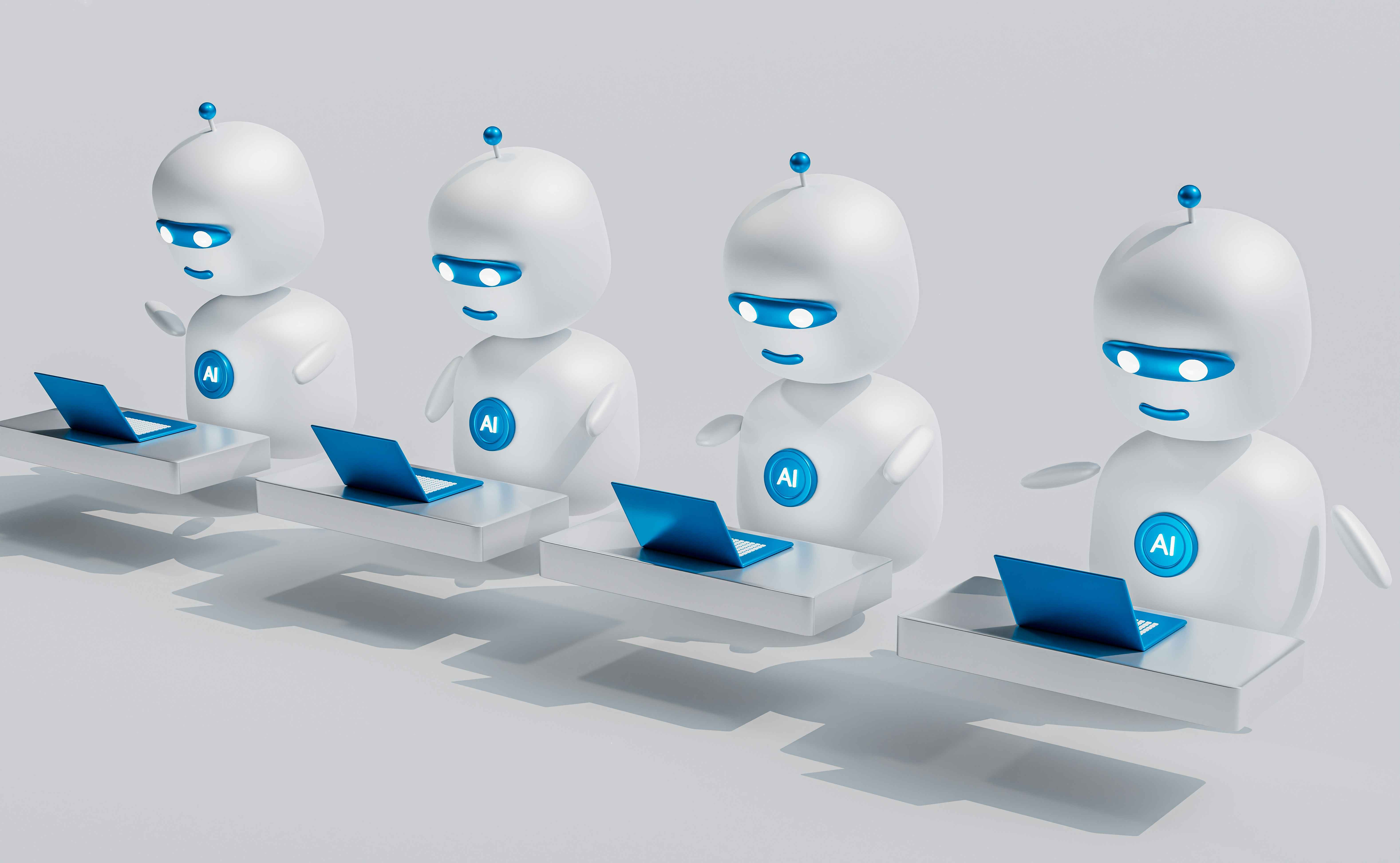
In 2025, tens of thousands of white-collar workers were laid off under the banners of efficiency, automation, restructuring, and AI-enabled productivity. At IBM, Meta, Salesforce, Duolingo, Klarna, and later Amazon, the message was unmistakable: the future of work was being rewritten in real time. Then in August 2025, MIT's NANDA initiative released a study that should have ended the celebration. Across hundreds of enterprise generative AI deployments, 95% had produced no measurable impact on the bottom line.
The clearest confession of this gap came from one of the CEOs who had cheered the loudest. In early 2024, Klarna's Sebastian Siemiatkowski stood on a stage in Stockholm and announced that a single AI assistant was now doing the work of 700 customer service agents, saving $40 million a year. Investors cheered. A little over a year later, he began bringing humans back into the customer experience conversation, he quietly began hiring humans again — admitting in a public interview that cost had become "a too predominant evaluation factor." Translation: they had measured the wrong thing. Klarna had not failed at using AI. Klarna had succeeded at the wrong thing. And that, in one sentence, is the story of corporate AI in 2026.
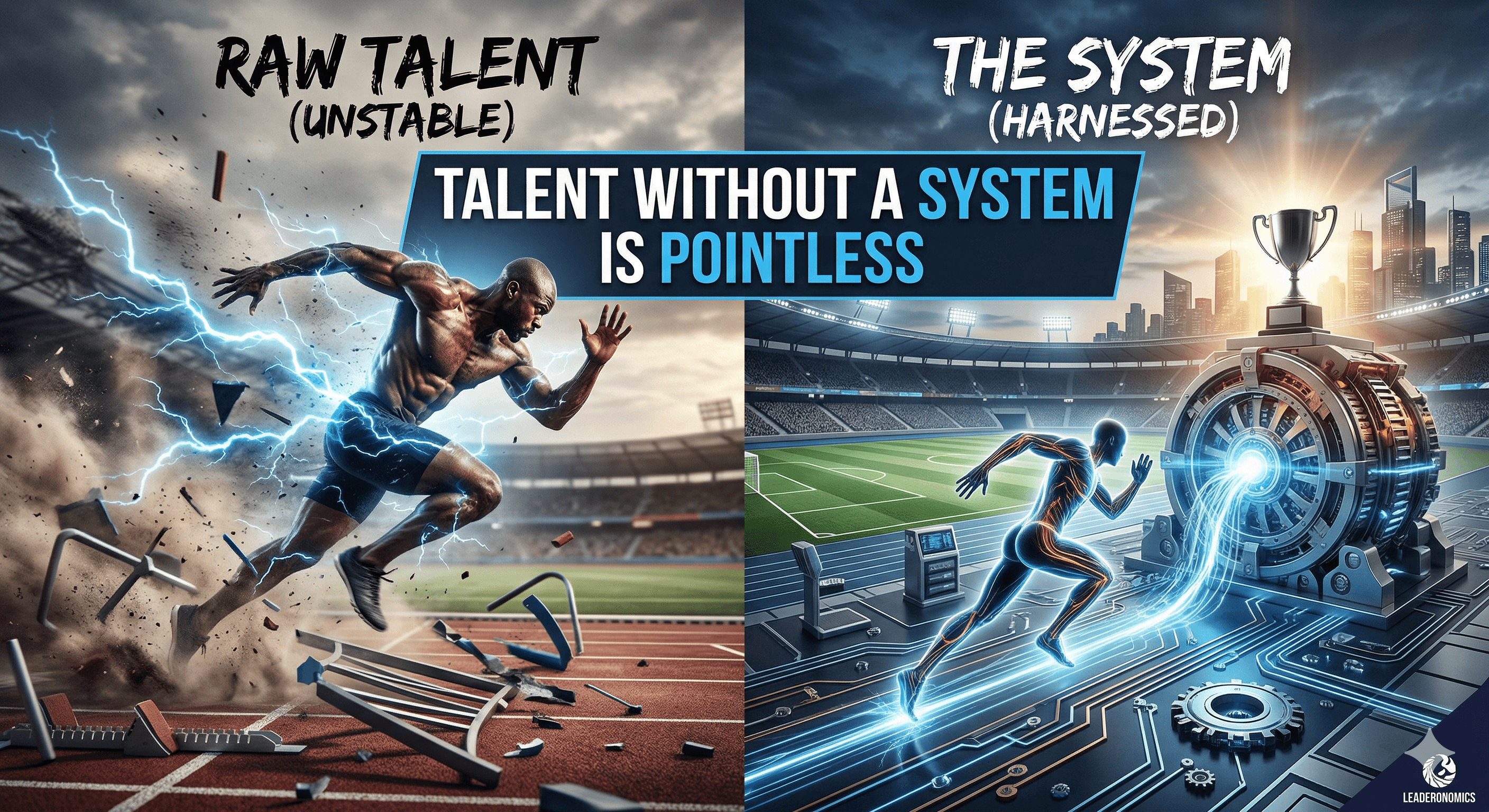
As someone who plays football as a striker trying to always score goals to win games, I know a fundamental truth: having the most advanced, high-tech football boots on the pitch doesn't guarantee a single goal if your team's formation is a complete mess. Right now, the business world is buying the most expensive football boots on the planet, called Artificial Intelligence, but many companies are still playing in a formation designed for another century. We have been here before.
Back in my early career days at ExxonMobil and GE in the 1990s, we lived through a very similar phenomenon. We were rolling out massive IT infrastructure, putting a desktop computer on every desk, and staring at our balance sheets waiting for the magic to happen. It didn't. In fact, in 1987, the Nobel Prize-winning MIT economist Robert Solow famously quipped, "You can see the computer age everywhere but in the productivity statistics." Back then, we called it the Productivity Paradox.
This paradox refers to the unexpected lag between the massive investment and widespread adoption of information technology—such as rolling out desktop computers and IT infrastructure in the 1980s and 90s—and the lack of corresponding growth in national productivity statistics.

We've been here before: The 1980s Computer Paradox. Source: iStock
The data is sobering. MIT's NANDA initiative found in August 2025 that roughly 95% of enterprise generative AI pilots produced no measurable impact on the P&L. McKinsey's most recent State of AI report tells the same story from a different angle: most companies have widely adopted AI tools, but almost none can point to enterprise-level value creation. We're writing emails faster, generating code quicker, producing reports at light speed — and we cannot find the productivity in the books. Why? Because we are making the exact same mistake we made in the '80s and '90s.
To understand how to break this cycle, we have to look back. When electricity was introduced to factories in the 1880s, productivity didn't increase for almost 40 years. Why? Because early factory owners simply replaced their single massive steam engine with a massive electric motor, keeping the old, convoluted belt-driven layout. It wasn't until the 1920s, when they realized electricity allowed them to restructure the entire factory floor into an assembly line, that productivity skyrocketed. The same lag happened when computers were introduced and it took 20 years.
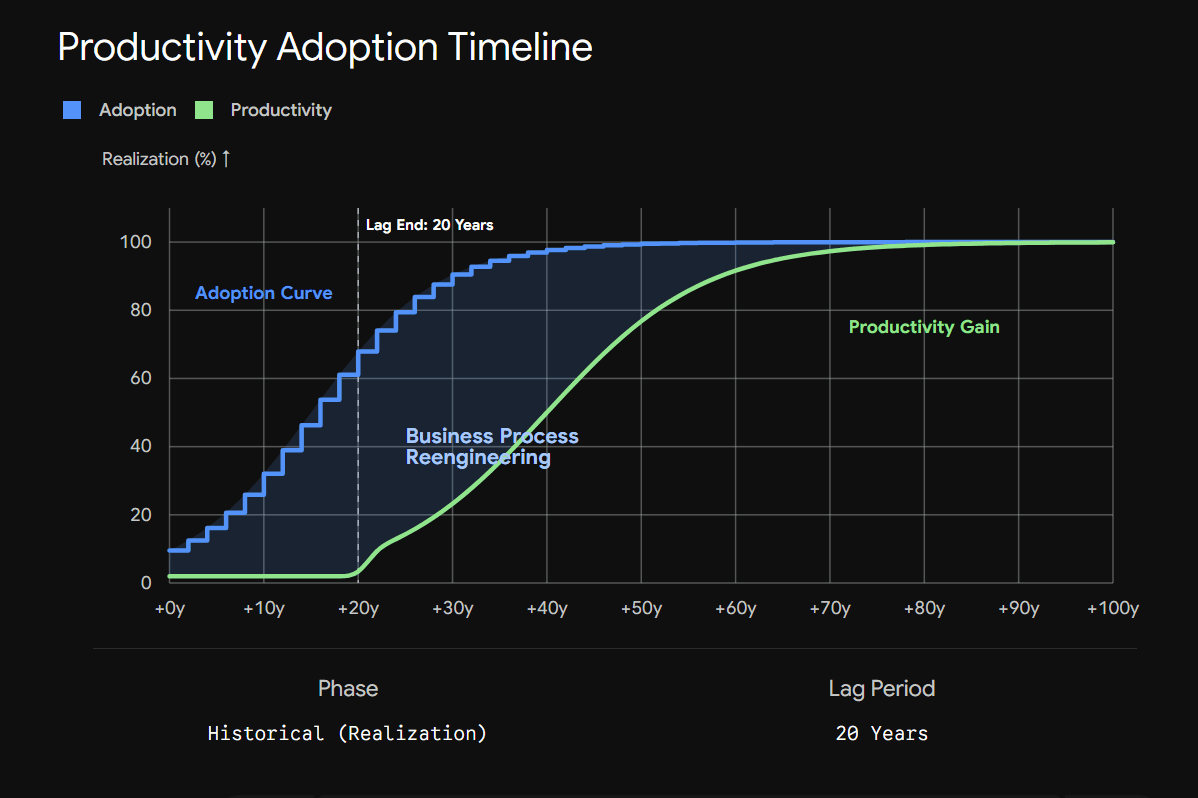
The lag between productivity and adoption for computers also took more than 20 years, similar to what was experienced by electricity (40 year lag). Image by Roshan Thiran
You cannot layer a transformational technology over a legacy foundation. Instead of the computer, the problem was that companies installed computers into old workflows, old hierarchies, old scorecards, and old assumptions about work.
This is not a new teaching or insight—almost two thousand years old—Jesus made this point, "And no one pours new wine into old wineskins. Otherwise, the wine will burst the skins, and both the wine and the wineskins will be ruined." AI is the most potent new wine of our generation. If we pour it into the rigid, hierarchical, siloed old wine-skins of 20th-century corporate management, things will break. New capacity requires a new container. Force it into the old one, and you lose both.
The old wineskin was not evil. It had served its season. Bureaucracy, hierarchy, process control, annual planning, functional departments, and managerial approvals helped organisations scale in the industrial age. They created order. They reduced chaos. They allowed large companies to coordinate thousands of people across markets.
But every wineskin has a limit. What once preserved value can eventually prevent fermentation. What once created stability can later suffocate movement. That is the danger facing leaders today. We are not being asked to despise the old wineskins. We are being asked to recognise when they can no longer carry the pressure of the new wine.
The Paradox Question
The real question, then, is not, “How do we use AI?” That is too small. The deeper leadership question is, “What kind of organisation can actually hold the power of AI without bursting?”
This is where the Science of Transforming Organisations, or SOTO, becomes critical. If AI is the new wine, then the wineskin is the organisation itself: its business model, structure, processes, and alignment systems. Pouring AI into old business models simply produces faster inefficiency. Pouring AI into old structures produces faster bureaucracy. Pouring AI into old processes produces faster exhaustion. Pouring AI into old cultures produces faster distrust.
The work of AI transformation is therefore not tool adoption. It is organisational redesign. Here are some ideas of how you can do it for your business in these 4 different dimensions:
1. The Business Model: Don’t Pour New Wine Into an Old Value Proposition
In the '90s, traditional bookstores tried to use computers to track their physical inventory better. Amazon used computers to eliminate the physical bookstore entirely. Blockbuster used data to track late fees; Netflix used it to stream directly to living rooms.
Right now, most companies are using AI as a "horizontal copilot"—a fancy tool to help an employee write an email or generate a report 10 percent faster. That is mere cost-cutting, not value creation. We need to shift to vertical, agentic AI, where the business model itself is reimagined. Instead of asking, "How can AI help our customer service reps answer phones faster?" we should be asking, "How does AI allow us to predict and solve the customer's problem before they even pick up the phone?"
AI shouldn't just optimise your current model; it should make your current model obsolete. Here is how three massive legacy industries are successfully tearing down their old wineskins today:
John Deere: From Selling Iron to Selling Outcomes
John Deere is a nearly 200-year-old company built on heavy iron, steel, and horsepower. They did not treat AI as a simple back-office efficiency tool, but executed a massive business model pivot.
With the launch of their fully autonomous 8R tractors and AI-driven "See & Spray" computer vision (which distinguishes weeds from crops in real-time, reducing chemical usage by up to 77%), Deere isn't just selling tractors anymore. They are shifting to a "Tech-as-a-Service" model. They now charge farmers based on outcomes—precision yields and chemical savings. By building a massive data moat from over 370 million acres of connected farmland, John Deere is transitioning from a cyclical heavy equipment manufacturer to an intelligence subscription service, targeting 10% of their total revenue to come from software and subscriptions by 2030.
Big Pharma: From "Lab Roulette" to Computing Medicine
For decades, traditional pharmaceutical drug discovery was essentially a multi-billion dollar roulette wheel. You threw incredible amounts of money at massive physical labs, hoping that 10% of your molecules would survive clinical trials. Because of the massive overhead, Big Pharma routinely ignored rare diseases because there was "no market" for them.
Today, thanks to AI systems like Google DeepMind's AlphaFold 3, the entire business model is flipping from physical "market medicine" to algorithmic "computing medicine." Companies like Isomorphic Labs are using AI to predict 3D protein structures and simulate how molecules interact before they ever touch a physical lab. The model shifts from manufacturing chemicals to licensing algorithmic discoveries. This radically lowers the cost curve, allowing these new AI-driven platforms to target rare diseases that legacy companies deemed unprofitable for 30 years.
Industrial Logistics: From Tracking to "Agentic Task Forces"
In my early days at GE, supply chain optimisation meant human planners staring at spreadsheets and reacting to delays. Today, legacy industrial giants like the BMW Group are blowing up that reactive model.
Using AI platforms like SORDI.ai, BMW has created highly accurate digital twins of their factories. But they aren't just using AI to give humans better dashboards; they are creating agentic workflows. Supply chain AI agents are talking directly to compliance AI agents, running thousands of simulations, predicting bottlenecks, and re-routing resources autonomously. They eliminated the manual middleman entirely, shifting the business model from "managing a supply chain" to "orchestrating an autonomous network."
The Litmus Test for Your Business:
Three questions cut to whether you are transforming your business model or merely decorating it:
- Are you still charging customers for inputs—hours, units, licences, transactions—or are you charging for the outcomes AI now lets you guarantee? John Deere is shifting from selling tractors to selling yield. What is your equivalent move?
- If your AI strategy succeeded beyond your wildest projections, would it obsolete your most profitable product? If the answer is no, you are optimising—not transforming. Isomorphic Labs is willing to make traditional drug discovery economically irrelevant. Are you willing to make your current cash cow irrelevant before someone else does it for you?
- If a competitor with no legacy, no sunk costs, and no internal politics launched tomorrow with the same AI capabilities you have today, what would they build that you cannot? The gap between their answer and yours is the size of your old wineskin.
Leadership Warning
The deepest trap in AI-era business model design is using the technology to defend the existing model rather than to invent the next one. Boards will applaud you for using AI to make your cash cow 10% cheaper to milk. Almost none of them will warn you when a competitor uses AI to render the cow itself irrelevant. The Blockbusters and Kodaks of this decade will not die because they ignored AI. They will die because they used AI to optimise the very business model that AI was built to replace.
| Industry | The Old Wineskin (Legacy Model) | The New Wine (AI Business Pivot) |
| Agriculture | Selling heavy machinery (one-off hardware) | Subscribing to autonomous crop yields (SaaS) |
| Pharma | Trial-and-error physical lab testing | Algorithmic protein simulation & licensing |
| Logistics | Human-managed dashboards & tracking | Autonomous "Agentic" supply chain networks |
2. Structure: Don’t Pour New Wine Into Old Silos
The traditional corporate org chart—with its rigid hierarchies and isolated departments—was designed to manage human communication bottlenecks. AI does not remove every bottleneck, but it changes where the bottlenecks live. The old bottlenecks were often information bottlenecks. The new bottlenecks are design, trust, governance, and decision-rights bottlenecks. If you introduce rapid AI capabilities into a rigid hierarchy, you just create massive traffic jams at the middle-management approval layer. We need to move away from functional silos (Marketing, HR, Finance) and toward cross-functional, mission-driven "pods."
During my time at General Electric, Jack Welch famously championed the "boundaryless
organisation." I watched Welch say it in person at Crotonville. I watched our division try to do it. And I watched, three years later, the silos quietly reassemble themselves under different names. Not because anyone was malicious — because in a world where information moves through human meetings, you needed the silo to keep the cognitive load manageable. The silo was never the problem. It was the symptom of how information moved.
AI changes that variable. For the first time, information doesn't have to move through humans to be useful. Which means the cognitive justification for the silo—the one nobody ever said out loud—is finally gone. AI does not remove the need for expertise, but it does remove many of the excuses for fragmentation.
Recently I read a sentence again written 2000 years ago, "Just as a body, though one, has many parts, but all its many parts form one body…" Think of the human body. One body, many parts—but the nervous system communicates instantly across all of them. The hand doesn't need a meeting to know what the foot is doing. For decades, our companies have operated like dismembered bodies: the marketing hand with no idea what the operations foot was up to. AI, finally, can act as the corporate nervous system—but only if we let the body be one.
In 2026, AI acts as the central nervous system, allowing the organisation to finally operate as one unified body. Here is how that changes the actual anatomy of a business:
A. How People Are Organised: The Rise of the "Outcome Pod"
The traditional corporate org chart is a vertical hierarchy designed to pass information up and pass orders down. This created a massive layer of "traffic cop" middle managers whose primary job was just moving data from one silo to another.
We are seeing a brutal correction to this. In late 2025, Amazon announced about 14,000 corporate job cuts as part of a broader push to reduce bureaucracy, simplify layers, and adapt to AI-enabled ways of working. By early 2026, further corporate reductions were reported. But the real lesson is not “cut managers.” The real lesson is that AI exposes structures whose main job was to move information around.
Instead of organising people by function (e.g., all the finance people sit together), AI-native organisations are structuring people into cross-functional Outcome Pods. According to recent Stanford enterprise research, AI agents don't fix broken processes; they amplify them. If you drop an AI agent into a siloed hierarchy, it just creates bottlenecks faster.
- The Shift: Middle managers are no longer "people supervisors" managing task execution. The AI executes the tasks. The human leaders have become "orchestrators" and "exception handlers." You don't manage the process anymore; you manage the parameters of the AI, stitching things together and stepping in only for high-stakes, human-centric decisions.
B. Go-To-Market (GTM): The Death of the Handoff
Nowhere were silos more toxic than in Go-To-Market strategies. The old playbook was rigid: Marketing generated leads, threw them over the wall to Sales Development Reps (SDRs) who qualified them, who then handed them to Account Executives (AEs) to close, who finally passed them to Customer Success. Customers hated this fragmented experience.
Today, AI has entirely collapsed that funnel.
- The Shift: We are seeing the rapid deployment of Autonomous Revenue Teams. AI agents now act as the ultimate SDR, operating 24/7, analyzing intent signals, and responding to inbound queries within seconds. By integrating data across the entire customer journey, the AI doesn't just sell; it predicts churn and identifies upsell opportunities simultaneously. We are seeing startups in 2026 hit product-market fit in 6 to 9 months—half the time it took just a few years ago—while dropping their customer acquisition costs by up to 50%. The GTM team is no longer segmented by funnel stage; it is a single, unified brain focused entirely on customer lifetime value.
C. Policy Formulation: From Static Manuals to Dynamic Guardrails
In the past, formulating corporate policy meant a group of executives writing a 100-page PDF manual, putting it on a company intranet, and praying employees followed it. Compliance was reactive—you only knew someone broke the policy after the damage was done.
When you empower AI agents to execute workflows, you cannot rely on a PDF manual.
- The Shift: In 2026, policy and governance are built into the workflow. It is known as "embedded governance." Instead of writing a policy about data privacy, organisations code Role-Based Access Control (RBAC) and audit gates directly into their internal AI architecture. The AI agent cannot physically execute an action that violates the policy.
- Dynamic Adaptation: Furthermore, policies are no longer static. If a supply chain AI detects a geopolitical disruption, the procurement policy can dynamically adjust its risk parameters in real-time, routing approvals for new vendors to a human overseer instantly, rather than waiting for a quarterly policy review board.
The Litmus Test for Your Structure: Are your teams organised around the functions they perform, or the outcomes they are supposed to deliver? If it's the former, your structure is blocking your technology and productivity gains.
Leadership Warning: Flattening an organisation is not the same as transforming it. Removing managers without redesigning decision rights, workflows, accountability, and culture merely creates chaos with fewer adults in the room. AI-native structure is not leaderless. It is differently led.
3. Processes: Don’t Pour New Wine Into Broken Workflows
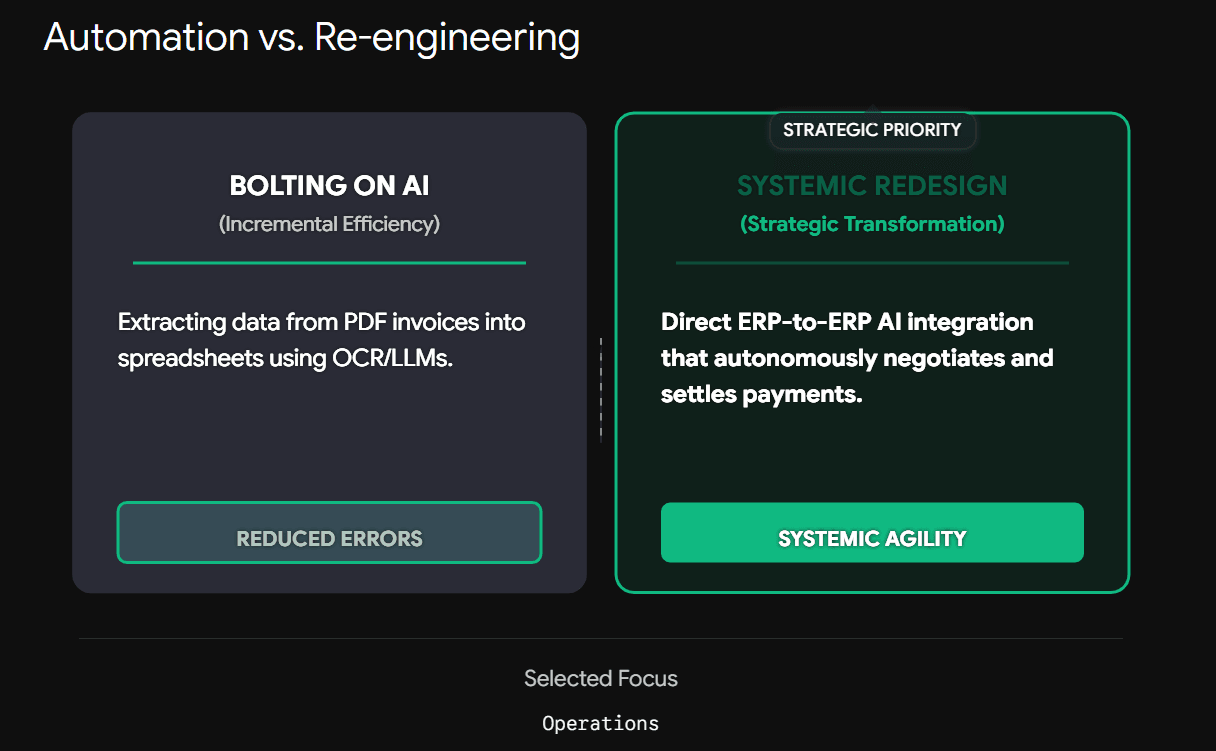
When organisations first encounter a powerful new technology, their instinct is to bolt it onto their existing way of doing things. They look at a broken, inefficient process and say, "How can AI make this broken process run faster?"
This is where the productivity paradox traps us. MIT economist Erik Brynjolfsson identified a dangerous phenomenon here called the "task composition effect." Here is how it works: Every job is made up of a mix of tasks—some are easy and repetitive; some are highly complex and emotionally taxing. When a company introduces AI, it usually automates the easy 80 percent of the job.
What happens to the human worker? They are left with a highly concentrated batch of the most difficult, complex, edge-case problems. The worker doesn't actually save time; they just experience severe cognitive burnout because they never get a "break" doing the easy stuff (ie The worker does not become free; the worker becomes the permanent dumping ground for complexity). You haven't made them more productive; you've just made their job infinitely harder.
To see real returns, we must stop automating tasks and start re-engineering end-to-end workflows. Recent field research from Harvard Business School and INSEAD proved this: Startups that trained their teams on workflow reorganisation (not just how to use AI tools) generated 90% higher revenue and needed 40% less capital than those who just handed their employees the tools. At Leaderonomics, when we dive into the Science of Transforming Organisations (SOTO), we emphasise that true transformation requires looking at workflows holistically.
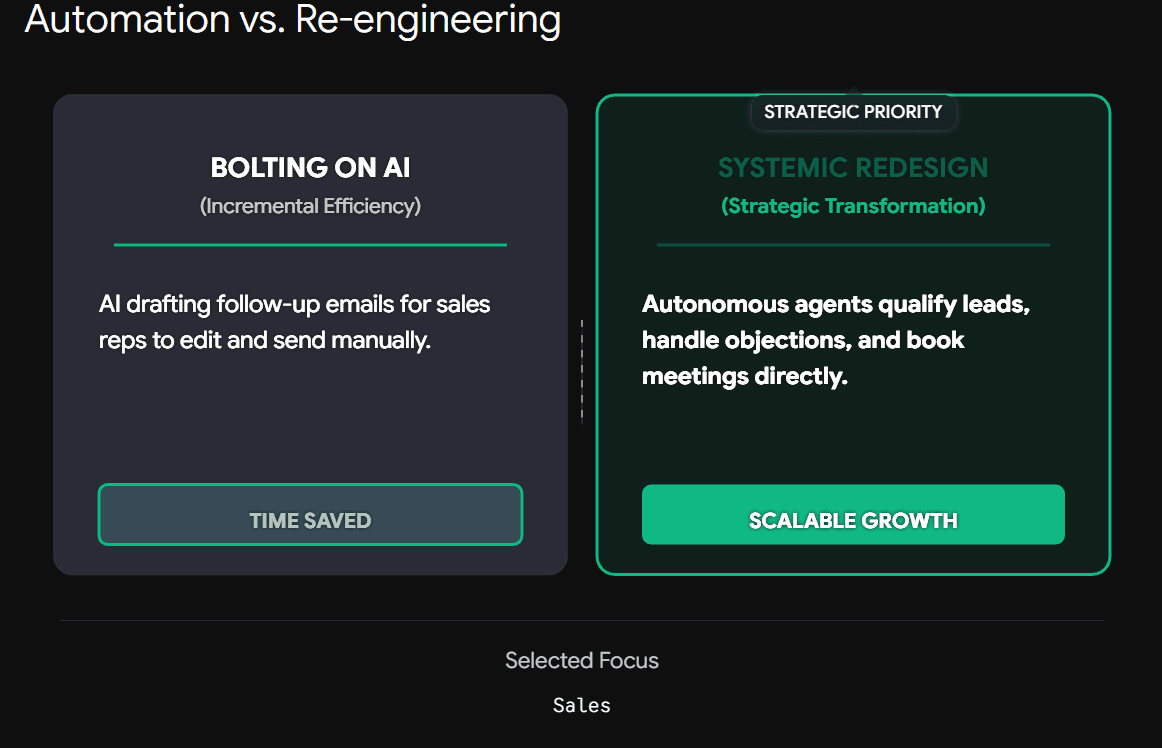
An Example of Bolting on AI vs Doing a Redesign in the Sales Space. Info-graphic created by Roshan Thiran
Here is how leading businesses are shifting from tasks to workflows:
The Coffee Shop Queue: A Lesson in Systems Thinking
Consider a non-AI example that perfectly illustrates this mindset: Starbucks. When Starbucks faced long queues, the obvious "task" fix was to hire more baristas. But that would have just crowded the workspace.
Instead, they mapped the entire system. They realised that custom drink requests created bottlenecks, baristas were walking too far for supplies, and the order system ran in parallel with preparation rather than in sequence. By simplifying the menu layout, repositioning equipment based on movement patterns, and adding order-ahead capability, they fixed the workflow. They achieved shorter wait times, higher sales per hour, and happier staff—without adding headcount. The lesson for AI is simple: before you automate the barista, understand the queue.
When you automate a task without mapping dependencies, you just shift work somewhere else. If AI helps marketing generate leads 10x faster (a task), but sales can't process them, you haven't improved the business; you've just buried sales.
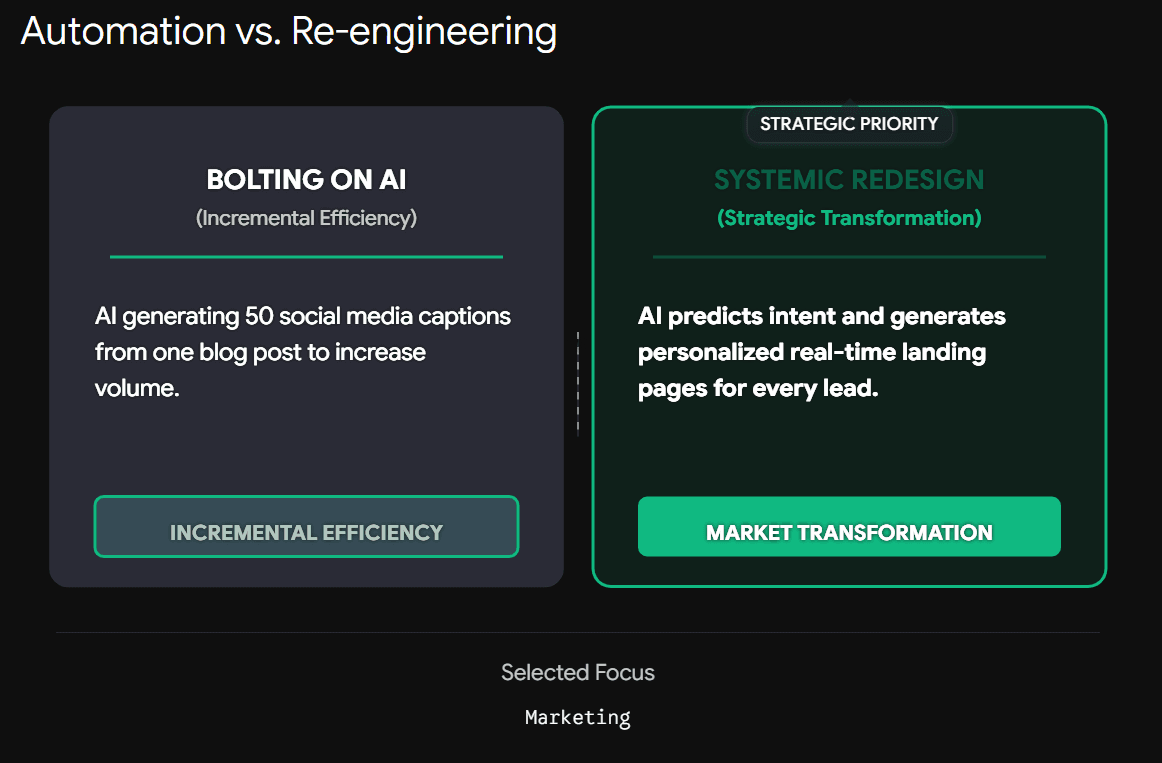
Infographic from Roshan Thiran
Transforming Construction: From Paper to Custom Reasoning Systems
The construction industry is notorious for running over budget and behind schedule, often bogged down by manual estimating and field management processes that haven't changed in decades.
A company called Myte Group is changing this by building custom reasoning systems. Instead of using generic AI to answer questions (a task), they embed domain expertise—construction-specific constraints, codes, and practices—into AI workflows.
Rather than automating the task of typing up an estimate, the AI compresses entire planning timelines. What used to take weeks to create roadmaps and estimate costs now takes hours. By programming experience into the workflow, they provide full visibility with flowcharts and timelines that can be audited. The result? Some companies have cut delays by 30% and reduced costs by 20% on major projects.
The AI Audiobook Supply Chain
In the publishing world, producing an audiobook has always been an expensive and slow workflow involving recording, editing, and distribution. Most authors simply skipped it.
Spotify didn't just create a tool to read text aloud (a task). They are turning AI audiobook creation into a complete publishing workflow. By integrating ElevenLabs into Spotify for Authors, they are positioning themselves at the start of the audiobook supply chain, allowing authors to generate audiobooks without the massive overhead. They aren't just speeding up recording; they are re-engineering how a book gets from the author's computer to the listener's ears.
The Litmus Test for Your Processes:
Are you using AI to do a single step faster (e.g., "drafting an email"), or are you redesigning the system so that the step isn't needed in the first place?
4. Culture: Don’t Pour New Wine Into Outdated Mindsets & Belief Systems
Years ago, at one of the global companies I worked in, the CEO stood in front of 3,000 employees and declared us a "digital-first" enterprise. The slides were beautiful. The standing ovation was loud. We walked out of that town-hall convinced something fundamental had shifted. By Friday, nothing had shifted at all.
That same week, the procurement system still required four signatures for a $200 software licence. The performance review still rewarded hours logged, not problems solved. The bonus pool still flowed toward the loudest voices in the room, not the wisest. By Monday, every employee in that auditorium had quietly returned to the behaviours the system was paying them to perform.
This is a lesson I have watched companies relearn every five years for three decades. You cannot “speech” your way into a new culture. You can only design your way into one.
If business model is the what of an organisation, structure is the who, and process is the how, then culture is the why people actually do anything at all. It is the deepest layer of the wineskin, and the most stubborn. You can rebuild every other layer—pivot your offering, flatten your hierarchy, re-engineer your workflows—but if your culture still pays people to hide failure, hoard information, and resist anything that threatens their turf, the new wine of AI will sour the moment it touches the container.
Recent data from Deloitte shows that organisations that heavily invest in change management are 1.6 times more likely to exceed their AI expectations. But "change management" has become one of the most abused phrases in modern business. For most companies, it is shorthand for posters, townhalls, and an offsite. None of that is design. All of it is theatre. Transformation is not a software update. It is a renewal of how people think. The oldest wisdom from Paul of Tarsus on this is brutally simple: do not conform to the patterns you inherited; let your mind be made new. Culture change without cognitive change is theatre.
This is where, at Leaderonomics, we lean hard on what we call the Budaya framework—the conviction that most organisations don't have a culture problem. They have a design problem dressed up as a culture problem. Culture is not what leaders announce. Culture is what the system repeatedly rewards, tolerates, measures, and remembers. Change the design, and the culture follows. Change only the messaging, and nothing follows at all.
To build a culture that can actually hold the new wine of AI, leaders must intervene across three layers simultaneously: the Experiences people have every day, the Beliefs they hold about what's normal, and the Actions the system rewards or punishes. Touch only one, and the culture snaps back. Touch all three together, and the wineskin starts to stretch.
A. Experiences: Make the Right Behaviour the Easiest Behaviour
Culture grows along the path of least resistance. This is one of the most underestimated truths in organisational design.
If you want your team to adopt a new AI workflow but the platform requires five clicks, a slow VPN login, and a security approval bottleneck—while the old manual way takes one click and zero permissions—they will bypass the AI every single time. Not because they don't believe in transformation. Because friction always wins.
I have seen leaders spend millions on AI licences, then lose 80% of usage within ninety days because a single login step took too long. The behaviour you want to encourage must be the behaviour that costs the least energy. Friction is to culture what gravity is to physics—silent, constant, and undefeated.
The leadership move here is mundane but powerful. Run the journey yourself with a stopwatch. Open the AI tool the way your most reluctant employee would. Count the seconds, the clicks, the permission walls, the dead-end error messages. Then ruthlessly remove the longest, most painful step. Then do it again next quarter. And again. Culture changes not when leaders preach the right behaviours, but when the right behaviours become easier than the wrong ones.
B. Beliefs: Engineer the Social Proof of "People Like Me Use AI"
People don't change because we tell them what they should do. They change because they see what people like them already do.
The cleanest illustration of this is Robert Cialdini's famous hotel towel experiment. A standard sign asking guests to reuse towels "to help save the environment" produced modest results. The researchers then changed the sign to read: "75% of guests who stayed in this room reused their towels." Reuse jumped by 26%. The mechanism was social proof—not a moral appeal, but a quiet signal that this is what people like me do here.
If you want to drive AI adoption, telling employees "AI is the future" is noble but weak. It's the towel sign that doesn't work. What works is making peer behaviour visible. Pilot AI tools with influential, respected teams first—the people others already watch—and then make their wins wildly transparent. A dashboard that shows "83% of your peers in product used AI to save 4 hours this week" will shift more behaviour in seven days than seven townhalls will in seven months.
We don't follow the crowd in general. We follow the crowd that looks like us. The leader's job is to make sure the right crowd is visible first.
C. Actions: Break the Silence Tax
The most valuable AI innovations in your company will not come from the C-suite. They will come from the frontline workers who actually touch the friction every day—the analyst who knows where the reports are duplicated, the salesperson who knows which steps in the funnel are wasteful, the operations lead who knows which handoffs are pure theatre.
But here is the terrifying reality: research shows that even when employees have improvement ideas, 40% never raise them. Leaders almost always assume the reason is fear. It is not. By a factor of nearly two-to-one, the reason is futility. Employees stay silent because they believe nothing will happen anyway. One dismissed idea teaches an employee "don't bother" faster than ten welcomed ones teach "do bother."
This is the Silence Tax—and in an era of rapid AI experimentation, it is lethal. You cannot transform what you cannot hear.
Breaking it requires two disciplines. The first is borrowed from improv comedy: the rule of "Yes, and...". When a frontline worker suggests a wild idea for an AI agent, the first response from a leader shapes the next ten ideas. A "No, but..." kills the room. A "Yes, and..." accepts the premise, builds on it, and tells everyone watching that ideas are safe here.
The second discipline is closing the loop visibly. Not every idea must be implemented—but every idea deserves a response. A culture where ideas disappear into a black hole will go silent within a quarter. A culture where ideas come back with a thoughtful yes, no, or "not yet, here's why" will keep generating ideas for years.
There is one final test for this: the Townhall Test. Culture is revealed not when the CEO is speaking, but when the CEO has stopped speaking. If your culture only operates when leadership is in the room, you don't have culture. You have events.
Where Culture Actually Lives: In the Rewards System
The three levers above—friction, social proof, voice—are the daily interventions. But they all eventually feed into the deepest layer of the wineskin: what the organisation rewards.
This is where most AI transformations quietly die. A CEO announces that the company must become AI-first. The townhall is energetic. The slides are beautiful. The consultants nod wisely. Then Monday arrives, and every employee returns to the same KPIs, the same approval rituals, the same budgeting cycles, the same fear of intelligent failure, the same bonus formulas that reward output volume over outcome quality.
Culture is not what leaders announce. Culture is what the system pays people to do.
So the final question every senior leader must ask is brutal in its simplicity. Do people get rewarded for using AI to eliminate unnecessary work, or only for looking busy? Are teams encouraged to redesign workflows, or merely expected to produce more output with fewer people? Do managers celebrate experiments that reveal bad assumptions, or punish teams for not getting it right the first time? Are AI wins shared across the organisation, or trapped inside heroic pockets that never scale?
The old wineskin rewards activity, hours, and headcount. The new wineskin rewards learning velocity, customer outcomes, ethical experimentation, and cross-functional trust. Until your reward system reflects the second list, your culture will keep producing the first.
One data point worth holding onto: real-time listening platforms show that employees who give recognition are trusted nine times more than those who don't. Most companies focus on making sure everyone receives recognition. The multiplier comes from getting more people to give it. As AI takes over the mechanical tasks, the uniquely human work—noticing, naming, and celebrating the good in one another—becomes the most strategic act a leader can model. When enough people begin doing that daily, culture stops being something written on the wall and becomes something carried in the room.
The Litmus Test for Your Culture
Walk into your office tomorrow and ask three questions. Is the AI behaviour you want easier or harder than the old behaviour it replaces? Can your employees name three peers—by face, not by title—who are already using AI well? And when someone fails intelligently using AI, does the system reward the learning, or punish the failure?
If the answer to any of those is the wrong one, no amount of communication will fix it. You don't have a culture problem. You have a design problem wearing a culture costume.
Leadership Warning
Culture is the slowest of the four wineskins to change, and the fastest to revert. Most leaders dramatically overestimate how much culture they can shift in a year, and dramatically underestimate how much they can shift in five. The work of redesigning experiences, beliefs, and rewards is not glamorous. It will not generate a press release. But it is the only work that determines whether the new wine of AI ferments into something extraordinary—or bursts the skin and leaves you with nothing but the smell of what could have been.
The Bottom Line
AI (our new wine) is not exposing a technology gap. It is exposing the design assumptions our organisations were built on. That every silo, every approval layer, every quarterly KPI was a coping mechanism for human cognitive load. And now that AI removes the coping requirement, the scaffolding we built on top of it is collapsing under its own weight—and we're blaming the technology for the collapse. The only way to forward (and to release its value) is to redesign the wineskins: business model, structure, process, and culture/alignment.
The AI productivity lag may not take forty years like electricity. It may not even take twenty like the computer age. But it will take longer than impatient executives expect—because technology adoption is fast, and organisational transformation is slow.
The companies that win this decade will not be the ones with the most AI tools. They will be the ones brave enough to redesign their wineskins: their business models, their structures, their workflows, their incentives, their rituals, their leadership behaviours.
For two thousand years, leaders have known a simple truth: new wine demands new containers. AI is simply exposing how many of our organisations were never designed for transformation. They were designed for control.
The new wine is already here. The only question left is whether we have the courage to honour what got us here, release what can no longer carry us, and build something worthy of what is coming.
To understand how you can incorporate this timeless principle from Jesus (new wine into old wineskins) into your AI initiatives, reach out to info@leaderonomics.com for insights into their Science of Transforming Organisations (SOTO) model


Business

Roshan is the Founder and “Kuli” of the Leaderonomics Group of companies. He believes that everyone can be a leader and "make a dent in the universe," in their own special ways. He is featured on TV, radio and numerous publications sharing the Science of Building Leaders and on leadership development. Follow him at www.roshanthiran.com