Why “Smart” People Stay Broke and “Dumb” People Get Rich
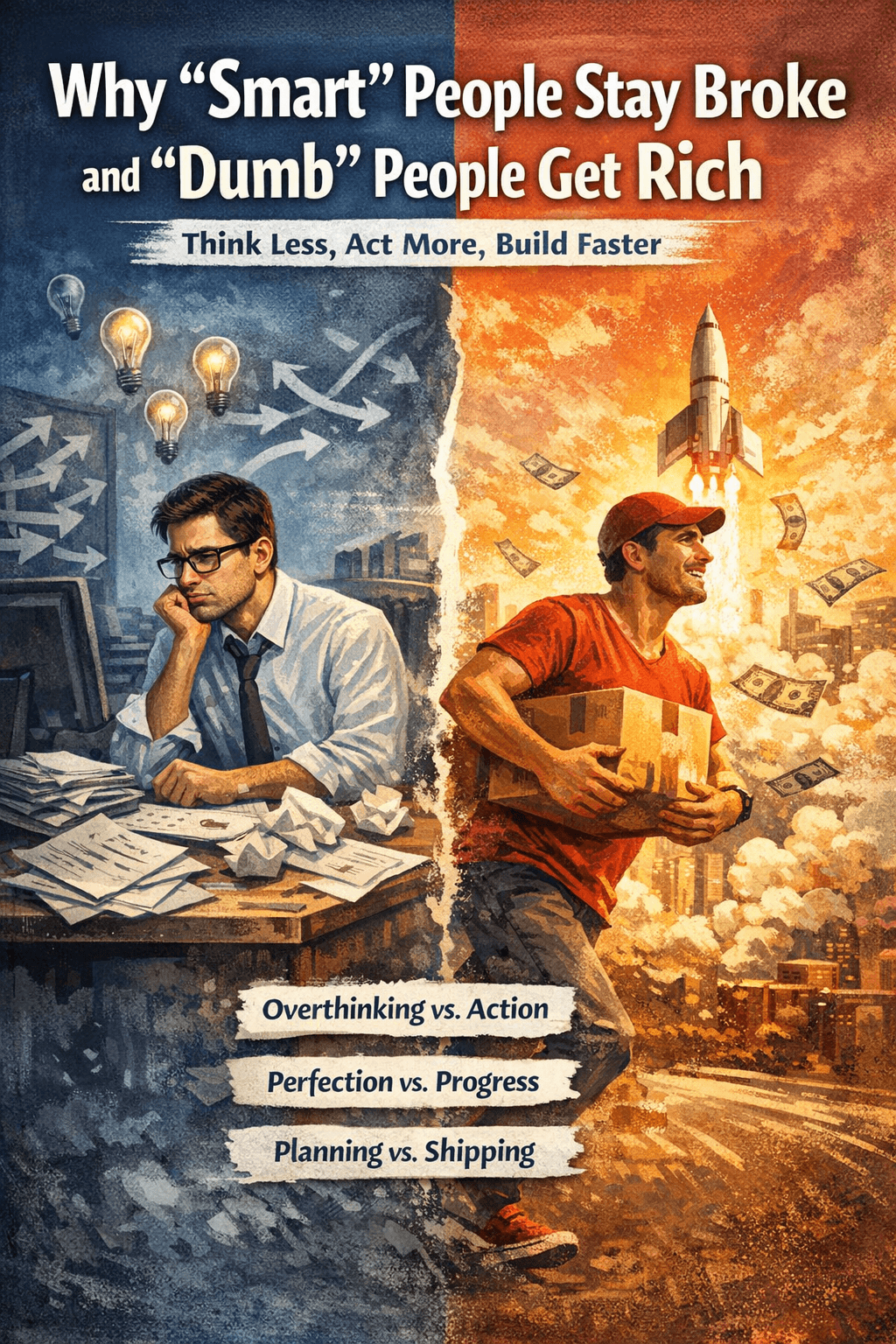
This video title is provocative — and intentionally so.
“Why smart people stay broke and dumb people get rich?” sounds like a jab at intelligence. But if you look deeper, it’s not attacking intelligence at all. It’s attacking a trap many high-capability people fall into: over-analysis, perfectionism, and delayed execution.
The framing line of the video says it well: “Stop thinking, start shipping.” And honestly, that line alone is worth sitting with for a while. Because in leadership, business, content creation, entrepreneurship — and even personal growth — many of us are not stuck because we lack ideas. We are stuck because we are waiting for the perfect idea, the perfect timing, the perfect plan, the perfect confidence. Meanwhile, someone less polished but more decisive is already on version 5.
And version 5 always beats version 0.
The real issue is not intelligence — it is friction
Most “smart” people are trained to optimise for correctness.
We were rewarded in school for getting the right answer.
We were praised at work for being precise.
We built our identity around being thoughtful, credible, and competent.
That’s a strength… until it becomes a prison.
Because in the real world, especially in business, speed of learning matters more than speed of thinking. And speed of learning comes from action. You don’t learn by staring at the whiteboard. You learn by launching, getting feedback, adjusting, and going again.
I’ve seen this everywhere:
Leaders who spend 9 months designing a culture initiative… and never run a pilot.
Teams who debate AI strategy endlessly… while a smaller competitor deploys 3 use cases and starts compounding.
Founders who keep refining the deck… but never ask for the sale.
Content creators who want the perfect message… and never post.
Meanwhile, the so-called “less smart” person just starts.
Not because they know more.
But because they are less attached to looking smart.
That’s the painful truth.
“Dumb” is often just code for bold, practical, and unafraid to look messy
Let’s be fair: many people we casually label as “dumb” are not dumb at all.
They may simply be:
less theoretical
less concerned about image
less trapped by perfectionism
more willing to test
more resilient when embarrassed
more commercial in instinct
more comfortable learning publicly
They don’t need a 42-slide strategy before they begin. They need enough clarity to take the next step.
And that gives them an unfair advantage. In leadership terms, they have what many brilliant people lack: executional courage.
I’ve worked with incredibly intelligent people across GE, J&J, and many global environments. Some of the best thinkers in the room were not the ones who built the most. Why? Because intelligence can become a sophisticated form of procrastination.
- You can hide behind analysis.
- You can hide behind frameworks.
- You can hide behind “we need more data.”
- You can hide behind “the timing is not right.”
- And all the while, life moves on.
The hidden enemy: identity
Here’s where this gets deeper.
Many high performers don’t fear failure.
They fear looking foolish.
That fear is stronger than most people realize.
If your identity is “I’m the smart one,” then trying something new is threatening. Because beginners look clumsy. Entrepreneurs look uncertain. Creators get ignored at first. Builders make mistakes in public. Leaders trying to transform culture get resistance. AI pilots fail. Products flop.
And if your self-worth is tied to being right, you will avoid any arena where you may look wrong.
So you stay in your head.
You become the person with brilliant opinions and unfinished projects.
That’s not a capability issue.
That’s an identity issue.
In business, momentum beats brilliance
This is one of the most important lessons in leadership and enterprise:
Wealth, impact, and transformation often come from momentum — not genius.
Brilliance matters. Strategy matters. Thinking matters.
But only when paired with movement.
A mediocre plan, executed and improved, will outperform a brilliant plan that lives in a notebook.
That’s why in many organisations, the winners are not always the smartest teams. They are the teams that:
move fast,
learn fast,
recover fast,
and keep moving.
This is also why many transformations fail. Companies over-design the future and under-practice it. They optimise the presentation deck and ignore the behavioural loop. They talk culture but don’t change rituals. They talk innovation but punish experimentation.
You don’t build transformation through intelligence alone.
You build it through repeated acts of courageous execution.
The leadership lesson: stop admiring the map, start taking steps
If I had to translate this video into a CEO sentence, it would be this:
Your organisation is not stuck because it lacks ideas. It is stuck because it has built a culture where movement is more risky than delay.
That’s the real leadership challenge.
If leaders punish mistakes, teams will overthink.
If leaders reward polish over progress, teams will hide.
If leaders worship strategy and ignore experimentation, nothing changes.
So what do we do?
1) Reward shipping, not just planning
Celebrate teams that test and learn — not only teams that present beautifully.
2) Build “small win” loops
People need evidence that progress is possible. Start with pilots. Start with one habit. Start with one customer segment. Start with one AI workflow. Momentum creates belief.
3) Normalize imperfect first drafts
The first version of anything meaningful is usually ugly. That’s not failure. That’s the price of building.
4) Separate identity from outcomes
A failed idea does not mean you are a failure. It means you ran an experiment. Leaders must model this publicly.
5) Shorten the distance between idea and action
If your teams need 7 approvals to test something small, don’t be surprised if they stop trying.
A personal reflection for all of us
This message is not just for entrepreneurs. It is for all of us.
How many dreams have we delayed because we were “thinking”?
How many conversations have we postponed because we wanted the perfect words?
How many projects, books, products, partnerships, and ideas are sitting in draft mode?
Sometimes the breakthrough is not another insight.
Sometimes the breakthrough is simply this:
Press publish.
Make the call.
Run the pilot.
Start the workout.
Launch the programme.
Send the proposal.
Ship the first version.
You can be deeply thoughtful and still decisive.
You can be strategic and still move quickly.
You can be intelligent without becoming imprisoned by your intelligence.
That is the balance.
Final takeaway
The title may sound harsh, but the lesson is powerful:
It’s not that “dumb” people win.
It’s that people who move, learn, and persist often beat people who only think.
In this season — whether you’re building a business, leading a team, transforming culture, or trying to grow personally — don’t let brilliance become your bottleneck.
Be wise enough to think.
Be humble enough to start.
Be bold enough to ship.
Because in the end, the world rarely rewards the best idea in your head.
It rewards the one you had the courage to put into motion.

Personal
Tags: Productive Mindset

Roshan is the Founder and “Kuli” of the Leaderonomics Group of companies. He believes that everyone can be a leader and "make a dent in the universe," in their own special ways. He is featured on TV, radio and numerous publications sharing the Science of Building Leaders and on leadership development. Follow him at www.roshanthiran.com