When the World Catches Fire, Stay Seated
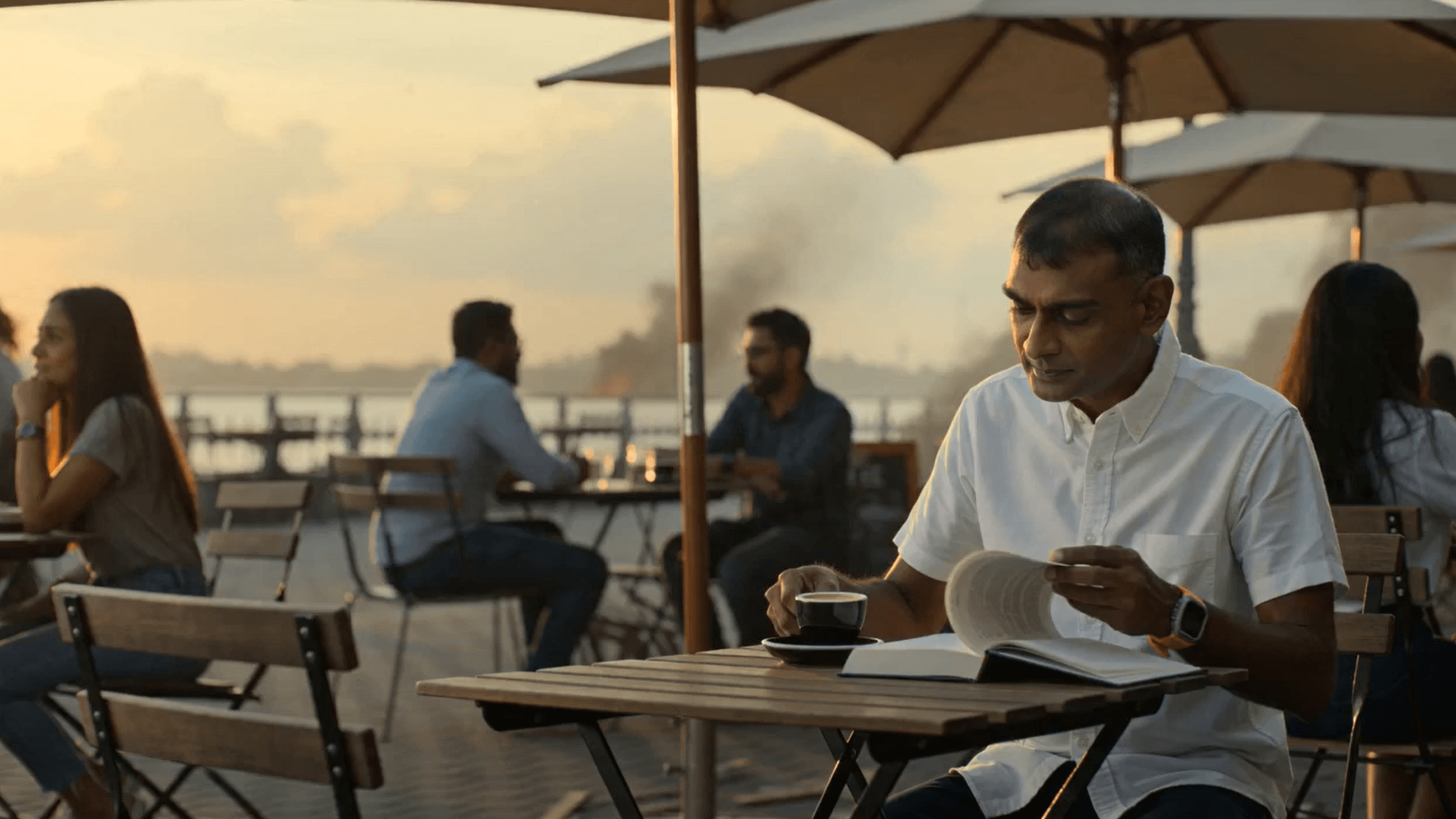
There is a short film attached to this article. In it, I am sitting at a café by the water, reading a book and finishing my coffee. Behind me, the world is coming apart. Smoke rises off the pier. People are shouting and running. And for a few seconds, a glowing suit of armour assembles itself across my body, as if I am about to leap up and fight whatever is coming. Then it dissolves. I turn a page. I keep reading.
I made that film because it is the most honest picture I have of a change that took me the better part of twenty years to undergo. For most of my career, I was the armour. The instant anything disturbed my peace, an interruption, a crisis, a problem walking toward my table, I suited up. I charged. I tried to shoot the monster down. It took me a long time, and a fair amount of pain, to learn the thing the video is really about. You cannot fight your way to peace.
The war you cannot win
Here is the trap. If your calm depends on silence, you have made your inner life hostage to your outer circumstances. And the outer circumstances of any leader worth the title will never be quiet. There is always another fire, another ping, another person who needs something now. Win one battle with the noise and three more arrive. You end up exhausted, reactive, and strangely never present for the work that actually matters.
The data on this is sobering. Gloria Mark, who has studied human attention at the University of California, Irvine for nearly two decades, found that when she began in the early 2000s, we held our focus on a screen for about two and a half minutes before switching. Today it is roughly 47 seconds. And a single genuine interruption costs us, on average, around 23 minutes to fully return to the original task. Most of us are not overworked so much as we are fragmented. We have become people who are always almost concentrating. So the answer cannot be to add more armour, more hustle, more aggressive defence of our time. That is just fighting harder in a war that does not end. The answer is something quieter, and much harder to learn.
The deeper layer: Frankl
When I first shared this story, someone left a comment that was only three words long: logotherapy, Viktor Frankl. They were pointing me to the foundation under the whole idea, and they were right.
Frankl was a psychiatrist who survived the Nazi concentration camps, and out of that unimaginable place he built a school of thought called logotherapy. Strip away the academic language and it rests on a few convictions that have quietly reorganised how I lead. The first is what he called the freedom of will. Frankl insisted that between what happens to us and how we respond, there is always a gap, and inside that gap sits our freedom. He wrote that the last of the human freedoms, the one that could not be taken even in the camps, is the freedom to choose one's attitude in any given set of circumstances. The fire on the pier is not the problem. What I do in the half-second after I notice it is the problem, and that half-second belongs to me.
Most of us have shrunk that gap to almost nothing. Stimulus, then instant reaction. Ping, then panic. The work of a lifetime is to widen it again. The second conviction is what Frankl called the will to meaning. He argued that the deepest human drive is not pleasure or power but meaning, and that when our sense of meaning collapses, everything else wobbles. This is why some people fall apart at the first disruption while others stay steady through genuine catastrophe. Calm, it turns out, is downstream of meaning. When you are anchored to something that matters more than the interruption, the interruption loses its power to move you. The man in the video is not calm because nothing is wrong. He is calm because he knows what he is there to do, and a little smoke does not change that.
Dereflection, or the book in my hands
The third idea is the most practical, and it is the secret hiding in plain sight in the film. Frankl had a technique he called dereflection. When someone is trapped in anxiety, the instinct is to fight the anxiety directly, to wrestle it, analyse it, defeat it. Frankl found that this usually makes it worse, because the wrestling keeps your attention nailed to the very thing you want to escape. Dereflection does the opposite. It gently turns your attention away from the problem and toward something meaningful and worth doing.
Watch the video again with that in mind. I do not defeat the chaos. I do not even engage it. I keep reading the page in front of me. The book is dereflection made visible. It is not denial, because I can clearly see the fire. It is a decision about where my attention will live. This is the move I wish I had learned earlier as a leader. When a crisis hits, the reactive leader pours all their attention into the crisis and amplifies it for everyone around them. The steady leader notices the crisis, decides what genuinely deserves a response, and keeps doing the meaningful work that the panic is trying to interrupt. They hear everything. They are ruled by almost none of it.
Frankl paired this with what he called tragic optimism, and I want to be careful here, because this is not the cheap positivity of a motivational poster. Tragic optimism does not pretend the fire is not real. The losses are real, the pressure is real, the suffering is sometimes real. It simply insists that even in the middle of all of it, meaning remains available to us through how we choose to respond. That is a far sturdier thing to stand on than the hope that things will finally calm down.
Calm is a muscle, not a mood
If this still sounds like a personality you either have or you do not, the neuroscience offers some encouragement. Studies on mindfulness practice have shown that roughly eight weeks of training measurably lowers reactivity in the amygdala, the brain's alarm system, and strengthens its connection to the prefrontal cortex, the part we use to pause and choose a response rather than fire off a reflex. In other words, the gap Frankl described is not just philosophy. It has a physical home in the brain, and it can be widened with practice. Calm is a muscle, not a mood. I am living proof that you can be born without much of it and build it anyway.
So what does this look like on a normal, noisy Tuesday? It looks like a pause before the reply, not after the regret. It looks like asking, when the next monster appears at your table, one quiet question: does this need my reaction, or just my attention? Most things need only the second. It looks like protecting the meaningful work the way the man in the film protects his book, not by building higher walls against interruption, but by being so anchored to what matters that the interruptions stop running the show. And for those who lead others, it looks like understanding that your nervous system sets the temperature of the room. A reactive leader trains a reactive culture. A steady one gives everyone else permission to breathe.
I am still learning all of this. I still get pulled. There are days the armour snaps back on before I can stop it. But I am getting better, and the change has been worth every uncomfortable year it took. The world is not going to get quieter. The pings will multiply, the fires will keep starting, and the monsters will keep arriving right when you have finally found a good page. Your task was never to silence any of it.
It is to become someone it can no longer move.

Personal
Tags: Be A Leader
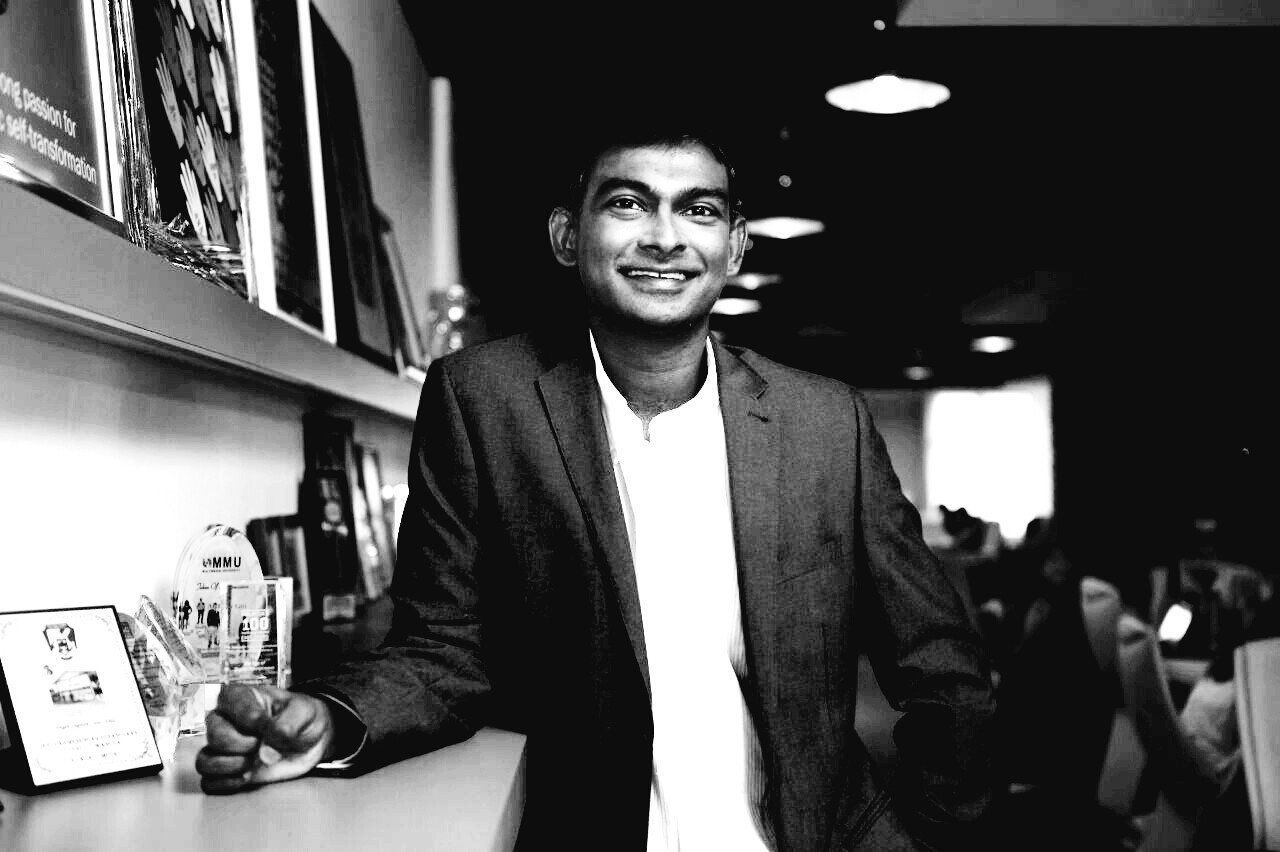
Roshan is the Founder and “Kuli” of the Leaderonomics Group of companies. He believes that everyone can be a leader and "make a dent in the universe," in their own special ways. He is featured on TV, radio and numerous publications sharing the Science of Building Leaders and on leadership development. Follow him at www.roshanthiran.com