Become Dangerously Smart With AI: From Passive User to Active Master
I recently came across a video that stopped me in my tracks. It wasn’t another tech tutorial or a review of the latest ChatGPT feature. It was a warning.
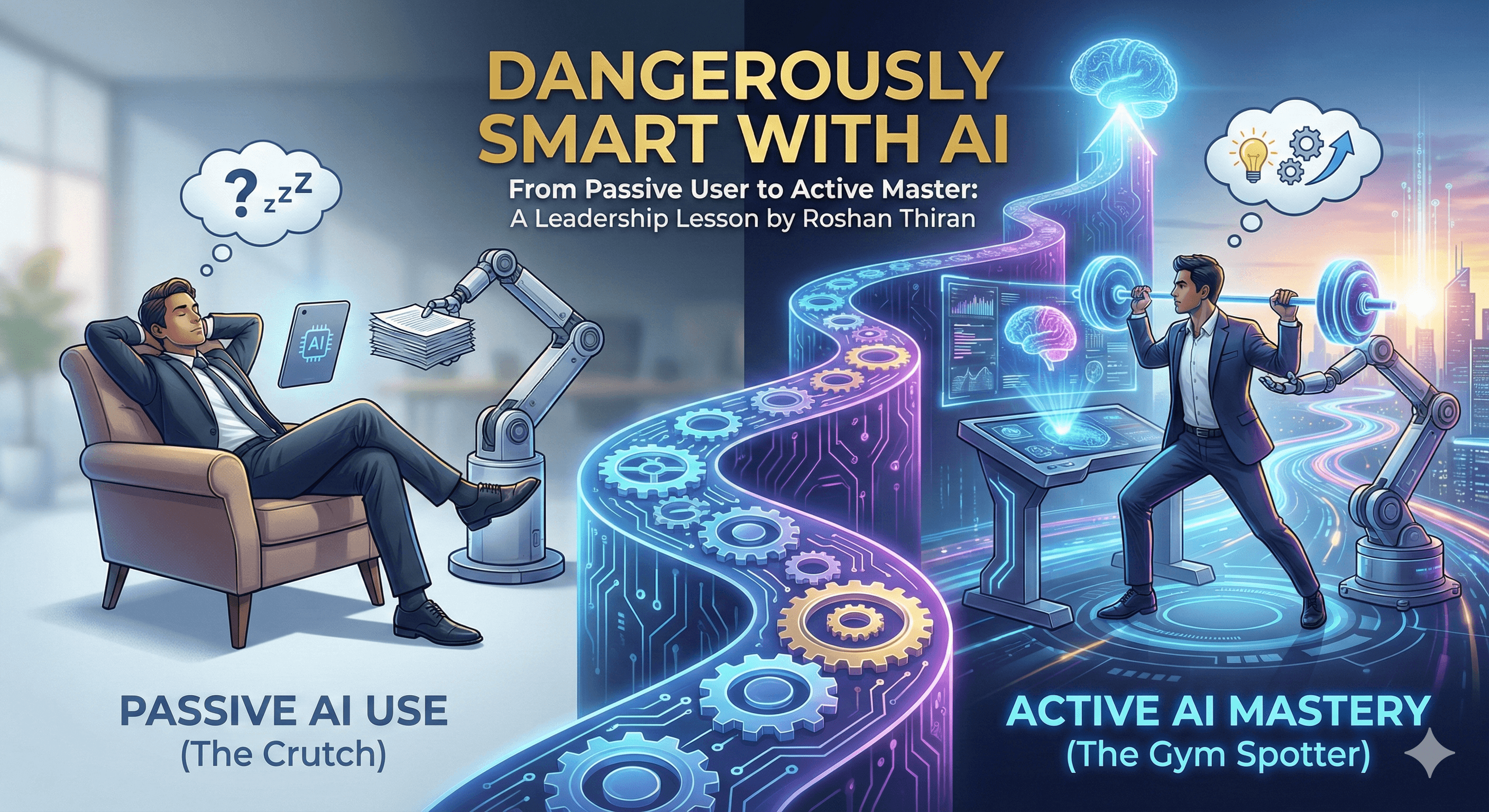
The speaker, a former MIT grad known as "theMITmonk," posed a question that every leader needs to answer right now: Is AI your wheelchair, or is it your gym spotter?
Most of us are using AI to do the work for us. We are letting our critical thinking muscles atrophy. But the top 1%—the leaders who are actually getting ahead—are doing the exact opposite. They aren't using AI to be lazy; they are using it to become "dangerously smart."
As I watched this breakdown, I realized this is exactly what we preach at Leaderonomics. Technology shouldn't replace your leadership; it should elevate it.
Here are the 4 transformative lessons from this case study on how to stop being a user and start being a master.
The Case Study: A Quick Breakdown
Video: Give Me 18 Minutes and I'll Make you Dangerously Smart (with AI) - refer above
The Core Idea: Most people use AI to remove friction (laziness). The elite use AI to add friction (learning).
Here is the framework that changes the game:
1. Practice "Intelligent Laziness" (0:37)
We often waste our best brainpower on low-value tasks. The speaker calls these "Capped Payoff" tasks—emails, scheduling, basic formatting. To be a strategic leader, you must ruthlessly outsource the drudgery so you can obsess over the "Uncapped Payoff" work (strategy, innovation, connection). The Lesson: If you are still writing every email from scratch, you aren't being diligent; you're being inefficient. Save your brain for the decisions that actually move the needle.
2. The D.R.A.G. Framework (3:47)
What exactly should you delegate? The video offers a brilliant acronym for the "grunt work" you should hand over to AI immediately:
D - Drafting: Never start with a blank page. Let AI write the first messy draft.
R - Research: Let AI compile the data so you can synthesize the insights.
A - Analysis: Let AI crunch the numbers so you can find the story.
G - Grunt Work: Formatting, cleaning data, administrative tasks. The Lesson: Your job is not to be the architect and the bricklayer. Be the architect. Let AI carry the bricks.
3. Climb the "Intelligent Hill" (6:43)
Most people treat AI like a slot machine—they type a prompt and hope for a lucky answer. This is "Zero-Shot" prompting, and it’s gambling, not leadership. To get smarter, you need to force the AI to show its work. Ask it for "Chain of Thought" reasoning. Make it explain how it got to the answer.
The Lesson: Don't settle for the answer. Demand the logic. When you force AI to reason, you force yourself to evaluate that reason. That is how you sharpen your judgment.
4. The "Intelligent Gym" & The Fool's Advantage (12:13 - 15:03)
This was my favourite point. If you use AI to skip the struggle of learning, you become weaker. Instead, use AI as a Sparring Partner.
Don't ask AI to write your speech; ask it to critique your speech.
Don't ask AI to solve the problem; ask it to quiz you on the solution. The speaker references Satya Nadella’s shift at Microsoft from a culture of "Know-it-alls" to "Learn-it-alls." The "Intelligent Fool" isn't afraid to ask AI to "explain this to me like I'm 10." The Lesson: True confidence comes from admitting what you don't know. Use AI to fill your knowledge gaps, not to hide them.
My Final Thoughts
The danger of AI isn't that it will outsmart us. The danger is that we will let ourselves become dumb.
We are at a crossroads. You can use this technology to become a passive consumer, or you can use it to build a "second brain" that challenges you, pushes you, and makes you better.
As you go into this week, ask yourself: Am I using AI to skip the workout, or am I using it to lift heavier weights?
Be a leader today.
- Roshan

Functional
Tags: Artificial Intelligence

Roshan is the Founder and “Kuli” of the Leaderonomics Group of companies. He believes that everyone can be a leader and "make a dent in the universe," in their own special ways. He is featured on TV, radio and numerous publications sharing the Science of Building Leaders and on leadership development. Follow him at www.roshanthiran.com