The Chemical Reason Your Boss Can Seem a Little Heartless

Freepik
I’ve long referenced something I called the empathy gap.
If you picture it, it looks like a fjord. On one side stands the senior leader, focused, driven, responsible for outcomes that carry real weight. But just how wide the gap is depends on the viewer. To the executive in the C-suite, it might look like this:
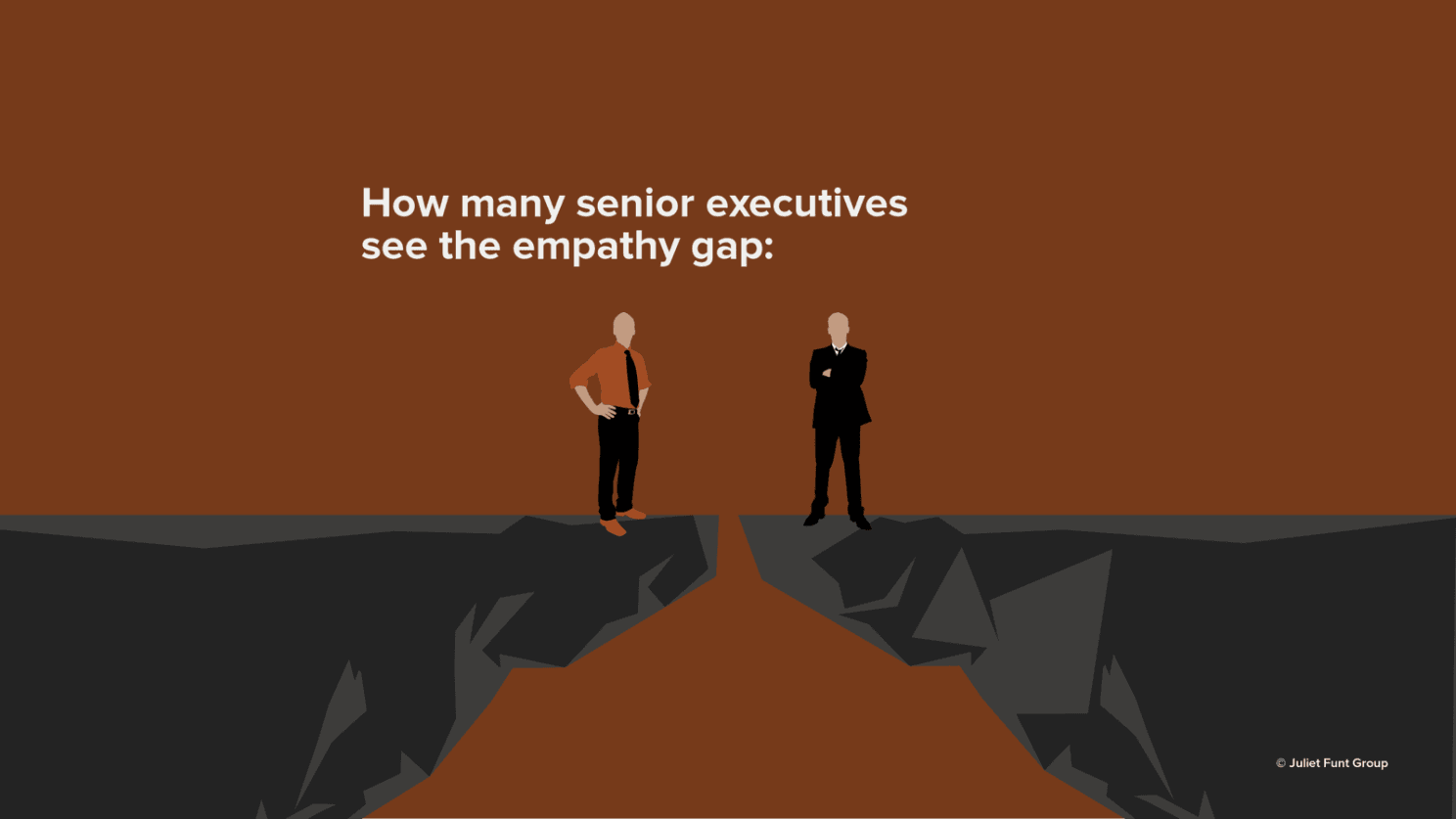
Source: Juliet Funt on LinkedIn
But on the other side of the fjord stands the employee, closer to the daily experience of the work, the endless pressure, the interpersonal friction, and the emotional price of it all. In their eyes, the distance between them and senior leadership might feel more like this:
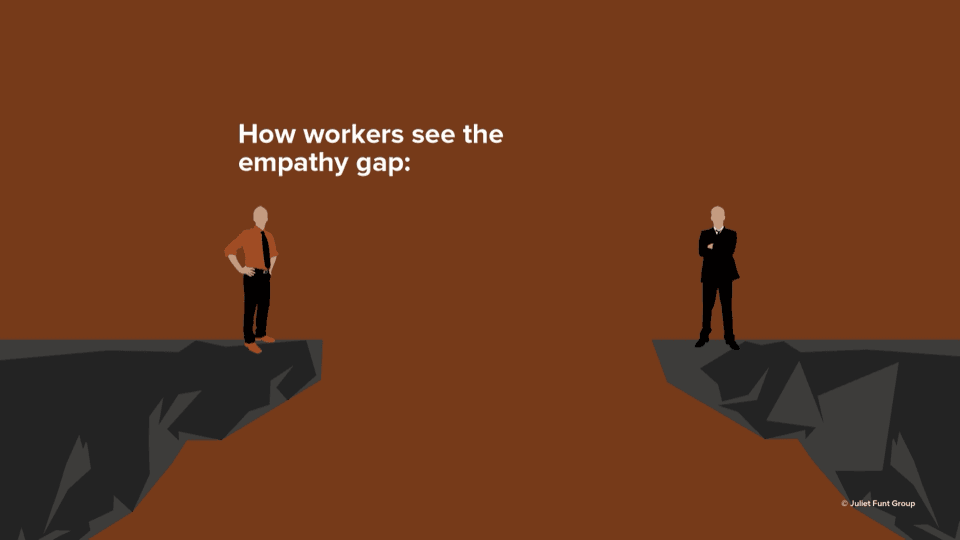
Source: Juliet Funt on LinkedIn
Frontline workers have no more clarity about seeing their boss's pains and pressures than the reverse. Between them is a vast distance, not because either side is bad or doesn’t care, but because they quite literally do not experience the same reality.
For a long time, I explained this empathy gap through behavior, pressure, and perspective. Leaders are further from the day-to-day truth because they have to be. They’re juggling more variables, often under intense scrutiny and expectation. They don’t always see what’s happening on the ground floor because their attention is powerfully pulled in so many competing directions.
All of that is still true. But recently, I came across a lens that adds something deeper to the conversation. It suggests the gap may not just be structural; it may also be chemical.
Dopamine’s Big Impact on Leadership
For the last 25 years, I’ve talked about dopamine in a very specific way. Most of us are familiar with what’s called the desire dopamine circuit, which is the part of us that craves novelty, excitement, and the next hit of pleasure.
It’s the feeling of: “I can’t wait to check my email,” “I wonder what’s coming next,” “Let me just refresh one more time.” It’s unleashed when opening every Amazon package or peering in the window of a bakery. And this version of dopamine is everywhere in modern work. It fuels urgency, responsiveness, and that constant low-level buzz of “what’s next?”
But in reading the fascinating book The Molecule of More, I was introduced to something I’d never known: There isn’t just one dopamine circuit, there are two. The second one changes how we understand leadership entirely.
The Control Dopamine Circuit: Why Leaders Become Builders
The second dopamine system is what the authors describe as the control dopamine circuit.
If the desire dopamine circuit is about the next thrilling and novel thing, the control dopamine circuit is about wanting more in the big picture. This dopamine circuit is all about the long-term, future-oriented goals and rewards. It’s about building, scaling, and achieving something substantial over time.
And here’s the critical part: People with naturally higher activity in this control circuit are far more likely to become senior leaders. Which makes sense, right? They are the ones who can stay focused on distant goals, be endlessly tenacious towards a goal, and build companies over time.
What Gets Lost: The “Here and Now” Circuit
On the other side of this equation is something called the H&N circuit, short for Here and Now. This is the part of us that feels connection, notices subtle emotional cues, appreciates small moments, and responds to human experience. It’s essentially the circuitry that allows empathy.
And here’s where things get complicated. When control dopamine is highly active, focused on a big future goal…the H&N circuit is muted.
So if you follow this all the way through, you get to a compelling conclusion: The very people who are best wired to build the future…are often the least wired to fully experience the present and the people in it. Many senior leaders simply have a natural hardwiring that draws them away from the human side of things. It’s baked into their brains and their chemistry.
You may like: Paradoxical Leadership
Reframing the “Heartless Boss”
So now let’s say you have a boss who is making everyone work longer than normal hours or sends a scathing email when a Q2 financial goal hasn’t been met. For employees, these moments have real impact. This is naturally the moment where many employees jump to a moral conclusion: “My boss doesn’t care.” “They’re disconnected.” “They’ve lost touch.” And while that can certainly be how it feels on the receiving end, it’s not always the full story.
Often, something else is happening. What looks like indifference may actually be a genetic predisposition, then combined with real pressure and high stakes. A leader sitting in a control-dominant state is focused on outcomes that don’t yet exist. They’re thinking in timelines that stretch months or years ahead, carrying the weight of financial targets, stakeholder expectations, and decisions that impact many people at once. They are filtering everything through scale, risk, and long-term impact.
So What Do You Do With This?
This is the part where most conversations about empathy stall. We identify the gap, but we don’t always know how to work with it. Because if this dynamic is partly chemical, partly structural, and partly reinforced by success itself, then it’s not something you solve with a single training or a well-worded memo. It requires something more deliberate.
De-personalize the Moment in Real Time When something lands harshly, insert a mental buffer: “This may be pressure + wiring, not intent.” That small reframe doesn’t excuse bad behavior, but it prevents you from layering unnecessary emotional meaning onto it, which is where most of the damage to your state of mind compounds.
Use a Translator Layer Between Pressure and People Some leaders are never going to be naturally warm in the moment. Fine. Then build a bridge. Strong managers can translate executive urgency into language people can absorb, and translate employee strain into signals leadership can actually hear. A great middle layer keeps pressure from becoming harm.
Build Micro-Sources of Empathy Elsewhere If your primary leader is not naturally empathetic, don’t make them your only source of validation. Cultivate peer relationships, mentors, or even one trusted leader who does operate in the here-and-now. You’re stabilizing your own experience rather than waiting for one person to change.
A Final Thought
One of the most important shifts you can make as a leader (or as someone working with leaders) is this: Stop assuming the empathy gap is about intent and start recognizing that it may be about wiring.
Because when you understand that, two things become possible: Leaders can begin to re-enter the here and now, even in small, intentional ways, and teams can stop personalizing what was never entirely personal to begin with.
The fjord may always be there, but it doesn’t have to stay un-crossed.
This was also published on Juliet Funt's LinkedIn.



Leadership