The Deficit Reflex: Why Most Culture Transformations Fail (And How to Fix It)

Vectorarte from Freepik
Every change management practitioner knows that 70% of transformations fail.
It’s the statistic that shows up in decks, proposals, and keynotes… usually right before we prescribe the same playbook that has produced that failure rate in the first place. I recently read Vibhas Ratanjee’s excellent Forbes piece call this pattern what it really is, The Deficit Reflex — the automatic habit of scanning for what’s broken, fixing it fast, and mistaking speed for competence.
But here’s the uncomfortable truth I’ve seen repeatedly (in my days at Exxon, GE & Johnson & Johnson, in boardrooms, and now across hundreds of organisations in Asia): Most transformations don’t fail because people can’t execute. They fail because leaders try to replace the system without ever truly understanding (hearing) it.
And that’s exactly why culture transformation must be treated less like an initiative and more like a science — a repeatable method grounded in behavioural design, real-time feedback loops, and measurable rituals.
1. The 70% Failure Story Is Both True… and Still Missing the Point

Pch.vector from Freepik
Let’s be fair, the 70% failure narrative has been repeated so often that people have started debating whether it’s exaggerated, misattributed, or too simplistic.
And yet… even if you argue the number is wrong, the experience is not.
McKinsey has cited results consistent with the idea that only about one transformation in three succeeds (so, roughly the same story). HBR has also published the blunt claim that about 70% of all change initiatives fail.
So yes, the statistic may be messy. But the pattern is painfully consistent:
- big launches
- disciplined governance
- comms cascades
- stakeholder alignment maps
- change champions
- dashboards
- then… a slow return to old behaviour, just with shinier language.
Which raises the question Ratanjee is really asking, what if we keep solving the wrong problem?
2. Replacement is Not Transformation, It’s Renovation Without Living in the House
Ratanjee draws on Otto Scharmer’s distinction that most organisations confuse transformation with replacement, throwing out what’s not working and install something new.
That sounds logical. It’s also why we get:
- reorganisations that change reporting lines but not decision rights
- new values decks while the same incentives reward the old behaviour
- customer centricity posters while customers still suffer handoffs and delays
- agile transformations where teams sprint… but leaders still micromanage.
One of the most haunting lines in the article is this:
They’ve described the building perfectly. They have no idea what it feels like to live in it.
That is the difference between:
- mapping the architecture (structures, charts, policies, rituals) and
- inhabiting the experience (fear, trust, voice, dignity, belonging, overload, the real daily trade-offs)
And if you don’t inhabit the experience, you just repaint the system.
3. The Real Failure is Emotional

Source: Pch.vector from Freepik
Ratanjee shares Gallup data that explains the failure rate more honestly than any governance model. Only 6% of U.S. employees strongly agree with the four items most predictive of effective change management:
- my supervisor supports the changes
- communication is open across levels
- I’m asked for input
- leaders help me see how changes shape the future.
And then this explosive point:
- where those conditions are met, 77% of employees are engaged
- where they are not, 1% are
That 77-to-1 ratio is basically Gallup politely telling leaders that your change plan is failing because people don’t feel heard, supported, or safe enough to participate.
Which leads to my favourite line in the article (because it’s brutally accurate):
People don’t resist change. They resist being handled.
And once people feel handled, they do what humans do best in corporate life:
They comply. They nod. They fill the survey. They attend the townhall. They clap at the right slide. And then, they change nothing.
Compliance is the graveyard of transformation.
4. Why the Same Leaders Recreate the Same Outcomes
Here’s where Scharmer goes deeper — and where most change management frameworks stay silent:
The success of an intervention depends on the interior condition of the intervenor.
In simple language, you can’t lead a new culture with an old consciousness.
If leaders are operating from fear, ego-protection, control, image management, political survival — they can install new systems, but they will unconsciously recreate the same outcomes.
That’s why presencing matters. Before imposing solutions, we need to pay close attention to what is already unfolding within the system.
Now let me make this practical with a very Asian corporate example:
If your leaders have spent 10 years being rewarded for:
- avoiding mistakes
- escalating everything upward
- protecting their function
- keeping bad news quiet
- shipping green dashboards instead of reality.
…and suddenly you announce “empowerment” and “customer obsession”…
You don’t have a change problem. You have an identity and incentive problem. No amount of comms will override a nervous system trained by years of consequences.
5) So… Is Organisational Change a Science?
Yes. And we should stop treating it like theatre. A science has a few characteristics:
- it measures what matters
- it tests hypotheses
- it runs experiments
- it tracks leading indicators
- it builds feedback loops
- it adapts based on data
- it focuses on repeatable mechanisms.
That is exactly how we approach culture transformation in Budaya (and how we’ve applied it in customer-centricity work in various organisations). In our work, the premise is simple:
Culture is not what you say. Culture is what you repeatedly do — especially under pressure.
So instead of values rollout, we engineer rituals — measurable behaviours embedded into operating rhythms. And we treat change as a system.
Related: Lost in January KPIs? Here's How HR Can Step In
The Budaya 3-Phase Culture System
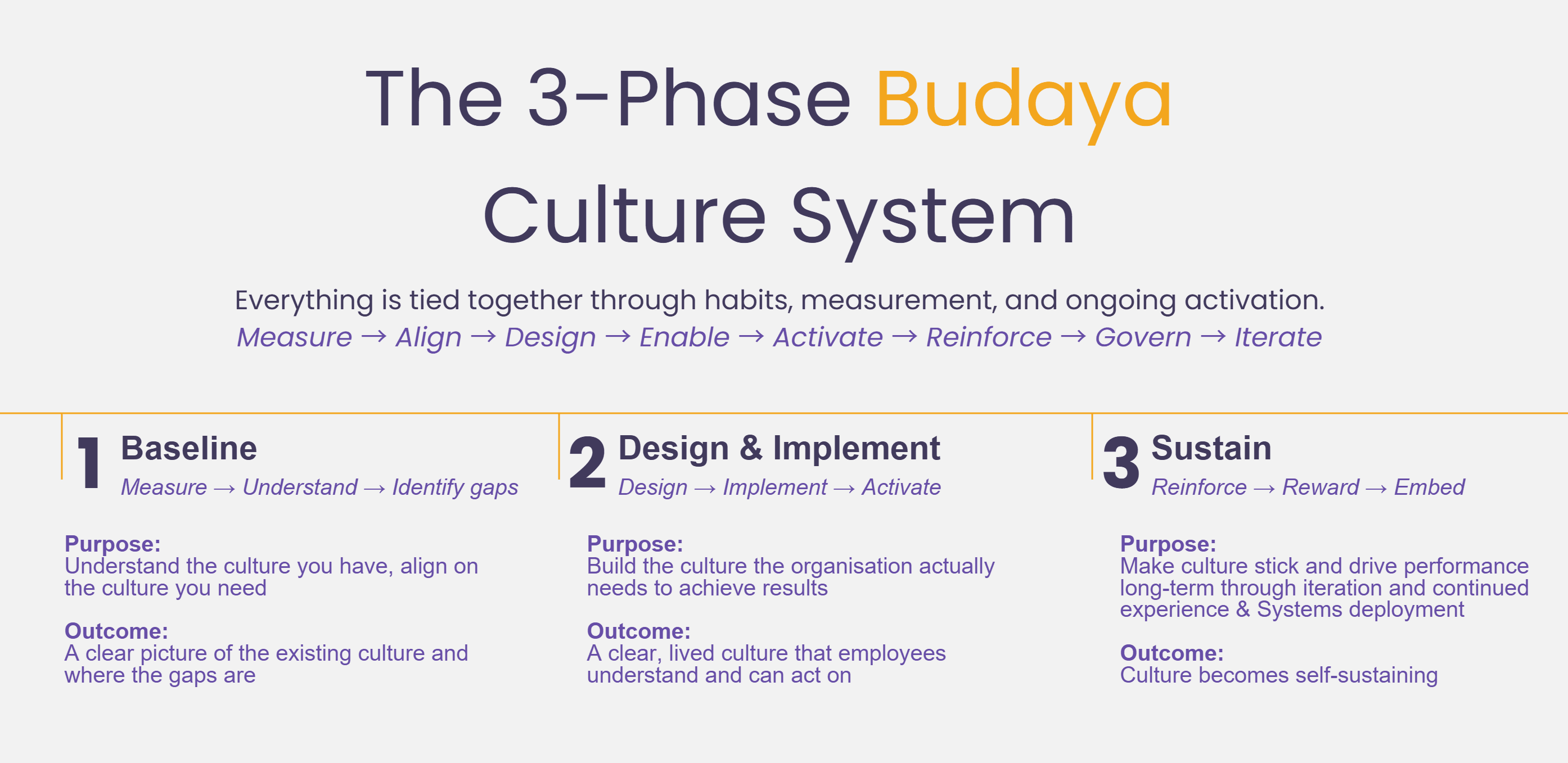
- Baseline: measure → understand → identify gaps
- Design & Implement: design → implement → activate
- Sustain: reinforce → reward → embed
This is a structured approach you'll want to start applying sooner than later.
6. How to Make It Work in Practice
If you only do presencing without structure, you get beautiful conversations… and no organisational shift. If you only do structure without presencing, you get dashboards and no behavioural shift.
The real win is bridging both.
a) Baseline (listening, sensing, inhabiting the experience)
Every organisation is different and will require a different baselining strategy but the key outcome is to try to listen and truly understand what the inherent culture of the team or organisation is. In one of the organisations we supported, we built the baseline phase around Voice of Employee (VOE) in three streams:
- leadership one-on-ones
- focus groups
- digital rollout tracking engagement, psychological safety, workload signals, trust, change readiness, value-behaviour alignment.
Then the data was synthesised across five lenses:
- engagement & emotional climate
- behavioural alignment to values
- psychological safety & voice
- workload & sustainability
- team-level cultural differences.
That is presencing made measurable. You’re not guessing what the system feels like, but mapping it with lived experience and real signals.
b) Design (turning values into rituals)
Once you understand where you are, you can start the design phase and start understanding where you want to go from where you are. In the same organisation where we created VOE streams to really hear the culture, we then outlined five design principles that are basically anti-deficit reflex principles:
- From value to ritual: customer centricity becomes measurable rituals that govern decisions
- End-to-end empathy: anchor changes in the customer journey
- Zero-friction ownership: empower teams to resolve issues at source
- Silo-busting design: cross-functional accountability around journey friction points
- Data-driven ritual health: refer to the bottom of the article of some of the rituals the Budaya team track on culture.
This is the part most culture programmes skip. They inspire people, but don’t redesign the moments where culture is actually formed (meetings, escalation rules, handoffs, decision checklists, feedback loops).
c) Implementation (experiments)
Instead of rolling out everything everywhere, the approach used in the example above applied a Lighthouse Team strategy — essentially a controlled field experiment designed to validate, refine, and prove the rituals before scaling. Culture change is behavioural change, and behavioural change is best achieved through small, testable interventions that generate evidence, learning, and credibility.
Here’s what that looked like:
- Select influential teams: Teams with high connectivity, credibility, and network influence — the kind of groups others naturally watch. In diffusion science, these become the early reference points that shape what feels normal across the organisation.
- Pilot 2 rituals for 2 weeks: Keep the intervention lightweight and observable. Two weeks is long enough to establish repetition (habit formation relies on repeated cues and routines), yet short enough to iterate quickly based on real feedback.
- Run weekly check-ins: Structured reflection loops to learn what’s working, where friction exists, and what needs redesign. In implementation science, this is how you close the knowing–doing gap. You treat adoption barriers as design problems, not attitude problems.
- Collect anecdotes + early metrics: You need both. Stories provide meaning (“this changed a real customer outcome”), while metrics provide credibility (“this reduced handoffs by X%” or improved first-contact resolution). This combination reduces ambiguity and builds confidence across stakeholders.
- Create social proof so adoption becomes desire: Once lighthouse teams demonstrate visible wins, the rituals gain legitimacy. This is behavioural science 101, people adopt faster when the behaviour is observable, beneficial, and already practiced by peers they respect. Scaling then becomes less about enforcement and more about pull — “we want that too".
That’s how humans work. We don’t change because of memos; we change because we see trusted people succeed with a better way, and our brains register it as both safe and worthwhile. When implementation is treated as experimentation, culture change stops being theatre and starts becoming a repeatable, scalable science.
d) Sustaining Change (where transformations usually die)
Most transformations collapse because the reinforcement system is missing. Early momentum fades, leaders move on to the next fire, and the organisation quietly snaps back to its old defaults. Sustainable culture change, therefore, is less about motivation and more about mechanism design: building a set of repeatable reinforcement loops that make the desired behaviour the path of least resistance.
A scientific sustainment approach typically has four interlocking loops:
- Ritual reinforcement embedded into operating rhythms: Instead of adding extra change meetings, the rituals are engineered into existing cadences (weekly team huddles, monthly business reviews, post-mortems, leadership standups). This matters because habit formation is driven by repetition in stable contexts.
- Behavioural scorecards tied to leadership accountability: Culture becomes measurable when behaviours are translated into observable markers (e.g., customer-journey review conducted, root-cause actions closed, cross-functional handoffs reduced). These indicators then sit inside leadership reviews as leading metrics to prevent drift and make culture visible in governance.
- Decision architecture that forces the new way of thinking: The fastest way to change culture is to change how decisions are made. Sustainment requires choice design: lightweight decision checklists, criteria gates, and meeting prompts that repeatedly anchor teams back to customer outcomes, trade-offs, and end-to-end ownership.
- Always-on measurement and feedback loops: Lagging metrics like NPS or revenue tell you what happened after culture has already drifted. Scientific sustainment relies on continuous sensing: micro-pulses on clarity, ownership, friction, psychological safety, and sentiment; behavioural adoption signals from rituals; and momentum tracking across teams. This enables early intervention before the organisation regresses.
In short: transformation sustains when reinforcement becomes systemic. When the environment consistently rewards the desired behaviours, the culture starts running like an operating system.
Related: How Gamification and AI Transform Organisational Culture
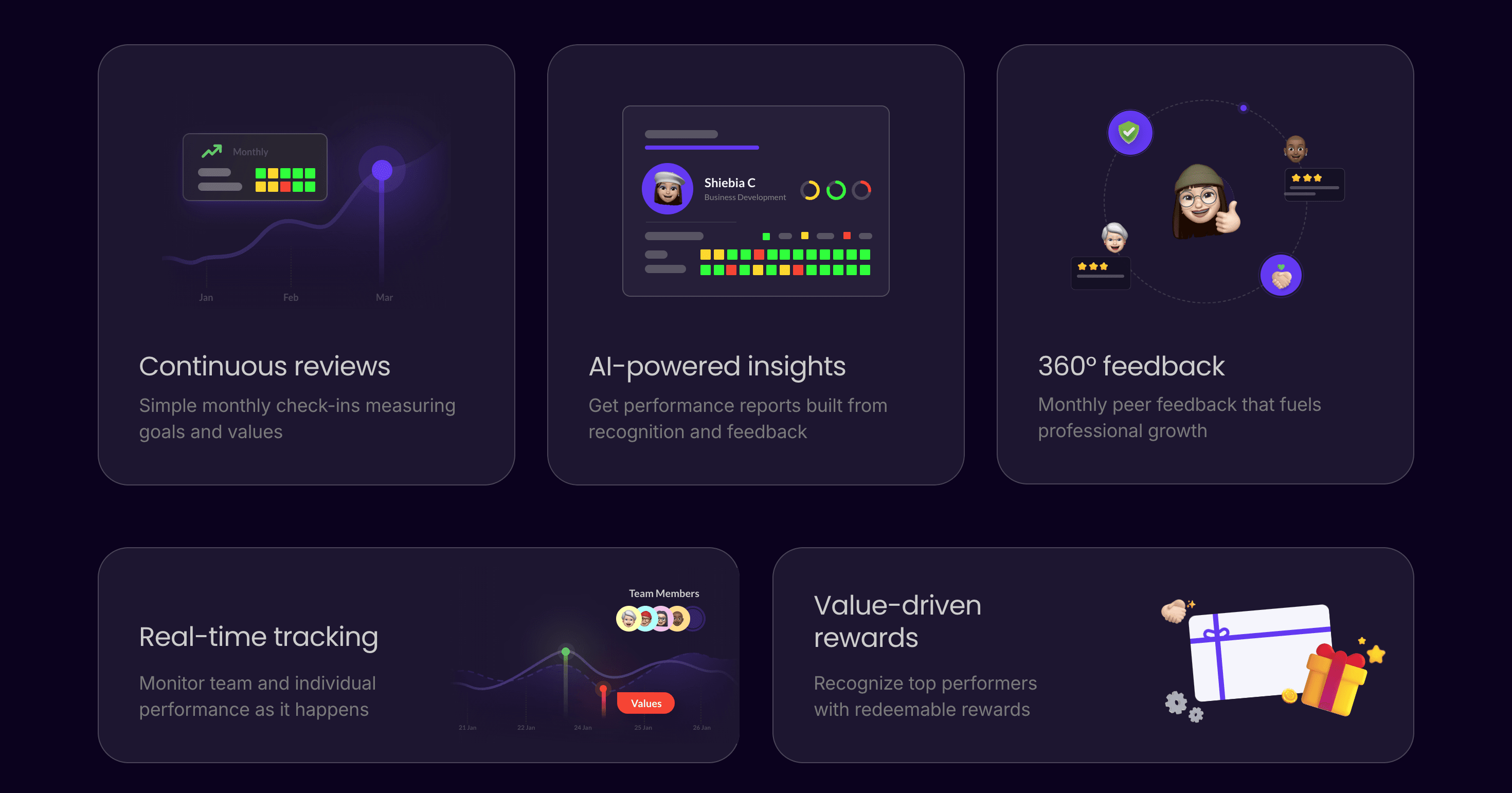
The Budaya App & Technology dashboard
7) Before the Next Kickoff
Ratanjee offers three deceptively simple starting points. I want to strengthen them with a “science-of-culture” lens — because the goal isn’t a better kickoff. The goal is a better system: one that prevents snapback, surfaces truth early, and converts resistance into ownership.
1) Start with capability, not deficiency: “What is already working that we cannot afford to lose?”
This one question interrupts the deficit reflex immediately because it forces leaders to scan for assets, not just gaps. In strengths-based research, what you pay attention to expands — and most organisations have invisible pockets of excellence living in frontline workarounds, informal rituals, and practical micro-innovations. Those are not “exceptions.” They are often the seeds of the future culture. When leaders ask this question sincerely, they uncover locally-built practices that outperform the shiny solution being imported — and they gain something even more valuable: credibility. People will follow a change that respects what they already built.
2) Replace the first month of “roadmap” with sensing: no solutions allowed
Most transformations fail before they begin because leaders rush to certainty. They announce the answers first, then run “listening sessions” that quietly function as validation exercises. Real sensing is different — it’s disciplined observation and meaning-making before design. Think of it like diagnosis in medicine: you don’t prescribe before you understand the system’s condition.
To make sensing real, leaders need a few non-negotiables:
- No fixing (premature solutions contaminate the data)
- No defending (defensiveness shuts down truth-telling)
- No power moves (rank-based pressure distorts what people share)
- No “thanks for sharing” without follow-through (nothing kills trust faster)
Gallup’s research reinforces why this matters: when people don’t feel consulted before change or valued after they give input, engagement collapses — and what you get isn’t support, it’s compliance. Compliance looks neat on dashboards and deadens real transformation.
3) Treat resistance as data, not disloyalty
Resistance is rarely irrational. More often, it is organisational memory speaking. It’s the system reminding you:
- “You promised this last time.”
- “We paid the price last time.”
- “We got punished for speaking up last time.”
In other words, resistance is information about trust, safety, and the gap between rhetoric and reality. Leaders who suppress resistance lose the most valuable diagnostic signal they have. Leaders who get curious can uncover what’s underneath: broken promises, misaligned incentives, fear of reputational risk, change fatigue, or unresolved grief from past restructures. When you treat resistance as data, you can redesign the change around real constraints — and that’s when resistance starts turning into responsibility.
Bottom line: before you kick off the next transformation, don’t obsess over the plan. Obsess over the conditions — capability recognition, disciplined sensing, and honest interpretation of resistance. That’s the difference between another corporate theatre production and a culture shift that actually holds.
8. Stop Optimising the Harvest, Start Tending the Soil
Ratanjee ends with a metaphor that should sting a little. Organisations keep obsessing over the harvest (targets, KPIs, quarterly wins), while neglecting culture, the soil that determines whether anything can grow sustainably.
Let me translate that into a CEO sentence:
You can’t demand a customer-centric culture (or whatever culture your are trying to build) from people who are overloaded, unheard, and quietly punished for taking ownership.
For example, if you want to build a customer-centric culture, are your employees feeling this reality daily:
- Do I have the authority to solve the customer’s problem?
- Is it safe to tell the truth about what’s broken?
- Will I be supported when I make a judgement call—or blamed when it gets messy?
- Are the systems and incentives aligned with the customer journey—or with internal politics?
When those conditions are present, customer-centric behaviour becomes natural. When they aren’t, no amount of branding will overcome the invisible signals the system sends every day. That’s why culture transformation is best treated as a science:
- You baseline reality (what people actually experience, not what leadership hopes is true)
- You design rituals (repeatable behaviours embedded into operating rhythms, not posters on walls)
- You run experiments (small pilots that generate evidence, learning, and social proof—not grand theatre launches)
- You engineer reinforcement (so the system rewards the right behaviour consistently, not occasionally)
- You track leading indicators (adoption, follow-through, friction, ownership, sentiment—before the lagging metrics move).
And when you do this well, something shifts that no comms plan can manufacture:
People move from resistance to responsibility.
If You’re Leading Change This Year…
Before you launch your next culture transformation, try this:
- Identify the 3–5 daily moments where your culture is actually being formed (meetings, escalations, approvals, feedback, customer complaints).
- Ask your people what those moments feel like today.
- Redesign those moments into measurable rituals.
- Pilot them with lighthouse teams.
- Reinforce and track adoption until it becomes “how we do things here".
After all, change should be rooted in cultural insight and expressed through system design.
P.S. I promised you some more information in the article on Data Driven Ritual Health.
Appendix on Data-Driven Ritual Health
Data-driven ritual health basically means: how do we know the ritual is alive, not just announced? And how do we detect drift early (before customer pain shows up in lagging metrics like NPS)? Here are practical indicators you can leverage in your ritual health analysis (BTW - Budaya has a deep science-based culture toolkit which you can access with all this information and much more).
1. Adoption Indicators (Is the ritual happening?)
These are your heartbeat metrics:
- Ritual completion rate: % of intended ritual instances actually executed (e.g., weekly customer-review huddle held).
- Consistency/cadence score: how regularly the ritual occurs without gaps (streaks matter).
- Coverage: % of teams/functions practicing the ritual (not just one champion team).
- Participation rate: attendance and active contribution, not just presence.
- Time-to-adopt: how many weeks from launch until the team consistently performs it.
Why it matters: Most rituals die in week 3–6 when leadership attention shifts.
2. Quality Indicators (Is it being done well, or “checkboxed”?)
This is where you separate compliance from transformation.
- Talk-time distribution: % of airtime from leader vs team (healthy rituals aren’t leader monologues).
- Depth score (simple rubric): are we naming root causes, or just listing symptoms?
- Decision follow-through rate: % of ritual decisions translated into actions within a set SLA.
- Customer evidence rate: % of discussions grounded in real customer signals (tickets, recordings, complaints, journey data), not opinions.
- Learning capture rate: number of reusable insights captured per session (patterns, principles, playbooks).
Tell-tale sign of bad ritual health: “We have meetings… but nothing changes.”
3. Outcome Proxies (Leading indicators that precede business results)
These are early wins that show the ritual is shaping behaviour.
- Cycle-time reduction in key customer journeys (time from request → resolution).
- First-contact resolution (FCR) improvement in service rituals.
- Escalation rate: fewer issues escalated upward because teams are empowered to solve.
- Rework / repeat-contact rate: fewer customers returning for the same issue.
- Handoff friction score: fewer back-and-forth loops across functions.
These are powerful because they move before NPS/CSAT shifts.
4. Behavioural Indicators (Is culture shifting in the room?)
These measure whether the ritual is changing the “how we work”.
- Ownership language frequency: “I will / we will” vs “they / management / someone should” (you can do lightweight text tagging from notes).
- Cross-functional collaboration index: number of actions requiring two or more functions that actually get completed.
- Customer empathy signals: frequency of “customer story” usage, persona references, journey mapping in everyday decisions.
- Speak-up rate: how often dissent, risk, or uncomfortable truths are voiced in the ritual (psychological safety proxy).
- Decision rights adherence: are decisions being made at the right level, or still pushed upward?
5. Energy & Sentiment Indicators (Is the ritual draining people or energising them?)
Rituals can become another meeting unless you track the human experience.
- Pulse sentiment after ritual (1–2 questions): “Was this useful?” “Do you feel clearer?”
- Emotional tone trend: frustration/confusion vs clarity/hope (qualitative tagging works).
- Perceived workload impact: “This ritual helps me prioritise” vs “this adds burden”.
- Burnout risk flags: fatigue signals rising even while ritual adoption is high.
A ritual that runs perfectly but exhausts people will not survive.
6. Integrity Indicators (Does the ritual survive pressure and leadership absence?)
This is the real test.
- Ritual survival rate during peak periods (quarter-end, crises).
- Leader-independent run rate: % of rituals conducted without the sponsor present.
- New-joiner assimilation time: how quickly new members adopt the ritual behaviour.
- Drift detection: how often the ritual reverts into old patterns (status updates, blame, no decisions).
Healthy rituals become self-propelling.
7. System Signals That Your Ritual is Working
These show the system is changing:
- Increase in problem-solving at source (fewer “send to HQ” patterns).
- Reduction in policy workarounds (fewer “shadow processes”).
- More customer issues solved permanently (root-cause fixes vs temporary patches).
- Higher reuse of solutions across teams (playbooks adopted).


Leadership
Tags: HR, Be A Leader

Roshan is the Founder and “Kuli” of the Leaderonomics Group of companies. He believes that everyone can be a leader and "make a dent in the universe," in their own special ways. He is featured on TV, radio and numerous publications sharing the Science of Building Leaders and on leadership development. Follow him at www.roshanthiran.com