The Leadership Case for a Remote Support Solution in Hybrid Workplaces

Photo by magnific @ magnific
A laptop that will not connect to a client call. A password reset that takes half a morning because the only person who can approve it is three floors, or three time zones, away. None of these moments shows up on a quarterly report. All of them shape whether someone feels supported or forgotten by the organisation they work for, quietly, over weeks and months of small daily interactions.
That is why a remote support solution for hybrid teams belongs on a leadership agenda, not just an IT procurement list. It is one of the more concrete ways a leader can demonstrate, in a hybrid setup, that people matter wherever they happen to be working that day.
Well-supported employees perform better and stay longer, and IT leaders themselves say so directly in Ivanti's 2025 Digital Employee Experience Report. Those are exactly the outcomes leaders are already accountable for, even when the underlying cause traces back to something as unglamorous as a support ticket.
Key Takeaways
- Remote support is not just a technical convenience; it shapes how supported employees feel in a hybrid workplace, day to day.
- Ivanti's 2025 research found IT professionals believe strong digital experience improves retention by 77%, satisfaction by 85%, and productivity by 87%.
- Hybrid teams already face coordination costs; slow tech support adds a second, quieter layer of friction on top.
- Leaders who treat support tooling as a genuine culture decision, rather than a routine line item, tend to see it reflected in morale.
- The business case holds up on its own merits: faster resolution, lower travel costs, and fewer stalled workdays.
Why This Belongs on a Leader's Desk, Not Just IT's
Hybrid work already asks a lot of leaders. Coordinating across locations, building trust without daily face time, and making sure no one feels like a second-class member of the team because they are not in the room. A slow, frustrating tech support experience quietly undercuts all of that work, one stalled morning at a time, and the erosion is hard to spot precisely because it never arrives as one dramatic event.
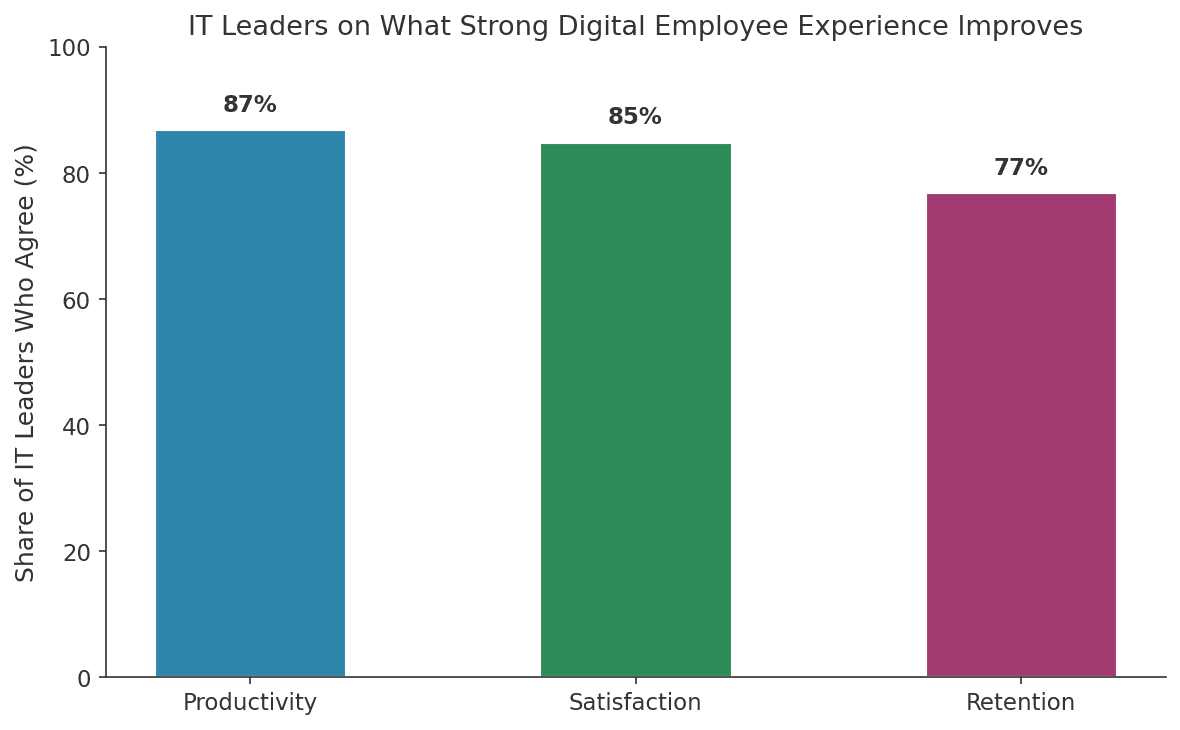
"IT professionals overwhelmingly believe strong digital employee experience positively affects employee productivity (87%), satisfaction (85%) and retention (77%)." — Ivanti, 2025 Digital Employee Experience Report
Those numbers reflect what most leaders already sense intuitively: people do not separate how supported they feel from how they feel about the job overall. A broken laptop that takes three days to fix reads as neglect, whether or not that was ever the intention.
Hybrid Work Already Carries Its Own Coordination Costs
Hybrid teams face real structural challenges even before technology enters the picture. As explored in Has Hybridity Killed Teamwork?, coordinating across locations already strains many leaders, with a large share of global managers reporting they lack the resources to fully support their distributed teams.

Slow technical support adds to that load rather than easing it. Teams already navigating the 5 challenges hybrid teams face do not need an additional source of friction layered on top of collaboration gaps that already exist.
What a Strong Remote Support Experience Actually Looks Like
Speed That Matches How People Actually Work
A hybrid employee working from home at 7am should not have to wait until someone reaches the office at 9am to get unblocked. Remote support closes that gap by letting a technician see and fix the issue directly, regardless of where either person happens to be sitting.
Consistency Across Every Location
An employee working from a co-working space should get the same quality of support as one sitting at head office. Inconsistent support quietly tells remote and hybrid staff they are a lower priority, even when no one intends to send that message.
Confidence That Problems Get Solved, Not Just Logged
A support ticket that sits untouched for days erodes trust faster than almost anything else in a distributed team. Visible, timely resolution signals that the organisation is paying attention, even to people it rarely sees in person.
| Pro Tip: Ask your IT lead for average resolution time broken down by location, not just an overall average. A strong headline number can mask a much worse experience for remote-only staff. |
The Cost of Doing Nothing vs. Investing in Remote Support
Leaders often underestimate how much a slow support experience actually costs, because the losses are distributed across many small moments rather than one visible line item that shows up clearly in a budget review.
| Factor | Status Quo (Slow or Inconsistent Support) | Investment in Remote Support |
|---|---|---|
| Time lost per incident | Hours to a full day | Minutes |
| Employee sentiment | Quiet frustration, rarely reported upward | Visible confidence in being supported |
| Equity across locations | Office staff get faster help | Consistent experience regardless of location |
| Retention risk | Difficult to quantify, easy to ignore | Directly tied to measurable satisfaction gains |
| Leadership visibility | Problem surfaces only after it compounds | Resolution data available proactively |
Security Is Part of the Trust Equation Too
Leaders extending support access across a hybrid workforce are also extending trust, and that trust needs guardrails. One cybersecurity vendor's overview of the security implications of a hybrid workforce is a useful reminder that convenience and security are not opposing goals; a properly configured support tool can be both fast for employees and defensible from a governance standpoint.
Questions Leaders Should Ask Before Signing Off
Not every remote support tool earns the trust leaders are extending on the organisation's behalf, and the differences between them are not always obvious from a sales pitch. Before approving one, ask:
- Does it treat every location equally? Confirm remote and in-office staff genuinely get the same speed of resolution.
- Is consent built in? Employees should always see and approve when someone connects to their device.
- Can we see the data? Leadership should see resolution times and satisfaction trends, not bury them in an IT dashboard no one checks.
- Does it scale with how we actually work? A tool built for a single office rarely holds up once the team is genuinely distributed.
Leaders navigating six serious challenges of hybrid work will recognise this pattern: the challenges that feel technical on the surface are usually about trust and visibility underneath.
Getting Started: A Simple Leadership Checklist
- Check with your IT lead on how support resolution times currently compare across office, home, and hybrid locations.
- Request a short survey or informal pulse check on how supported hybrid employees actually feel.
- Treat the remote support decision as a culture and equity issue in procurement conversations, not purely a cost line.
- Set a simple resolution-time target and review it quarterly alongside other people's metrics.
- Communicate the investment to the team; visibility itself builds trust, independent of the tool's technical merits.
Frequently Asked Questions
Why should a leader care about a technical tool like remote support software?
Because its effects show up in morale, retention, and trust, not just IT tickets. A slow or inconsistent support experience quietly signals which employees matter most, regardless of intent.
How does remote support connect to employee retention?
Frequent, unresolved digital friction wears people down over time, and the retention cost is measurable: Gallup's engagement research links top-quartile engaged teams to 21% lower turnover than bottom-quartile teams in high-turnover organisations.
Is this really a leadership decision, or should it stay with IT?
Both. IT should own the technical evaluation, but leaders should set the standard for what an equitable support experience looks like across every location, and hold the decision genuinely accountable to that standard.

What is the simplest way to start measuring this?
Ask for resolution-time data broken down by employee location. A gap between office and remote support speed is often the clearest early signal of a deeper equity problem.
Does upgrading remote support really change how people feel at work?
Indirectly, but meaningfully. Removing a recurring daily frustration frees up emotional bandwidth that would otherwise go toward quiet annoyance, and that bandwidth tends to show up elsewhere in how people genuinely engage with their work.
How do we know if our current setup is already good enough?
If resolution times are consistent across locations, employees rarely mention tech frustration unprompted, and IT can show you the data without digging, you are likely in reasonable shape already.
Leading Well Means Noticing the Small Frictions
Leadership in a distributed workplace is often about the things that never make it into a formal review: whether someone felt heard, whether a small problem got fixed quickly, whether the organisation seemed to notice they existed on a day nobody else was watching. Remote support sits quietly inside all of that.
It will never be the most visible leadership decision on the table. But treated seriously, it ranks among the most reliable ways to make hybrid work feel fair for people in the office and those who are not, and fairness, once noticed, tends to compound.


Leadership
Tags: Abundance Mindset, Alignment & Clarity, Building Functional Competencies, Business Management, Consultant Corner, Emerging Leadership, Executing Leadership, Resilience

Abhishri K M is an SEO and content strategist specialising in organic search, AI visibility, and content optimisation. She develops data-driven strategies that improve search performance, strengthen online visibility, and drive sustainable growth.