Most CHROs are Not Ready for the Future of Work

KamranAydinov from Freepik
Let me be direct: the Chief Human Resources Officer role, as it exists in most organisations today, was not built for this moment. And the data backs this up in uncomfortable ways.
This isn’t an indictment of the people in the role. Many CHROs I work with are brilliant, deeply empathetic, and genuinely trying to navigate an impossible set of demands. The problem is that the role itself in terms of its scope, its positioning, its historical DNA, is mismatched against the scale of the disruption it’s now expected to manage.
The future of work is not an HR initiative as so many think. It’s the central strategic question of the next decade. And most CHROs are being asked to answer it with a toolkit designed for a fundamentally different era.
A Role Designed for a World That Moved On
To understand why CHROs are struggling, you have to understand where the role came from.
The CHRO title didn’t exist before the 1980s which is a pretty crazy thing to think about. For most of the 20th century, the function we now call HR was called “personnel management”—an administrative operation focused on payroll, labor compliance, and basic hiring. It lived in a back office. It didn’t have a seat at the table. It existed because it had to, not because anyone wanted it.
By the late 1990s, the function started climbing. The term “strategic business partner” became the aspiration. Talent management replaced headcount tracking. CHROs started reporting to CEOs instead of CFOs. By the time COVID hit, the role had been fully elevated into the C-suite: CHROs were leading remote work transitions, managing pandemic-era mental health crises, and navigating the Great Resignation.
But here’s the crucial thing: each of these elevation moments was reactive. The role expanded because a crisis demanded it not because organisations proactively redesigned the function for a fundamentally different operating environment.
And now, AI represents a disruption that is categorically different from anything that came before. It doesn’t just change how people work. It challenges whether certain categories of human work are needed at all. This isn’t a talent management problem. This is an existential question about the relationship between human beings and organisations. And the CHRO role, despite decades of “strategic elevation,” still has one foot stuck in the administrative foundation it was built on in the 1980’s
The Josh Bersin Company’s recent research—based on 25,000+ CHRO profiles, a survey of 200 CHROs, and 50+ face-to-face interviews—frames this as a series of paradoxes. While 86% of surveyed CHROs say their role is changing “significantly” or “dramatically,” more than 70% have never held a job outside of HR. Only 3 in 10 have a business background in consulting, strategy, or commercial roles. And just 5% of CHROs ever become CEOs—42% actually move to lower-level HR positions after leaving the C-suite.
The pipeline that produces CHROs was optimized for a world that is being dismantled in real time.
Related: The Leadership Blind Spots That Frustrate Executive Teams
The Data Tells a Damning Story
If we’re going to have an honest conversation about whether CHROs are ready, we need to look at the numbers. And the numbers are not encouraging.
Only 21% of CHROs are closely involved in AI strategy decisions. According to AIHR’s analysis of 2026 HR trends, while 92% of HR leaders report “some level of participation” in AI implementation, the vast majority are peripheral players—consulted after the architecture is designed, not present when the blueprint is drawn. This mirrors a pattern I see repeatedly in my work: the CHRO is brought in to “manage the communication,” not to shape the decision.
Only 5% of CHROs describe their organisations as “very prepared” for an AI-enabled future of work. i4cp’s longitudinal research from 2021 through 2024 found that 70% of organisations are still struggling to equip their workforces with the skills needed for the future. The remaining 25% rate themselves as merely “somewhat prepared.” These are the people whose entire job is workforce readiness and they’re telling us the house isn’t ready.
Only 13% of HR leaders feel confident that their organisation is ready to scale AI effectively. And that number actually decreased by two percentage points from the prior year, according to Leathwaite’s 2025 survey. In other words: as AI accelerated, CHRO confidence in their ability to manage it went backward.
About 40% of CHROs and C-suite HR leaders remain uncertain about their AI strategy entirely, according to Aspect43 research presented at HR Tech 2025. They understand AI matters. They cannot articulate what to do about it.
Meanwhile, on the other side of the equation, the workforce is in full anxiety mode. EY’s AI Anxiety in Business Survey found that 75% of employees are concerned AI will make certain jobs obsolete, and 65% are anxious about AI replacing their specific role.
And here’s the data point that should alarm every CHRO: Deloitte’s TrustID Index found that employee trust in company-provided generative AI dropped 31% between May and July of 2025. Trust in agentic AI, that is systems that act autonomously, dropped 89% in the same period.
The workforce is losing faith in AI, not gaining it. And the role responsible for maintaining the trust contract between people and organisations is, by its own admission, not ready to manage this
The Five Structural Gaps
Through my work facilitating private CHRO sessions, advising C-suites, interviewing leaders on my podcast, speaking with them for my books, and through my Future of Work Leaders CHRO Community, I’ve identified five structural gaps that explain why even talented CHROs are falling short. These aren’t personal failings. They’re design flaws in how the role has been scoped.
Gap #1: The Legitimacy Gap
In the free briefing this week, I described how AI is creating “authority disputes”—conflicts over who has the final say when machines can approximate expert judgment. This is fundamentally a question of legitimacy: who has the right to evaluate, decide, and be held accountable?
Most CHROs don’t have the organisational authority to answer this question. Gartner’s annual survey of 426 CHROs found that fewer than half believe their culture currently drives employee performance. If CHROs can’t influence the culture that determines how work gets done, they certainly can’t renegotiate the legitimacy framework that determines how work gets valued.
And the trust deficit runs deep. PwC’s Global Workforce Hopes and Fears Survey 2025—one of the world’s largest, with nearly 50,000 respondents across 48 economies—found that barely half of employees trust top management. Workers who trust their direct managers the most are 72% more motivated than those with the lowest trust levels. But only 55% of employees say their leaders actually follow through on what they promise. This is the soil in which CHROs are trying to plant an AI transformation. It’s barren.
A Spencer Stuart analysis described the CHRO as having “five constituencies that could take this person out—all of them with competing and sometimes conflicting needs.” CHROs are simultaneously serving the CEO, the board, the leadership team, their HR team, and the entire workforce. When legitimacy is being renegotiated across all five of those constituencies simultaneously, the CHRO is often the person with the least room to take a clear position.
Gap #2: The Authority-Without-Ownership Gap
Here’s one of the most paradoxical findings from my research: CHROs are expected to lead the people side of AI transformation, but they rarely own the AI strategy itself. That belongs to the CTO, the CIO, or increasingly, the Chief AI Officer—48% of FTSE 100 companies now have one.
This creates what I call the “authority-without-ownership” trap. The CHRO is accountable for workforce outcomes—adoption, engagement, retention—but doesn’t control the variables that most directly drive those outcomes: which AI tools are selected, how they’re deployed, what decisions they’re allowed to make, and what human work gets reorganized as a result.
In practice, this means CHROs are managing the consequences of choices they didn’t make. They’re the cleanup crew, not the architects. And the workforce sees this clearly. When the person responsible for “people” doesn’t have a visible hand in shaping the technology that’s changing people’s jobs, it erodes the CHRO’s credibility precisely when credibility matters most.
The Josh Bersin Company calls this the “Influence Paradox”: six in ten CHROs see themselves as equal to other C-suite leaders, but only 12% rank among the top five highest-paid executives. Many still need to “influence without authority.” Despite HR’s rise in importance, the CHRO is still often seen as the C-suite’s support role.
Gap #3: The Skills Gap Within HR Itself
Deloitte’s recent analysis of C-suite skill requirements found that the number of unique skills CHROs are expected to bring to the table increased by 23% over the past five years—the highest increase of any executive role analyzed. And here’s the kicker: no skills are being removed from their plates in any meaningful way. The expectations are purely additive.
Consider what today’s CHRO is supposed to master: traditional talent management and compliance, workforce analytics and AI fluency, organisational design for human-machine collaboration, algorithmic fairness and AI ethics, the psychology of identity disruption (which I explored in this week’s free post), change management at a pace and scale that has no historical precedent, and board-level communication about all of the above.
Now consider that 93% of newly appointed CHROs in 2024 came from within the HR function itself. Their entire career was spent building expertise in a version of HR that is being rewritten in real time. The pipeline that produces CHROs was optimized for a different era.
Gap #4: The Tenure Gap
The CHRO role turns over faster than almost any other C-suite position. In 2024, Fortune 500 CHRO tenure averaged just 4.7 years—shorter than 2020, when it was about five and a half years. CHRO turnover ran at 9%, compared to 7% for the C-suite overall.
In 2025, things got worse. Russell Reynolds Associates found that global CHRO departures jumped 15% in Q1 alone—32% above the six-year average. Average tenure for departing CHROs dropped to 4.1 years, with nearly 20% serving under two years.
And there’s a compounding factor: 52% of CHROs turn over within 12 months of a CEO change, according to the Talent Strategy Group. When the person at the top changes, the person responsible for workforce transformation is frequently replaced too—resetting institutional knowledge at exactly the wrong moment.
You cannot lead a multi-year transformation of human-machine collaboration if the average leader in the seat doesn’t stay long enough to see it through. The structural incentive is to optimize for short-term wins—adoption dashboards, engagement scores, cost-per-hire—not for the deep, uncomfortable work of renegotiating the relationship between humans and organisations.
Gap #5: The Measurement Gap
This may be the most insidious gap of all. CHROs are still primarily measured on operational metrics: time-to-hire, attrition rates, engagement scores, cost-per-employee. These are backward-looking indicators designed for a steady-state world.
But the questions that matter in 2026 are forward-looking. How much of our workforce has been retrained for work that didn’t exist two years ago? What percentage of our AI-augmented processes have clear human accountability structures? How is our legitimacy contract—the implicit agreement about what we owe employees and what we expect in return—holding up under the pressure of automation?
Most boards aren’t asking these questions. Most CHROs aren’t reporting on them. And most HR technology stacks can’t even measure them. Only 39% of C-suite leaders use benchmarks to evaluate their AI systems at all, according to McKinsey. Among those who do, only 17% prioritize measuring fairness, bias, transparency, and other ethical dimensions. The measurement infrastructure simply doesn’t exist for the questions that matter most.
A Case Study in What’s Possible: Moderna’s Radical Bet
Before I get to recommendations, I want to highlight what happens when an organisation decides to close these gaps by force rather than wait for them to close on their own.
In mid-2025, Moderna merged its HR and IT departments into a single function—People and Digital Technology—and put its CHRO, Tracey Franklin, in charge. Not the CIO. Not a consultant. The person who owned the people strategy.
This wasn’t cosmetic. Moderna had already deployed more than 3,000 custom GPTs across the company through its partnership with OpenAI. The question was no longer “should we use AI?” but “who decides how humans and machines work together?” Franklin’s answer was to collapse the structural divide entirely. As she told UNLEASH: “This isn’t just about HR or Digital—it’s about rethinking, system-wide, how we build and rebuild the company to scale.”
The move directly attacked Gap #2—the authority-without-ownership trap. By putting the CHRO in charge of both people and technology, Moderna ensured that workforce transformation and technology strategy were no longer separate conversations happening in separate rooms.
Is the model perfect? No. Critics have rightly pointed out that it demands a rare “unicorn skillset”—deep fluency in both human capital and technology. And Moderna did cut about 10% of its digital tech workforce as part of the reorganisation, which raises questions about whether efficiency sometimes won over reinvention. But Franklin herself is clear-eyed about this: “We’ve had valuable learnings along the way and know there’s more to do.”
But here's what makes Moderna instructive. It isn't that they found the final answer. It's that they refused to accept the structural gap as permanent. Most organisations are still debating whether the CHRO should "have a seat at the table" for AI strategy. Moderna handed the CHRO the table.
What Future-Ready Actually Looks Like
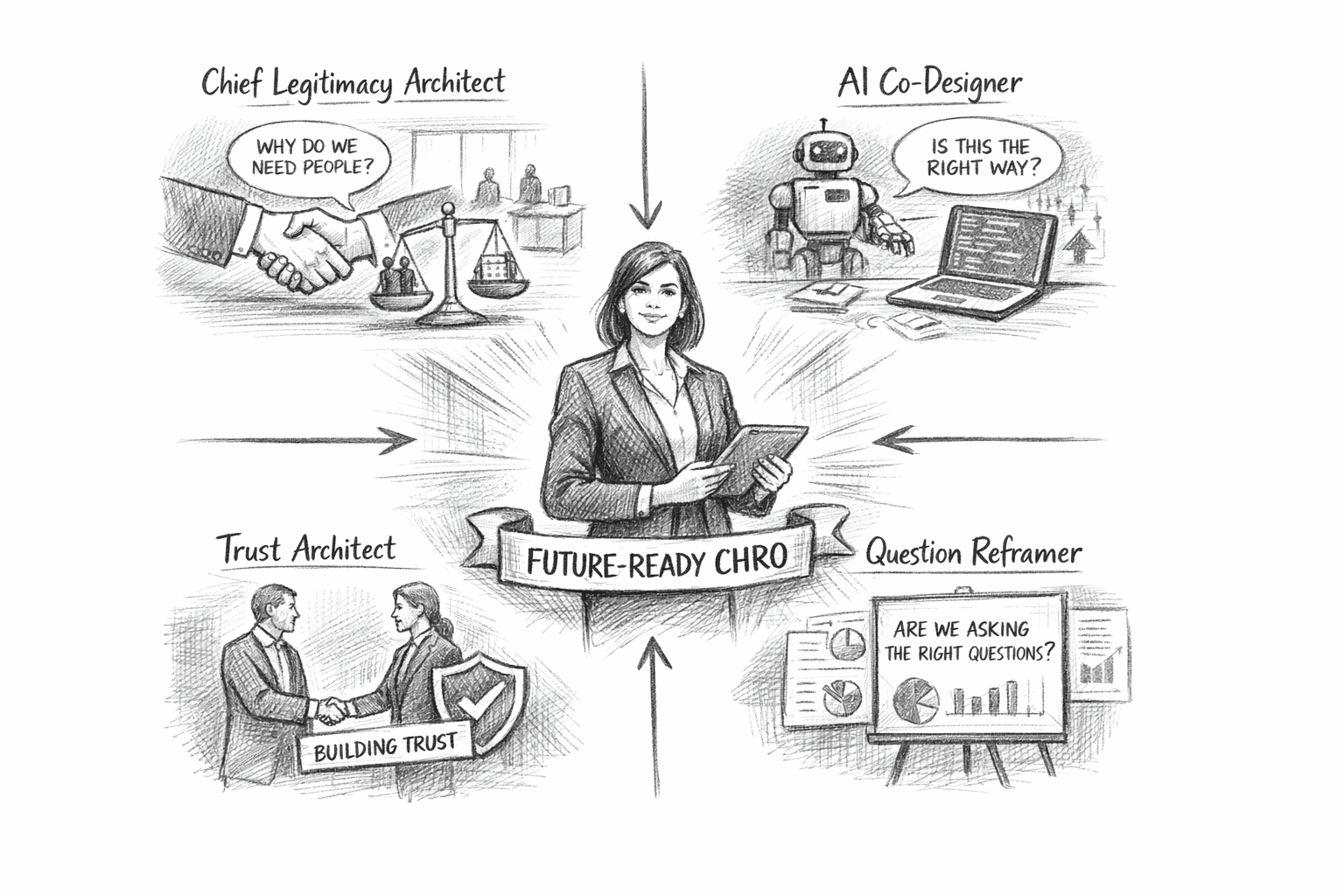
I don’t want to leave this as a diagnosis without direction. In my work with CHROs who are ahead of the curve, I see a fundamentally different operating model emerging. It’s not about being more “strategic” in the same old ways. It’s about redefining what the CHRO actually is.
- From Chief HR Officer to Chief Legitimacy Architect. The future-ready CHRO understands that their primary job is not to manage human resources. It’s to maintain the legitimacy of the human-organisation relationship. This means having a clear, defensible answer to the question: Why do we need people, and what do we owe them? Not as a poster on the wall, but as an operating principle that shapes every AI deployment decision, every restructuring, every compensation redesign.
- From AI Responder to AI Co-Designer. The 21% of CHROs who are closely involved in AI strategy decisions need to become the norm, not the exception. This means CHROs don’t just “manage the people impact” of AI—they sit in the room when algorithms are being designed and ask: what does this tool assume about human performance, and is that assumption worth encoding into our culture? If the CHRO isn’t shaping the design, they’ll always be managing the damage. Moderna proved this can work. Eightfold’s research reinforces it: 90% of organisations leading in AI adoption credit a strong CHRO-CIO partnership as essential to success.
- From Change Manager to Trust Architect. I keep coming back to this because it's the thing most organisations get wrong first. Traditional change management treats AI adoption as a rollout—training modules, communication plans, adoption KPIs. The future-ready CHRO treats it as a trust negotiation. Remember the Prologis case from the free post: their 95% adoption rate came from a trust commitment, not a change management playbook. Nathaalie Carey stood in front of the global workforce and said "we are not going to be doing layoffs because of AI." That single commitment changed the physics of the entire organisation. The companies that win will be the ones whose CHROs can articulate a credible exchange: Here's what we're investing in you. Here's what we expect in return. And here's what we will never automate.
- From Metric Reporter to Question Reframer. This last one takes guts. The CHRO who changes the game is the one who stops answering the board's existing questions and starts reframing what the board should be asking. Instead of reporting on attrition rates, ask: Are we losing people who are irreplaceable in a post-AI world? Instead of tracking engagement scores, ask: Do our people believe their work has a future here? The measurement gap won't close until the CHRO has the confidence and frankly, the political capital to redefine what gets measured. That's a hard conversation to have when your average tenure is 4.1 years.
Related: Team Leadership Development: A CEO's Guide to Building Leaders Who Actually Deliver
Five Questions Every CHRO Should Be Able to Answer Right Now
If you’re a CHRO reading this or a CEO evaluating your CHRO’s readiness, here are five questions that separate the future-ready from the structurally stuck. If you can’t answer these clearly today, the five gaps are already working against you.
- What is your organisation’s theory of human value? Not your mission statement. Not your EVP. A clear, specific answer to: Why do we need humans for this work, and what do we owe them in exchange for their contribution in an AI-augmented environment? If your answer is “we value our people,” you don’t have one yet. Sorry.
- Where exactly do you sit in the AI decision-making chain? Are you in the room when AI tools are selected and deployment architectures are designed? Or are you brought in afterward to “manage the change”? If it’s the latter, you are structurally positioned to fail no matter how talented you are. This isn’t your fault—but it is your problem.
- Can you name the five roles in your organisation that AI will most fundamentally transform in the next 18 months and do you have a plan for each one? Not a vague reskilling initiative. A specific, role-by-role plan that accounts for what work moves to AI, what new work emerges for humans, and how compensation and career paths adjust accordingly. Most can’t do this. I’ve asked. The room goes quiet.
- What is your trust metric? Not engagement. Not eNPS. How are you measuring whether your workforce believes that AI is being deployed in their interest and whether that belief is going up or down? If you don’t have one, you’re flying blind through the most significant trust negotiation of your career. Are you selling the AI vision and dream?
- What have you told your workforce they can count on? Prologis said “no layoffs because of AI.” Moderna said “we’re rethinking the whole system, and the CHRO is in charge.” What is your commitment? If your people can’t articulate it, you haven’t made one. And if you haven’t made one, you’re asking them to innovate with a tool they believe is designed to replace them.
The Window is Now and It’s Closing
Here’s what I’m watching: BCG’s latest research argues that CHROs unlock roughly 70% of the value that determines whether AI transformation actually sticks, what BCG calls the 10-20-70 rule (10% algorithms, 20% technology and data, 70% the transformation of people, organisation, and processes). Not the CTO. Not the CFO. The CHRO because the hardest part of AI transformation isn’t the technology it’s the human willingness to adopt, adapt, and trust.
That means the CHRO role has more latent power than almost any other position in the C-suite right now (and they don’t even know it)a. But latent power only becomes actual power when the role is redesigned by the CHROs themselves, by their CEOs, and by their boards.
Here is my prediction, and I'll put a timestamp on it: by the end of 2027, we will see a meaningful wave of CHRO title changes, not for branding, but because the role itself will have mutated beyond recognition. Moderna's "Chief People and Digital Technology Officer" is the first shot. Others will follow—Chief Work Officer, Chief Human-Machine Officer, Chief Workforce Architect. I'm not saying these exact titles will stick. I'm saying the old one won't. The organisations that resist this evolution, that keep the CHRO scoped to traditional HR while expecting them to lead an AI transformation, will face a measurable retention penalty among their top 10% of talent. The best people won't stay in organisations where no one owns the answer to "what happens to me?"
The organisations that get this right in the next 18 months will have an extraordinary competitive advantage. Not because they deployed AI faster, but because they maintained the trust, legitimacy, and psychological safety required to keep their best people engaged while AI reshapes everything around them.
The organisations that don’t? They’ll be stuck in an endless loop of authority disputes, identity crises, and talent flight, wondering why the “co-pilot” everyone promised is flying the plane into the ground.
The future of work doesn’t need a better HR function. It needs a fundamentally different kind of leader in the seat. The question is whether the CHROs who are there now have the structural support and the courage to become that leader before the window closes.
Right now, I don’t see it.
This article is republished courtesy of Thefutureorganization.com.



Leadership
Tags: Digital, Artificial Intelligence, Competence, Be A Leader, Case Studies, Companies

Jacob Morgan is one of the world’s leading authorities on leadership, the future of work, and employee experience. He’s the best-selling author of 5 books including his most recent one, Leading with Vulnerability: Unlock Your Greatest Superpower to Transform Yourself, Your Team, and Your Organization which is based on over 100 CEO interviews and a survey of 14,000 employees. He is also a keynote speaker, and futurist who advises business leaders and organisations around the world. For more information, please visit thefutureorganization.com