The Two Kinds of Waste We Keep Confusing

Freepik
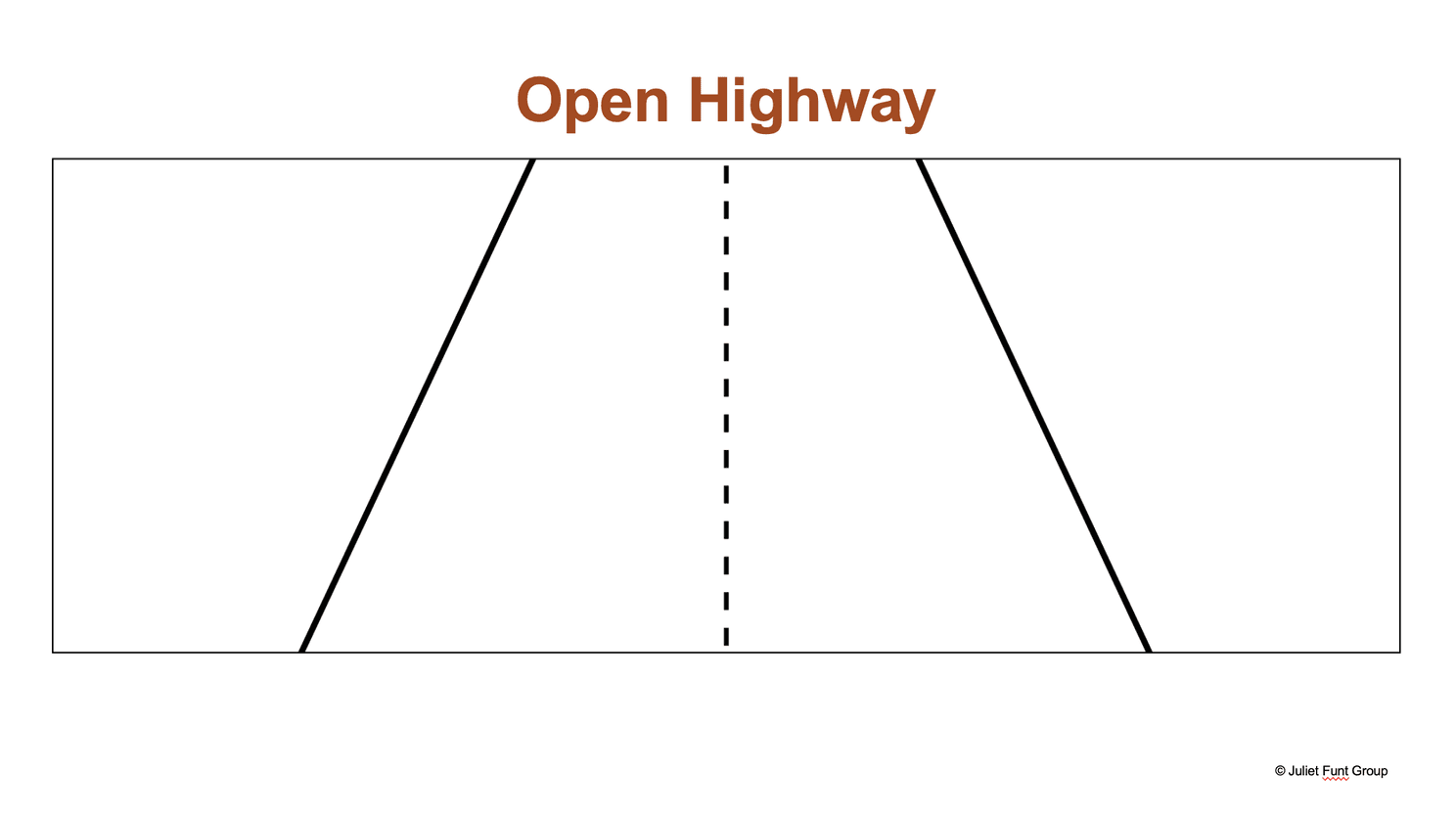
Every leadership team I work with wants the same thing: when they look ahead, they want to see an open highway leading to their goals. They want clear lanes, no congestion, everyone moving in the same direction, no sudden braking.
They’re seeking the capacity to pursue growth, revenue, and competitive advantage without constant drag. They want their best people focused forward and not stuck in bottlenecks managing friction. But the metaphorical highway rarely stays open for long.
Source: Juliet Funt Group
Inevitably, the road ahead starts to clog with organisational waste: meetings that shouldn’t exist, approvals that bounce around like a pinball, decks that become novels. Energy that should be propelling the business forward gets redirected into merging, navigating, re-routing, and circling back.
At first glance, it all looks like one big traffic problem. But when we really break it down, a meaningful chunk of that waste comes from two different sources that often run at the same time.
Until we separate them and address each, we can’t clear the road.
- Tactical Waste: created at the top when leaders choose too much.
- Behavioral Waste: created from the front line due to the weak desk skills.
If you only fix one, the other keeps churning out distractions. The solution, like in any other efficiency problem, is to bring the lens of intentionality to each locus and troubleshoot at the source.
Related: How Leaders Can Stop Playing Victim, Villain, or Rescuer at Work
Culprit #1: Tactical Waste
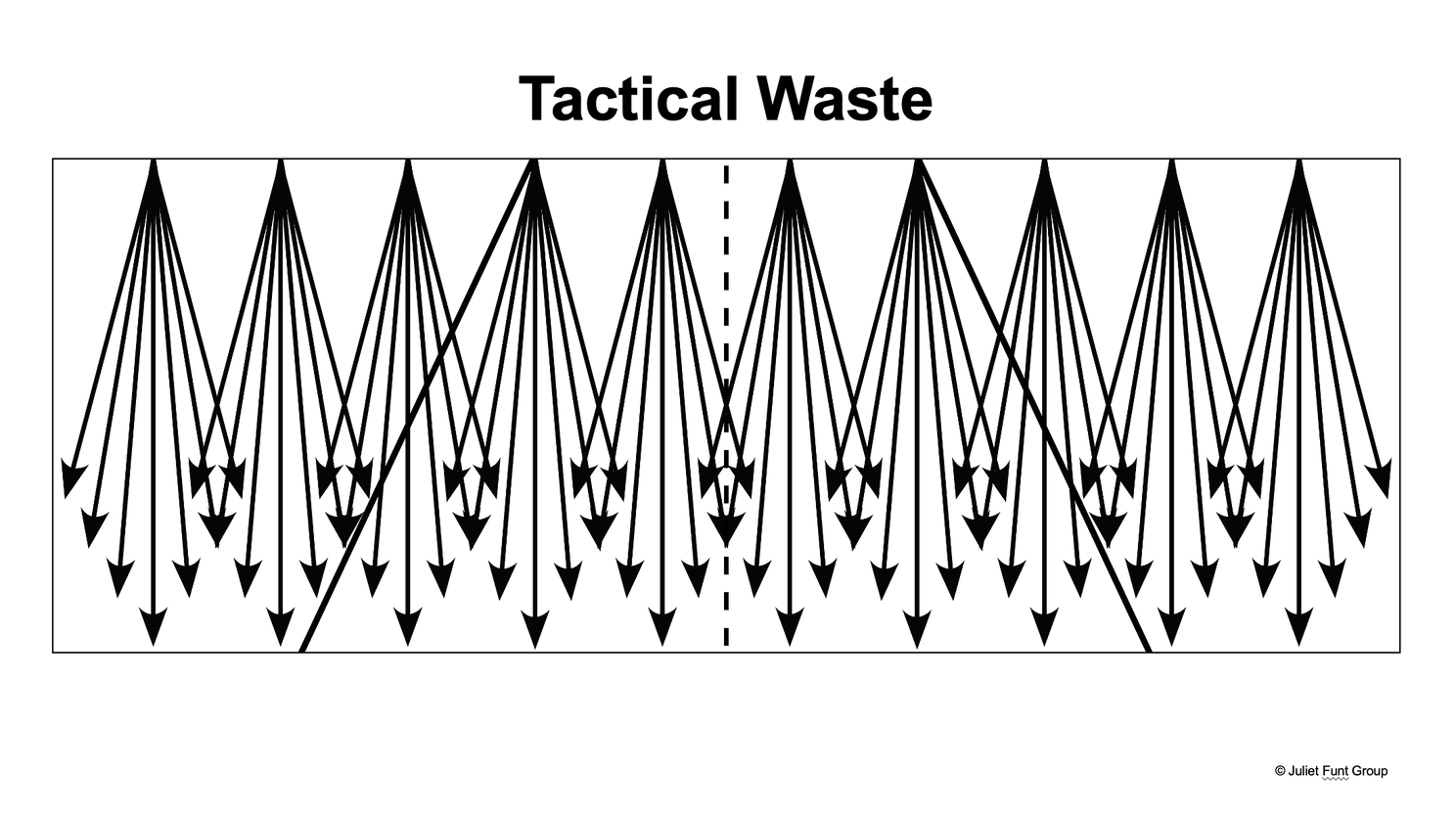
Tactical waste has a signature move: leaders add projects, plans, and priorities but don’t remove any others. Each and every goal or executive desire comes with a suitcase that, as it is unpacked, produces time-consuming data, dashboards, approval layers, project plans, marketing decks, and more. This leads to portfolio overload, and it clogs that open highway to competitive advantage.
Source: Juliet Funt Group
Pressure on senior leaders has never been higher. The AI wave alone is enough to make every executive feel behind because everywhere you look, someone appears to be moving faster. So the reflex is predictable: Add another initiative, fund another pilot, launch another task force. Saying yes always feels like progress.
It’s understandable how a leader’s ambition, responsiveness, and urgency can translate into tactical waste. The executive offsite ends with optimism and enthusiasm, and everyone leaves with a transformation initiative (urgent), a customer initiative (also urgent), a cost initiative (more urgent than the others), and of course a new AI initiative (because… 2026…and did I mention also very urgent?)
On Monday, the VP level receives this new list of urgent tasks and asks: “If we do all of this, what do we stop doing?” No answer comes back, because the reduction is a completely unfamiliar gear. Even in companies where de-selection is discussed, no one knows how because frameworks are not taught to support the e dialogue. So instead, the organisation does what organisations do when tradeoffs aren’t named, and they add without subtracting.
Microsoft has documented how much time is getting absorbed by all this overload coordination. In one Work Trend Index report, they noted the average employee spends 57% of their time communicating (meetings, email, chat) and 43% creating (documents, spreadsheets, presentations).
That’s not a moral failing, it’s just the inevitable outcome when too many things are added from the top without any subtraction to make room for them.
Culprit #2: Behavioral Waste
Source: Juliet Funt Group
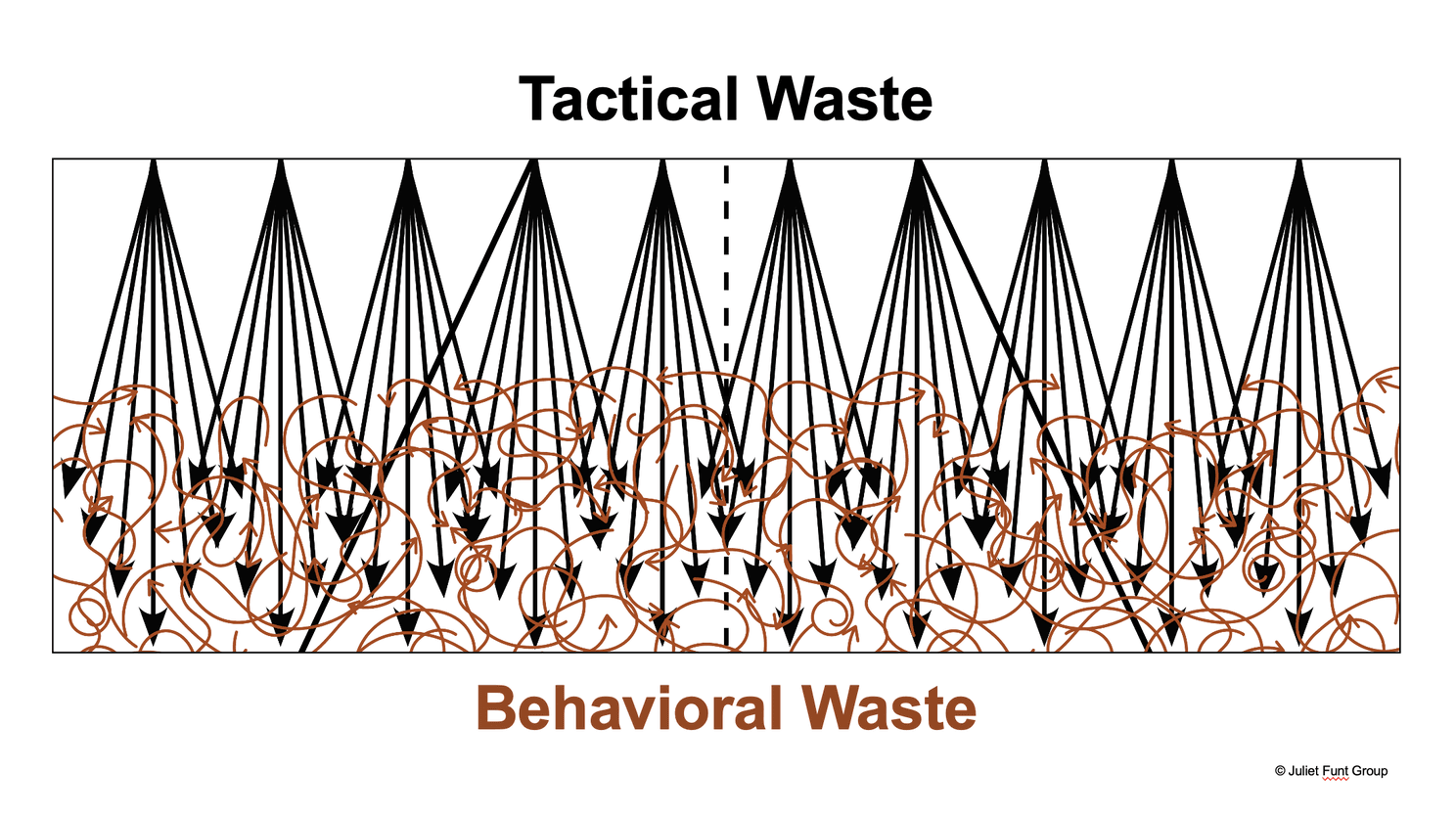
Next, we add the complicated and expensive spiraling upward of behavioral waste. Behavioral waste is made up of the practical behaviors that either cause or prevent friction, rework, and constant interruption.
It has been and remains amazing to me over the years that knowledge workers are never taught how to actually run an effective day. Email skills, meeting skills, decision making: employees each make up different ways of getting things done without instruction, team norms, and standardized methods toward excellence. This comes from the odd presumption that knowing how to sit down in the morning and work should be an innate capability of every person. It isn't.
We educate new employees in finance, engineering, marketing, and sales skills, but we almost never teach them how to:
- Plan their day
- Organize and effective meeting
- Write with clarity and constraints
- Make decisions at the right altitude (and document them)
- Handle email and chat without creating ping-pong
- Say no to work that doesn't serve the company
- Examine and identify process problems
- Share information effectively
So everyone invents their own working norms. The result?
- Glutted inboxes and calendars crowding out real work
- Re-work that is a result of four initial clarifying questions
- Last-minute fire-drill culture as a norm
- 30 volley email threads to clarify a two-sentence question
- Deadlines constantly missed due to overload
Multiply that across hundreds or thousands of employees and you get enormous drag.
Related: When You're Stuck Between a Rock and a C-Suite
The 20 Employees You Already Have
When I speak to executive teams about waste, I ask them a question:
“If I gave you 20 new employees, sparkly, enthusiastic, ready to do great work, and told you they were free… would that be the best day ever?”
Of course it would. But here’s the twist: you already have them. They’re just buried under unnecessary labor embedded in your tactical and behavioral workflow.
The real trap with operational waste is that one impacts the other. Tactical overload creates complexity and volume, while behavioral gaps make that complexity expensive to handle. But when you reduce tactical waste, you free capacity at the portfolio level. When you reduce behavioral waste, you free capacity at the execution level. Together, that reclaimed time often equals the output of dozens of full-time people without hiring a single one.
Clearing the Road
If you want that open-highway feeling, the space to pursue growth, revenue, and competitive advantage, you have to address both engines. Ask yourself:
- Where are we adding without subtracting?
- What must stop if something new starts?
- What norms of desk work have we never explicitly taught?
- Where are we tolerating friction that is actually trainable?
It’s important to remember that waste isn’t just “too many meetings,” it’s what happens when strategy expands faster than capacity and when skill doesn’t keep pace with complexity.
So clear the portfolio, strengthen the craft and you won’t just be reducing waste, you’ll be giving your organisation its speed back.
This was also published on Juliet Funt's LinkedIn.
For leaders carrying more than their job titles…
Be part of Malaysia Immersion Week 2026!
Join us for an 8-day journey (June 24–July 1, 2026) designed for leaders who want time and space to connect with like-minded business leaders. You’ll gain VIP access to the Malaysia Leadership Summit, engage in masterclasses with global leaders, and experience cultural immersion that offers fresh perspective on yourself and your team.
Apply now!




Leadership
Tags: Alignment & Clarity, Team Leadership, Be A Leader, Competence, Organisational Challenges