The Funny Little Hat That Makes You a Googler
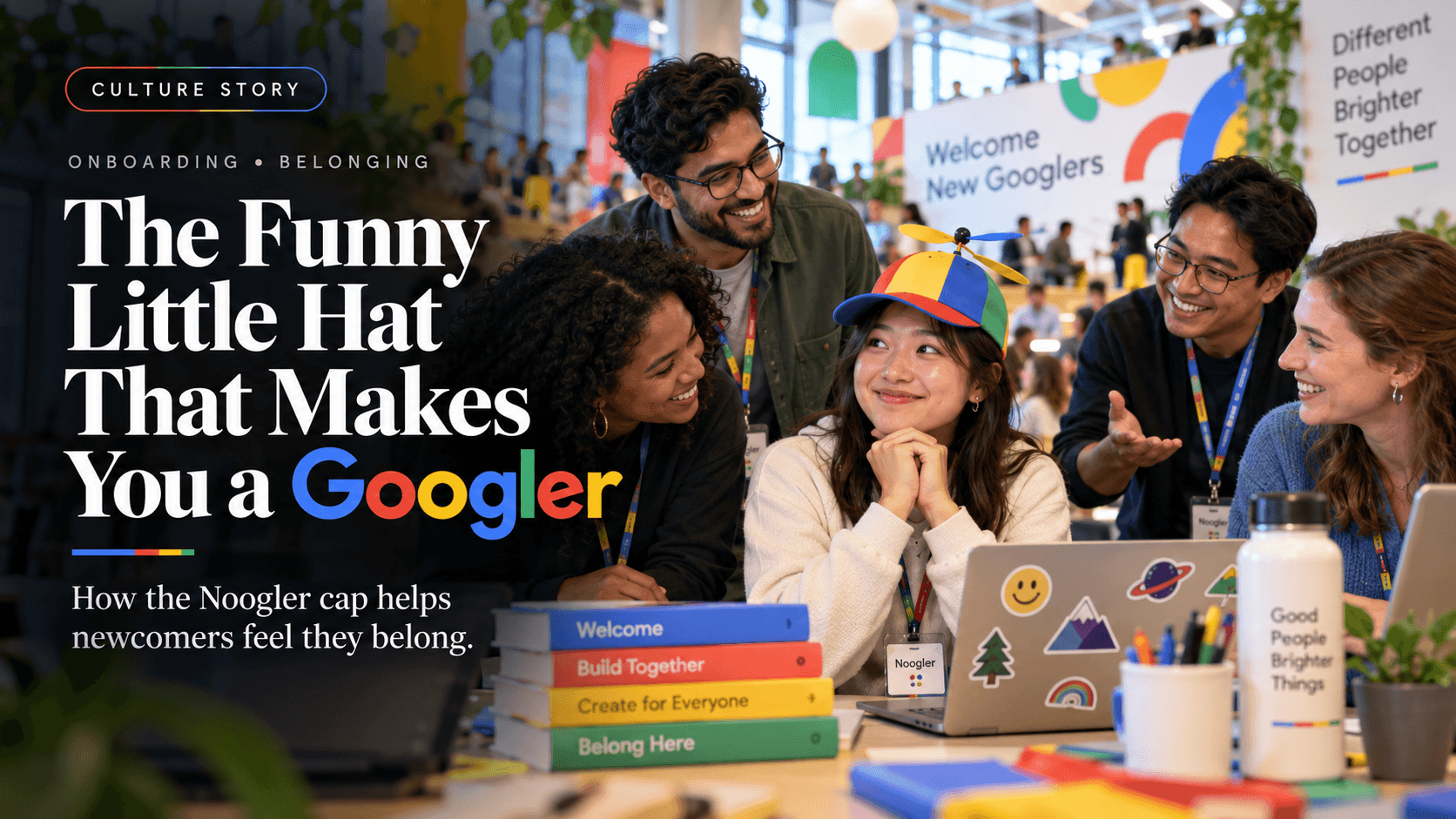
How Google's colourful Noogler cap became a symbol of belonging, and what this simple onboarding ritual teaches us about identity, connection and the psychology of starting a new job.
Congratulations. You've joined Google. Now put on this ridiculous hat!
Imagine this. After months of interviews, technical assessments and nervous anticipation, you've finally landed a job at Google, one of the world's most recognisable technology companies. You've prepared yourself for a sophisticated introduction to an organisation famous for engineering brilliance, artificial intelligence and innovation. And then somebody hands you a brightly coloured baseball cap.
Red. Yellow. Green. Blue.
With a little plastic propeller spinning on top.
Seriously? You've worked incredibly hard to get here, and now you're expected to look like a character from a children's cartoon.
Welcome to Google.
Or more precisely, welcome to being a Noogler. That's the affectionate term Google uses for its new employees, and the colourful propeller cap is one of the company's most recognisable onboarding traditions.
Over the years, countless new Googlers have worn these hats during orientation, posed for photographs and proudly displayed them as souvenirs of their first days. Google's own employee stories show Nooglers wearing their caps in locations ranging from California to Singapore and Kuala Lumpur. And while the hat might look like a piece of corporate silliness, there's something surprisingly sophisticated happening beneath that spinning propeller.
Because Google isn't merely welcoming a new employee. It's helping someone cross a psychological boundary. From outsider to insider. From stranger to member. From someone who hopes to belong to someone who has been publicly welcomed into the community.
And that transition may be one of the most important moments in an employee's entire journey.
The hidden anxiety of the first day
Think back to your first day at a new organisation. You probably remember the uncertainty. Where should I sit? Who do I talk to? Is it acceptable to ask questions? What happens if I make a mistake?
And the question many people carry quietly: Will I fit in here?
We often underestimate just how psychologically demanding joining a new organisation can be. Even highly experienced professionals can feel like schoolchildren on their first day. Suddenly, things they previously knew how to do become unfamiliar.
They don't understand the unwritten rules. They don't know which colleagues can help them. And they certainly don't know whether they are expected to behave like everyone else or bring their own personalities into the workplace.
Traditional onboarding programmes often approach this as an information problem. Give newcomers the employee handbook. Explain the policies. Set up the laptop. Complete the compliance training. Introduce the organisation chart.
All necessary.
But none of these automatically answers the more human question: "Do these people actually want me here?"
This is where Google's unusual tradition becomes interesting.
The hat that makes being new something to celebrate
Google could have given new employees an ordinary welcome badge. Instead, it created something that is difficult to ignore. A colourful propeller cap announcing that the wearer is a Noogler.
There is a fascinating reversal happening here. In many workplaces, being new is something employees try to hide. You don't want to appear inexperienced. You don't want to ask too many questions. You try to blend in and demonstrate competence as quickly as possible.
Google's hat makes the opposite statement. It makes your newcomer status visible. And in the right environment, that visibility can become an invitation rather than a vulnerability. Colleagues can recognise you as someone who has just joined. They have a natural opportunity to say hello, offer help or share a little advice. (in many cases they are asked to ensure anyone wearing a Noogler hat is made welcome - as they were when they wore the hat many years ago!)
Other Nooglers immediately have something in common with you. You may come from different countries, disciplines and professional backgrounds, but you're all entering this unfamiliar environment together.
One shared symbol can become the beginning of a conversation. A conversation can become a connection. And a connection can make the workplace feel just a little less intimidating.
It's important to recognise that these are plausible psychological mechanisms, not experimentally verified effects of the hat itself. But they help explain why rituals like this can matter. The cap makes a moment visible. The people surrounding the cap determine what that moment means.
A moment that becomes a memory
Consider the story of Nikhil, a Google employee featured on Google's own blog. His story includes a photograph from Noogler onboarding in Singapore in April 2019, wearing the colourful cap. In the interview, he spoke about the collaborative, humble and positive culture he experienced at Google, and about being able to bring his whole self to work.
Another employee, Rand El Morry, who joined Google's Warsaw office, was photographed wearing the distinctive cap. But when asked what was best about being a Noogler, he didn't talk about merchandise or office perks. He talked about mentorship.
He described having a mentor, an onboarding buddy, a manager and a team lead who offered support and resources. This distinction is worth dwelling on.
The hat is memorable. But the relationships make the welcome meaningful. A new employee might remember receiving the cap because it was funny, unusual or slightly embarrassing. Yet what truly shapes their experience is what happens next.
- Does a colleague approach them?
- Does their manager make time for them?
- Does someone explain the unwritten rules?
- Do they feel comfortable asking a question that might sound foolish?
The ritual becomes powerful when it opens the door to those experiences. The propeller might make someone smile. But belonging is built through what other people do after the smile.
The deeper psychology: Why symbolic rituals matter
Human beings have always used rituals to mark transitions - Graduations. Weddings. Welcoming ceremonies. Team initiations.
These events often include objects, special clothing, unfamiliar words or repeated actions. Why? Because a major life transition is not simply a change in administrative status. It's a change in identity.
- Yesterday, you were a student. Today, you're a graduate.
- Yesterday, you were an outsider. Today, you're a member.
- Yesterday, you were an applicant hoping to join Google. Today, you're a Noogler.
The cap provides a physical symbol of that transition. It also offers three possible psychological benefits.
First, it makes belonging visible: A person no longer has to wonder whether they have officially crossed into the community. The organisation gives them a recognisable marker of membership.
Second, it provides a shared experience: Every cohort has something unusual to remember together. A group photograph, a few laughs and a small moment of shared awkwardness can become a story people revisit years later.
Third, it communicates something about the organisation's character: For a business built around advanced technology, the willingness to celebrate a ridiculous propeller hat sends an interesting cultural signal. You can be technically brilliant without always taking yourself too seriously. You can be new without pretending you already know everything. And you can have fun while doing serious work.
However, we should avoid assuming that everyone experiences the ritual in the same way. Some employees may find the hat delightful. Others might feel uncomfortable being visibly singled out.
The difference between a welcoming tradition and an awkward initiation lies partly in whether employees are given dignity, choice and a genuinely supportive environment. That brings us to the research.
What the science tells us about belonging
In 2025, organisational researchers Talya Bauer and colleagues published an extensive updated meta-analysis examining how employees adapt when joining new organisations. One of their most striking findings was the importance of social acceptance.
Across the research they examined, newcomers who felt accepted by colleagues were more likely to report satisfaction, commitment and stronger performance. Social acceptance was positively correlated with job satisfaction (r = .42), organisational commitment (r = .40) and performance (r = .35).
It was negatively correlated with intentions to leave (r = -.27).
Now, these are correlations, not proof that giving someone a colourful hat will improve performance. And they certainly don't mean that every increase in belonging automatically produces a corresponding increase in business results.
But they reinforce a powerful principle. Helping newcomers feel accepted is not merely a nice thing to do. It is closely connected to important employee outcomes.
An earlier meta-analysis in 2007, drawing on 70 independent newcomer samples, likewise identified social acceptance, role clarity and self-efficacy as crucial elements of employee adjustment. In other words, onboarding works best when people learn more than the job.
They need to understand their role, build confidence and become socially connected. The Noogler tradition is most relevant to that third element. It can provide an opening for belonging. But it cannot substitute for the relationships that create belonging.
Google's more measurable onboarding ritual
Interestingly, Google's most compelling published onboarding productivity result comes from another small practice. Not the colourful hat.
An email.
As described by former Google people executive Laszlo Bock in Work Rules!, Google experimented with sending managers a simple checklist shortly before their new employee arrived. The checklist encouraged managers to clarify responsibilities, assign a buddy, help the newcomer build a social network, schedule regular check-ins and encourage open discussion.
Employees whose managers followed this approach reportedly became effective in their roles 25% faster than comparison employees. Think about that.
The visible initiation celebrated becoming a member.
The management checklist helped turn that welcome into practical support. One ritual was symbolic. The other prompted concrete managerial actions.
Together, they illustrate two different dimensions of onboarding: identity and integration.
And I would argue that this is an important distinction for any organisation serious about culture transformation. Symbols tell people what matters. Repeated behaviours prove whether it actually matters.
- A hat can say, "You're one of us."
- A helpful colleague makes someone experience it.
- A manager who schedules regular conversations reinforces it.
- And an organisation that welcomes questions makes it safe to keep learning.
The danger of confusing belonging with conformity
There is one more fascinating piece of research worth exploring. In 2013, researchers Daniel Cable, Francesca Gino and Bradley Staats published a study examining different approaches to welcoming new employees. Their field experiment took place in a large outsourcing organisation in India.
They compared onboarding that emphasised identification with the organisation against an approach that encouraged newcomers to express their individual strengths and identities. The personal-identity approach produced better retention and customer satisfaction outcomes six months later than the comparison approaches. This raises a wonderful question about the Noogler cap.
What is the organisation really asking newcomers to become? Are we saying, "Congratulations, you now belong, so become exactly like everybody else"? Or are we saying, "Congratulations, you belong, and we want you to bring your unique contribution into this community"?
There is an enormous difference. A healthy onboarding ritual should provide belonging without demanding sameness. And that's particularly important for organisations that depend on creativity, innovation and diverse perspectives.
If everybody feels they must think and behave identically to belong, you've created conformity rather than culture. The Noogler cap works best as an invitation into a community where individuality remains welcome.
Steal This Ritual: Create your own moment of belonging
So what might we learn from Google?
Should every Malaysian company rush out and purchase thousands of propeller hats?
Please don't. At least, not before asking what behaviour you're actually trying to create!
The lesson isn't the hat. The lesson is the power of making someone's arrival memorable, visible and meaningful.
Imagine designing a simple first-week welcome ritual in your own organisation. On the first day, give every newcomer a small symbol representing the organisation's purpose. It could be a badge, a book, a specially designed card or a meaningful object connected to the work.
But don't stop there.
Ask existing colleagues to personally welcome the newcomer. Create a simple opportunity for the newcomer to introduce something about themselves, including what they hope to contribute. Pair them with someone who can help them navigate the organisation. And after their first week, invite them to share something they have discovered.
Perhaps even ask: "What's one thing you've noticed that we could do better?"
Imagine the cultural message that sends. Not simply, "Welcome to our organisation."
But: "We're glad you're here. We want to know you. And your perspective matters from the beginning."
Then check whether the ritual actually works.
- Do newcomers feel more connected?
- Have they formed relationships beyond their immediate manager?
- Do they know whom to approach when they need help?
- Are they asking questions and contributing ideas?
These are the behaviours worth measuring. Because a ceremony may last ten minutes. But the culture it introduces someone to can shape their entire employee experience.
The real lesson beneath the propeller
I love the irony of the Noogler hat. An organisation famous for some of the world's most sophisticated technology welcomes talented professionals with something that looks rather unsophisticated.
A colourful cap.
A small plastic propeller.
A funny nickname.
Yet beneath that playful tradition lies a profound leadership question: How do we help someone stop feeling like a stranger and start feeling that they genuinely belong?
Not through a hundred PowerPoint slides. Not by handing them a corporate values booklet. And certainly not simply by making them memorise the organisation's mission statement. Belonging begins when people experience acceptance, recognition and connection.
A ritual can help create the occasion. But people must complete the promise. So here's my challenge.
Think about the newest employee who joined your organisation this month. Did they simply receive a laptop, attend an induction and start work? Or did something happen that made them feel they had become part of a community? And more importantly, what have your people done since then to reinforce that feeling?
Because perhaps the most important question in onboarding isn't: "Does this employee understand our organisation?"
It's: "Has this organisation made the employee feel they matter?"
Google's Noogler hat is a delightful reminder that sometimes, even a tiny spinning propeller can begin a much bigger conversation about culture. But the real magic isn't in the hat. It's in the welcome that follows.


Business
Tags: Culture

Roshan is the Founder and “Kuli” of the Leaderonomics Group of companies. He believes that everyone can be a leader and "make a dent in the universe," in their own special ways. He is featured on TV, radio and numerous publications sharing the Science of Building Leaders and on leadership development. Follow him at www.roshanthiran.com