Why Big Joe Can't Say No

Pressfoto from Freepik
Recently, I conducted a full-day executive session with a C-suite group of leaders. They were seasoned, authoritative, well-compensated, and had deep tenure in their organisations. As the day progressed, we worked through all the subjects central to my work: the de-selection of unnecessary tasks, the cultivation of strategic thinking, seeing the opportunity cost of wasteful work, and how to strengthen each of these within a global team. We spent the day learning how to focus on "True North," or the high-value activity in every day, week, and year that drives business forward.
A moment caught my eye that stayed with me long after the session ended. One of the executives was telling a story about a meeting he had been asked to attend. He had already scheduled a vacation that week. And instead of saying, "I'm sorry, I've already planned my vacation," he said okay, and moved it.
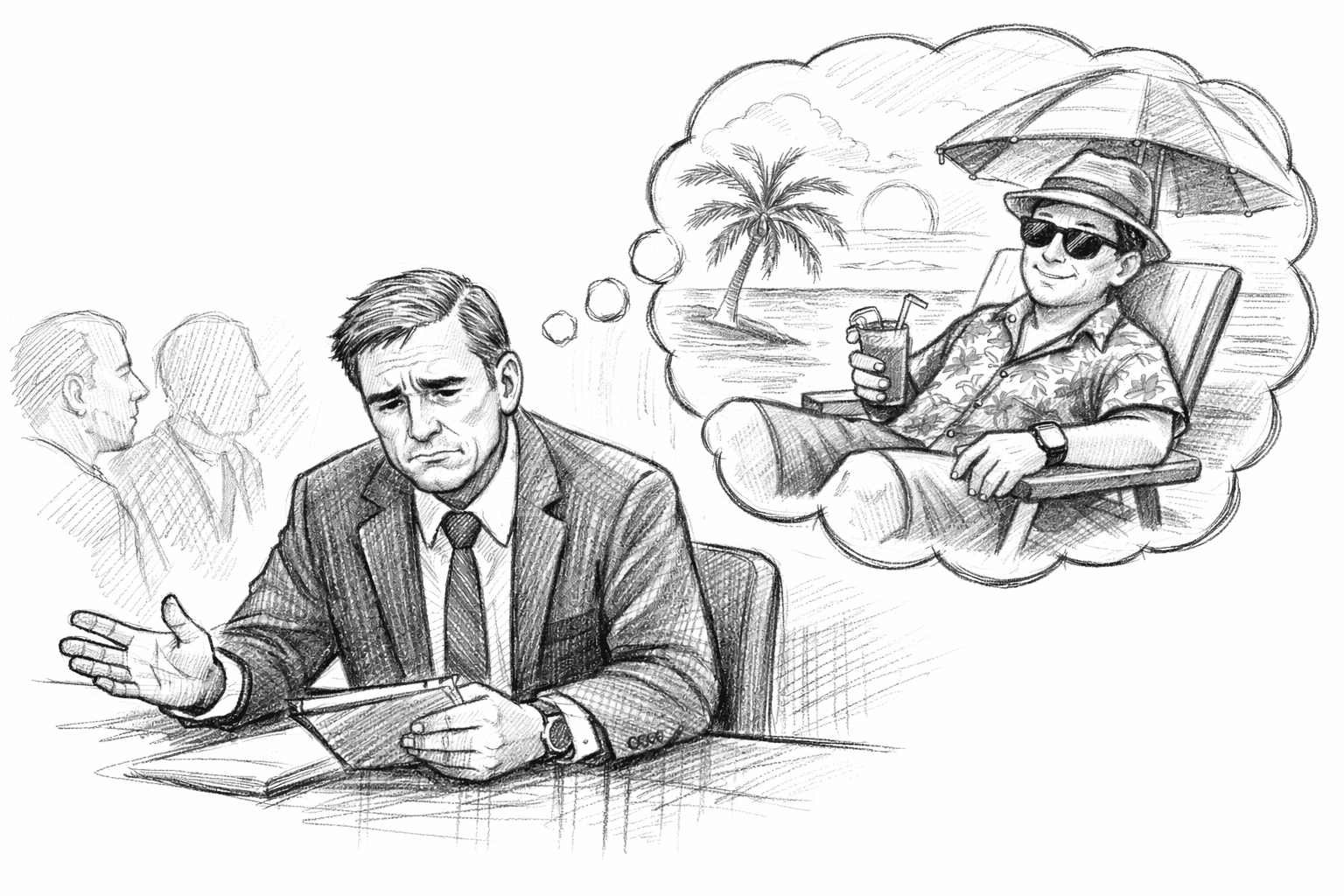
Saying no is paralyzingly difficult for so many people in so many companies that I visit. I found this executive version fascinating and worthy of exploration. Because if this man, at his level of seniority and confidence, could not protect his own vacation from a simple meeting request, then something in the entire system may need a shift.
Let's examine the possible reasons the word "no" was never said.
It could be personal. He may be someone who genuinely lives to serve, who finds deep meaning in showing up when others need him. If that's his value orientation, it's easy to favor others over yourself. He could privately struggle with people-pleasing, timidity, or discomfort with boundaries. Or maybe, most threateningly, he has developed a storyline in his head over years of corporate work that's just not what people do.
It could be cultural. Even in a warm and friendly environment, there are ghost rules and hierarchy. There may be something in this organisation, or even a norm in a past organisation that molded him, that makes boundary-setting feel unsafe, where he fears a consequence for saying no, even when no consequence is ever stated outright.
It could be social comparison. He may be surrounded by hard drivers. There may be a rhythm of pushing harder as the primary tool to fix everything, and he may look around at his peers seeing that none of them visibly prioritize self-care. So doing it himself feels exposed, even presumptuous. This discomfort has a neurological basis. UCLA researcher Naomi Eisenberger published a landmark study in Science showing that the brain processes social exclusion in the same region that it processes physical pain. The fear of standing apart from the group is not metaphorical. It genuinely hurts.
Related: Rethinking Organisational Well-Being
It could be a language problem. This is one I see constantly in leaders at every level, but especially at levels below them. It is not always the act of saying no that is hard. It is not knowing specifically what words to use. Phrases like "That's not going to work for me," or "Give me 24 hours to get back to you," often need to be practiced in off-time so that they will come to us in the moment of pressure.
It could be speed. In a fast-moving culture where decisions are made reflexively and without pause, commitments fly without thought. "Sure, I'll take on that project." "Yes, I can work late on Friday afternoon." "No, I don't need to go on that vacation right now." If he had simply given himself a beat, a breath, even a few hours to think it over, he might have found the self-preservation to respond differently.
And it is possible, of course, that I am reading too much into it. That moving the vacation was genuinely fine, or that the meeting mattered more than I could know. But that is not what I saw on his face when he told the story.
The reason this moment is worth an entire newsletter is that these quiet dynamics are what keep people healthy or conversely, exhausted in our organisations. Also, and critical to business, the same paralysis that stops a leader from saying "I'm already on vacation that week" is the same paralysis that stops him from sharing a bold idea, pushing back on wasteful work, or helping a more senior colleague see a dangerous blind spot. Amy Edmondson’s research with James Detert found that 85% of employees have withheld important information from their manager because they feared the consequences of speaking up. She showed that when people don't feel safe saying the difficult thing, the cost is never small.
I'll admit that this story caught my attention partly because I am passionate about vacations. Some of you know I am considering writing an entire book on the subject. But my passion for it is not arbitrary. When people plan to step away from work, it is among the most important things they do. The vacation is never just about the vacation. It is a referendum on whether a person believes their needs matter. And until leaders can answer that question with a quiet, undefended yes, the word "no" will continue to lodge in the throat, at the exact moment it is most needed.
This was also published on Juliet Funt's LinkedIn.
For leaders carrying more than their job titles…
Be part of Malaysia Immersion Week 2026!
Join us for an 8-day journey (June 24–July 1, 2026) designed for leaders who want time and space to connect with like-minded business leaders. You’ll gain VIP access to the Malaysia Leadership Summit, engage in masterclasses with global leaders, and experience cultural immersion that offers fresh perspective on yourself and your team.
Apply now!




Personal
Tags: Communication, Culture