The Governance Design That Builds Beyond the Founder

Start reading from Part 1.
Institutional permanence is rare because leaders won't be governed by their own rules.
Most leaders design governance for the organisation, while very few design governance that also governs them.
The distinction is foundational. Governance designed for others produces a system that holds when the leader honors it and breaks when they do not. Governance that governs the leader produces something categorically different.
That design requires a founder to accept three things: their judgment will sometimes be constrained by the institution's logic; overrides must be rare, named, bounded, and visible; and the standard they built outranks the position they hold.
Most organisations never cross the threshold because this cost is beyond what most leaders are prepared to pay.
Equip yourself for complexity with the Paradoxical Leadership framework →
The Founder Governance Moment
Most institutional transitions begin in ordinary decisions.
A founder reviews a supplier contract that the procurement team approved within its agreed authority. The terms are not what the founder would have chosen. The positional authority to reopen it is entirely theirs. In most organisations, they use it.
In the rare case where the transition is actually underway, they ask one question instead:
Was this decision made within the agreed authority and constraints?
The answer is yes. They let it stand.
That moment — unremarkable in isolation — is the governance transition made real.
The founder chose the institution's decision process over personal preference. They understood that a governance standard only becomes institutional when the person who created it is also governed by it.
What makes this moment rare is that institutional constraint almost always arrives before institutional belief. The first time governance limits a founder's preference, it will feel like a malfunction. The instinct is to correct it, to override, redirect, or quietly renegotiate the standard that is now inconveniently standing in the way.
The institutions that endure are built by founders who felt that instinct and chose the standard anyway.
A principle has not become institutional if its force still changes with the rank of the person interpreting it.
The Founder Governance Moment is where that test is passed or quietly failed.
Three Layers and One Sequence
Three Layers and One Sequence
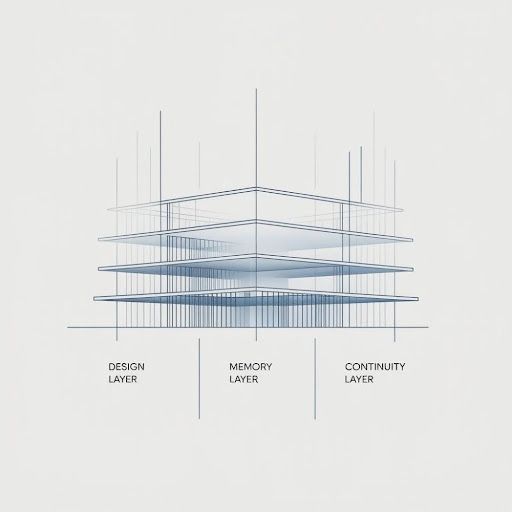
The Trust Architecture Framework rests on three governance layers: the Design Layer, the Memory Layer, and the Continuity Layer. Together they convert leadership-dependent behavior into institutionally embedded conditions.
Each layer depends on the previous one being in place. Build them out of order, and the architecture will not hold under the pressure it was designed to resist.
1. The Design Layer
The Design Layer must come first.
It is the only layer in the framework that cannot be built under pressure. By the time pressure arrives, it is already too late.
The Design Layer's purpose is to convert trustworthy behavior from something personally hoped for into something structurally expected. Without it, the organisation defaults to the hope model: standards hold only as long as the person holding them is present, willing, and not yet facing the specific pressure that will expose the structural gap.
Three pre-commitment choices constitute the Design Layer. Each must be made before pressure makes them costly, because under pressure none of them will be made honestly.
Decision thresholds defined explicitly. Specific categories of decision with named authority, named constraints, and named consultation requirements that do not depend on interpretation in the moment they are most needed.
Named stopping authority. A specific individual with pre-agreed authority to pause a commitment that violates the institution's governance standards. Their authority to stop the work must be legitimate before the moment of pressure that would otherwise make exercising it feel like disloyalty or insubordination.
The Reykjavik Summit of 1986 is perhaps the most documented illustration of this mechanism operating at institutional scale. In late-night negotiations with Soviet General Secretary Mikhail Gorbachev, President Ronald Reagan — driven by a genuine conviction about eliminating nuclear weapons — verbally indicated openness to a sweeping proposal to ban all strategic nuclear missiles within ten years. During a break, Secretary of State George Shultz and senior diplomatic advisors recognized the strategic vulnerability this would create for NATO without equivalent conventional force reductions. They intervened. Not as insubordination. As the pre-agreed institutional authority of advisors whose role was precisely to pause commitments that exceeded the bounds of established strategic doctrine.
Reagan heard them. When Gorbachev demanded that the U.S. also abandon its Strategic Defense Initiative as part of the agreement, Reagan held firm to his advisors' constraints and walked away from the deal.
The named stopping authority functioned. Shultz’s authority to intervene was institutionally legitimate before the moment that required it. The institution's governance conditions constrained the most powerful individual in the room at the most consequential moment of the negotiation.
That is what a named stopping authority is designed to produce. Not the prevention of agreement, but the guarantee that agreement cannot happen faster than the institution's governance conditions can be honored.
Written pre-commitment rules. The specific conditions that must be reviewed before a commitment is made regardless of urgency, regardless of seniority, regardless of the personal cost of the pause. Precise enough that their application requires no interpretation in the moment. Interpretation under pressure is where pre-commitment rules disappear.
2. The Memory Layer
The Design Layer establishes conditions. It prevents those conditions from being silently reinterpreted by each successive leader who encounters them.
Without the Memory Layer, institutional knowledge lives only in people. Each reinterpretation by an incoming leader is individually reasonable. Each compounds slightly on the previous one. Over time, the institution operates under conditions that bear no relationship to those originally designed, because the reasoning that made them intelligible departed with the people who held it.
The Memory Layer preserves the decision logic across time, making it possible to observe whether the institution is evolving deliberately or drifting invisibly through the accumulation of individually reasonable adjustments that collectively redefine what the institution has become.
That distinction — between deliberate evolution and invisible drift — is the deepest governance design problem the framework will address. The Memory Layer is what makes it observable rather than inevitable.
Three mechanisms constitute it.
Decision records that preserve reasoning. Why it was decided — what constraints were considered, what standards were applied, what tradeoffs were made explicit before commitment. The record that allows future leaders to understand not only what the institution did but what it was trying to preserve.
Rationale documentation. Reasoning recorded at the moment decisions are made, not reconstructed afterward. Reconstruction is memory. Documentation is institutional record. Only the second survives leadership transition with its integrity intact.
Response accountability. When a signal is raised through a legitimate governance channel, a response is structurally required within a defined timeframe. The Memory Layer records not only what was decided but what was raised, what was heard, and what was answered. An institution that cannot review its signal history cannot detect its own drift.
The operational difference is precise. Without the Memory Layer, an incoming leader inherits a role, a team, and a culture. With it, they inherit the reasoning behind every consequential decision in the previous three years, the constraints considered, the standards applied, the signals raised, and how they were answered. The first leader starts from observation. The second starts from institutional knowledge. The institution that built the Memory Layer does not lose its decision logic when it loses its decision-makers.
How to make culture transformation stick →
3. The Continuity Layer
The Design Layer establishes. The Memory Layer preserves. The Continuity Layer keeps the architecture alive, as a living governance system that continuously senses drift, maintains feedback channels, and enables self-correction before deterioration becomes visible in outcomes rather than readable in patterns.
Three mechanisms constitute it.
Leadership transition protocols ensure incoming leaders inherit conditions rather than roles. The institutional record travels with the authority — not just the title, the responsibilities, and the objectives, but the governance logic that produced the decisions the incoming leader is now accountable for continuing.
Information flow architecture ensures reasoning continues traveling through the organisation rather than accumulating at the top. When information flows toward authority rather than toward decision relevance, the institution loses the distributed intelligence that makes institutional self-correction possible.
Signal tracking ensures feedback channels remain open and visible rather than training themselves into silence — one ignored signal at a time — until the dashboard stays green not because the institution is healthy but because reporting has stopped feeling worthwhile.
The Continuity Layer also addresses a failure mode the other two layers cannot prevent alone: the well-intentioned celebrated leader whose sustained presence gradually creates dependency even inside an institution that has crossed the governance threshold. It is natural human tendency to defer to trusted authority rather than invoke an institutional standard that carries the same structural weight but less personal warmth. Signal tracking detects this drift early. Information flow architecture makes it visible across the organisation. Transition protocols prevent it from compounding silently across successive leaders.
What the Three Layers Produce

Nature solved this problem long before management theory attempted it.
Take the survival of a colony. It is based on the stability of the routes that have already been built. When those routes are clear, the swarm continues operating with the same precision regardless of which individual is leading.
The Design Layer is the soil. It establishes the conditions before anything grows in them.
The Memory Layer is the root system. It preserves the decision logic that makes the soil productive across seasons, across leadership transitions, market shifts, and the pressure events that test every governance assumption.
The Continuity Layer is the living ecosystem. It keeps the soil and the roots functioning — detecting drift before it compounds, maintaining feedback channels before they close, enabling self-correction before deterioration becomes irreversible.
Together they produce governance that outlasts the people who designed it.
The Standard That Holds
Organisations scale through capability. Institutions endure through governance.
That distinction is not marked by size, longevity, profitability, or culture. It is marked by one observable condition: the moment the system no longer depends on the judgment, discipline, or presence of any single leader to produce trustworthy behavior.
That condition is revealed under pressure — when leaders are challenged, when incentives diverge, when a difficult decision carries personal cost to the person responsible for enforcing the standard. That is when governance reveals whether it has become architecture or is still dependent on personalities.
The three layers are what produce architecture rather than dependency. Designed not for the leader who built them but for every leader who will inherit them long after the original architect is gone.
This article was firstly published on Syed Muddassir's LinkedIn.


Leadership
Tags: Systems & Structures

Syed Muddassir is an Enterprise Architect, organisational transformation leader, and author of The Architecture of Impact and The Curvions Architect. Drawing on more than two decades of experience in enterprise architecture, governance, organisational design, and business transformation, his work explores how institutions can be intentionally designed to build trust, strengthen decision-making, and sustain performance beyond individual leaders.